


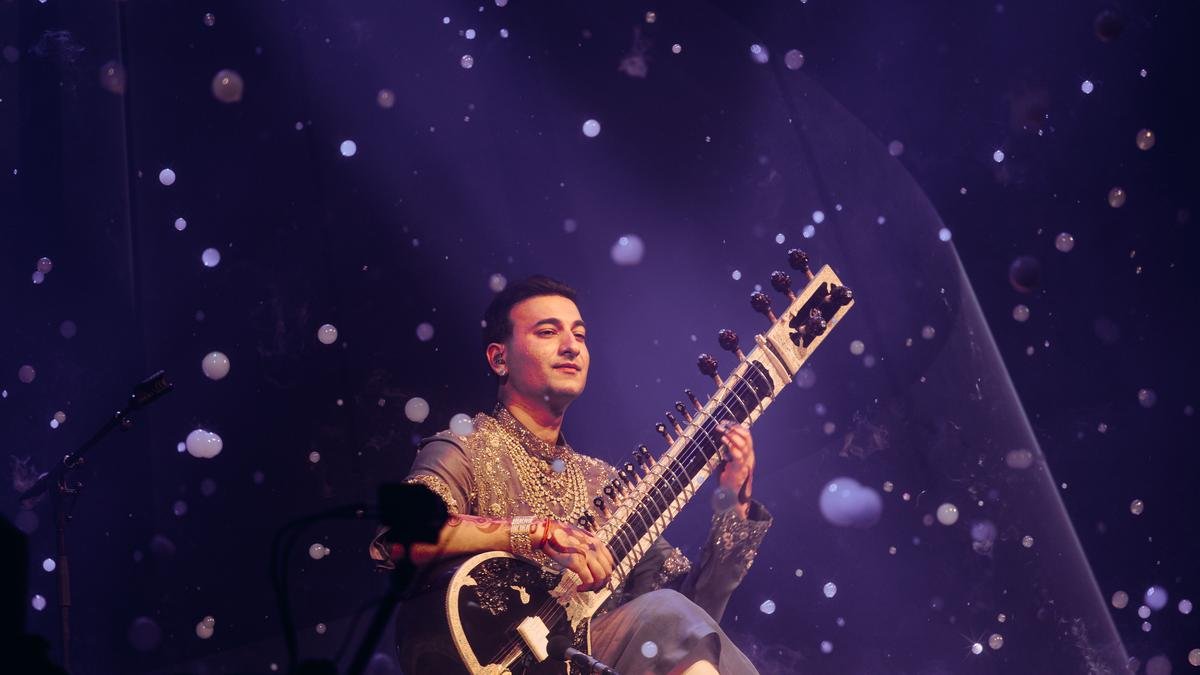
Sitarist Rishab Rikhiram Sharma performing at the Hitex Exbhition Centre in Hyderabad on Friday, March 27
| Photo Credit: Special Arrangement
In a departure from conventional concerts, the evening in Hyderabad began not with applause but with controlled breathing. As the tanpura’s drone filled the venue, over 10,000 attendees were guided to a moment of stillness through a breathing exercise before sitarist Rishab Rikhiram Sharma took the stage with his Sitar for Mental Health tour on Friday, March 27. The performance then moved through a repertoire of classical ragas, followed by original compositions and select Bollywood interpretations, culminating in a Tandavam finale.
On the sidelines of the concert, Rishab Rikhiram Sharma spoke to The Hindu about using music as a tool to address anxiety and depression, and how classical music can open up difficult conversations “It was about using the sitar as a voice to create awareness, while also highlighting its healing properties,” he said. Excerpts from the interview:
How did the idea of Sitar for Mental Health come about?
The idea was to promote mental health awareness, especially within the Indian community, where it remains highly stigmatised. For me, it was about using my instrument, the sitar, as a voice to create awareness through music, while also highlighting its healing properties. I began researching Raga Chikitsa and raga therapy to understand how ragas can aid healing. From there, we crafted the set that audiences experience today.
Was there a personal turning point that led you to connect classical music with mental health?
Yes, it was my grandfather’s death. I was very close to him, almost like he was my third parent. Losing him left me completely broken. It was through the sitar and therapy that I was able to recover. That experience became the foundation for this work.
The 10-city ‘Sitar for Mental Health’ national tour, which made its fourth stop in Hyderabad, will now travel to other cities across the country.
When someone attends your concert for the first time, what do you hope they take away from it?
This was my sixth time performing in Hyderabad, and while many in the audience had attended before, some were new. Even if someone goes home and simply Googles mental health after the concert, that is a big win for me. I want people to understand what conditions like generalised anxiety disorder and depression are, and recognise their symptoms. I want people to know that they are not alone.
You perform across multiple cities in quick succession. How does audience energy differ, and how was Hyderabad?
Hyderabad stood out as one of the most energetic audiences. People were cheering after every piece. I have not seen that level of energy in other cities yet, though there are still several performances ahead. The audience here is deeply passionate about music and appreciates quality.
The performance then moved through a repertoire of classical ragas, followed by original compositions and select Bollywood interpretations, culminating in a Tandavam finale.
| Photo Credit:
Special Arrangement
Despite growing awareness, mental health continues to carry stigma in India. How can music and art deepen this conversation?
The idea is to create awareness while also offering a path to healing. Our show does both. It speaks about mental health but also demonstrates how music, especially ragas, can help in the healing process. For instance, I spoke about Veer Rasa during the performance. There are nine rasas in music, each capable of evoking different emotions. Through this, we are not only highlighting the problem but also presenting a solution.
The 10-city national tour, which made its fourth stop in Hyderabad, will now travel to other cities across the country.
Published – March 29, 2026 09:00 am IST
