


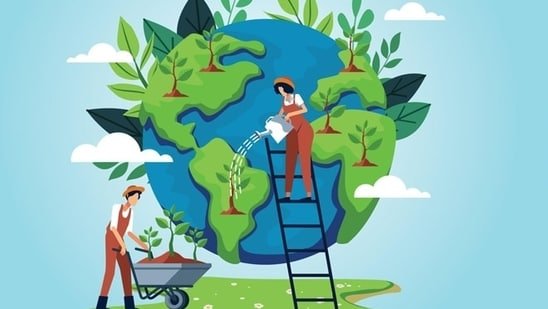
India is urbanising at an unprecedented pace, and in doing so, we are locking in decades of ecological impact through the materials we choose today. This World Earth Day, with the theme “Our Power, Our Planet”, is a timely reminder that climate action is no longer confined to policy rooms or global summits. It is playing out on construction sites, in procurement decisions, and in the everyday choices of homeowners, builders, and communities.

The most consequential environmental decisions are often the most local ones. A roof selected for durability, a block chosen for efficiency, or a pipe specified for longevity may appear routine, but collectively, these choices shape the environmental footprint of an entire nation.
For decades, roofing choices across rural, semi-urban, and industrial India have prioritised cost and familiarity, often overlooking long-term environmental impact. Galvanised iron sheets corrode and warp during monsoons, while traditional fired clay tiles involve energy-intensive kiln processes that contribute to carbon emissions. These have largely been choices of habit rather than informed sustainability.
Today, more climate-responsible alternatives are available. Cement Roofing Sheets, which are less energy-intensive to produce, offer greater durability and reduce the need for frequent replacements. Their resistance to moisture and extreme temperatures makes them better suited to India’s diverse climatic conditions.
When communities adopt such solutions for structures like community halls or industrial sheds, the environmental benefit is both immediate and cumulative. Scaled across millions of buildings, such decisions can significantly reduce the environmental burden of India’s construction sector and support the country’s net-zero ambitions for 2070.
India produces over 200 million tonnes of fly ash annually, much of which remains underutilised and poses risks to air quality, groundwater, and land use. This challenge also presents an opportunity.
Autoclaved Aerated Concrete (AAC) blocks, manufactured using fly ash, enable the productive use of this industrial byproduct. Each AAC block chosen over a conventional fired brick helps divert waste from the environment while contributing to more sustainable construction.
The benefits extend further. Traditional brick kilns are among the largest contributors to particulate pollution, especially across the Indo-Gangetic plain. Increased adoption of AAC blocks can help reduce this burden. Their superior thermal insulation also lowers energy consumption in buildings, while their lighter weight reduces structural load, leading to lower use of concrete and steel.
Water infrastructure is another critical yet often overlooked aspect of sustainable construction. Ageing galvanised iron pipes corrode over time, affecting water quality and leading to inefficiencies that demand frequent replacement.
Advanced polymer piping systems such as CPVC and uPVC, with its industry-first Organic Based Stabilizer (OBS) technology offer a 100% heavy metal-free, eco-friendly solution for potable water, making it a more durable and corrosion-resistant alternative.
As environmental standards evolve and green building practices gain momentum, material choices are becoming a strategic consideration rather than a functional one.
Sustainable construction cannot progress in isolation. It requires alignment between industry, policy, and communities to move from intent to measurable impact. The materials we choose today will define not just how we build, but how responsibly we grow.
On this Earth Day, the message is clear. The power to shape our planet does not rest only with institutions. It lies equally in the everyday decisions that define our built environment. Because the future of our planet will not just be imagined. It will need to be built.
(The views expressed are personal)
This article is authored by Akshat Seth, managing director and CEO, BirlaNu.
