


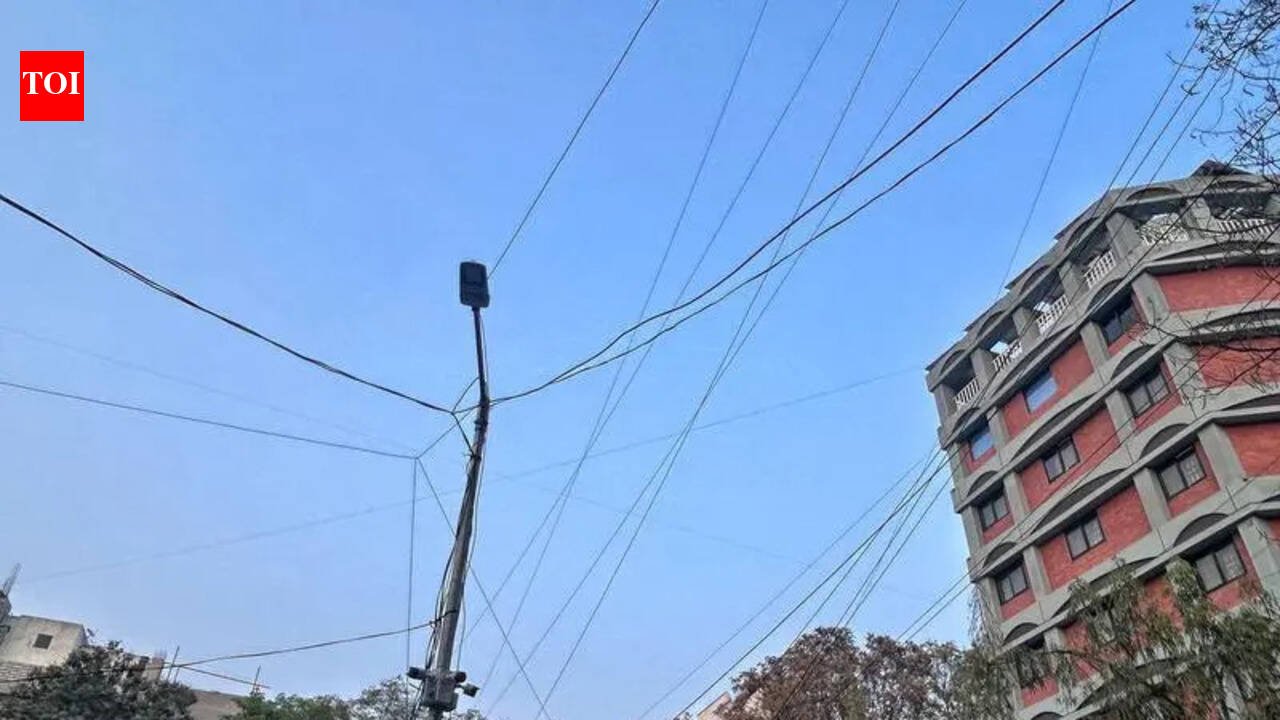
Pune: The civic administration on Tuesday began drafting a standard operating procedure (SOP) to regulate the city’s cluttered cable network. Officials said the civic body planned to adopt Hyderabad’s model, which included fixing height limits for overhead cables and introducing a rental fee structure for cable operators seeking to install independent poles.The PMC had suspended its cable removal drive last week. The officials said directives issued by the Union power and communications ministries in 2023-24 would be used as reference points while framing the policy.The SOP will also focus on the removal of cables along Palkhi Road and the conversion of overhead cables at major junctions into underground networks. “We discussed the legal framework under the Telecommunications Act and existing policies. The primary objective is to address safety concerns and improve urban aesthetics, while regulating how service providers install cables,” Omprakash Diwate, PMC’s additional commissioner, said.As part of the initiative, PMC will conduct a fresh survey in areas where overhead cables have not yet been mapped. To improve transparency, an online portal will be developed to allow service providers to apply for permissions. Till the portal is operational, a single-window system will be introduced to ensure time-bound approvals.Nodal officers from PMC, Pune police, traffic police, Maharashtra State Electricity Distribution Company Limited (MSEDCL) and Maharashtra Natural Gas Limited (MNGL) will be appointed to oversee the regulation and installation process. The SOP will also include provisions to deal with the extensive network of unauthorised cables across the city, incorporating feedback from stakeholders and local representatives.Under the Maharashtra Prevention of Defacement of Public Property Act, 1995, punitive action can be taken against individuals or entities found defacing public property. The Act specifically allows legal action against the installation of illegal overhead cables.Apart from being an eyesore, unauthorised cables pose serious safety hazards. Broken or low-hanging wires can cause accidents, injuries or even fatalities. Operators responsible for such cables can be prosecuted for criminal negligence.
