


Tsunami warnings downgraded
The warnings for those in the affected areas of northern Japan have been downgraded to advisory.
The information for people on the NKH website states:
If you are in the affected areas, keep away from coasts and river mouths which could overflow. Continue to evacuate until all advisories are lifted.
There may be some changes to the sea level, but there is no threat of tsunami damage.
Waves can get much higher than expected.
Key events
The International Atomic Energy Agency (IAEA) said that there have been no abnormalities observed at Japan’s nuclear facilities as of 8.16am GMT following a 7.7 magnitude earthquake earlier in the day.
Tsunami warnings downgraded
The warnings for those in the affected areas of northern Japan have been downgraded to advisory.
The information for people on the NKH website states:
If you are in the affected areas, keep away from coasts and river mouths which could overflow. Continue to evacuate until all advisories are lifted.
There may be some changes to the sea level, but there is no threat of tsunami damage.
Waves can get much higher than expected.
The meteorological agency said that “the likelihood of a new, huge earthquake occurring is relatively higher than during normal times”.
Municipalities in the affected region issued non-compulsory evacuation directives to more than 182,000 residents, according to the Fire and Disaster Management Agency.
The agency said the later advisory about another possible earthquake only reflected an elevated risk, rather than providing any specific predictions.
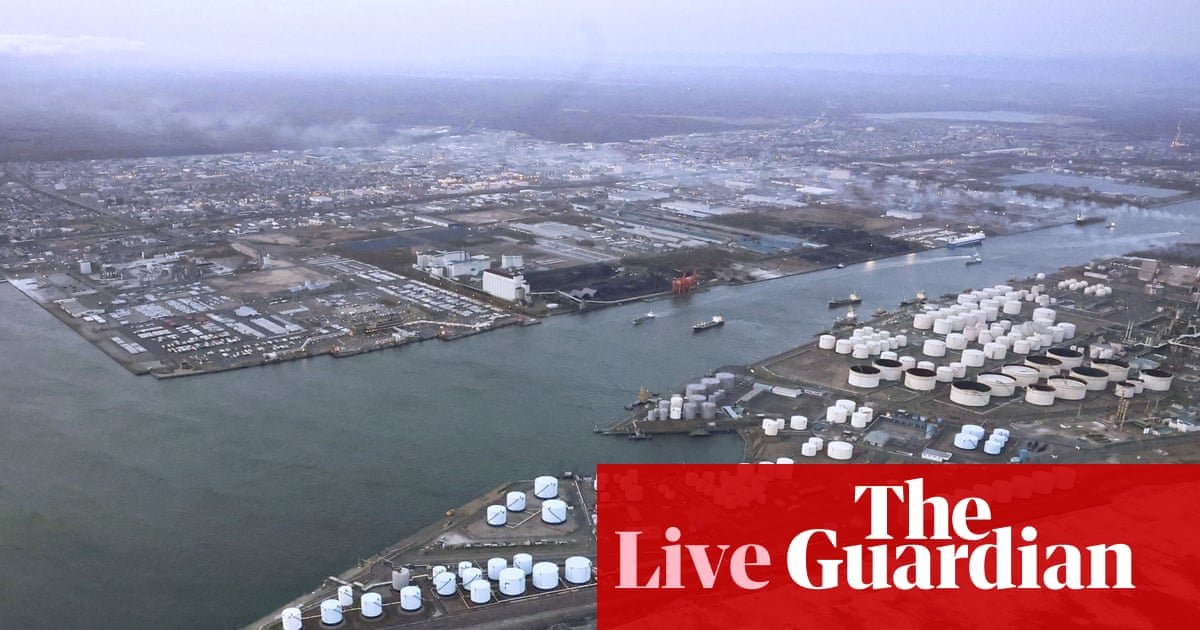
The coastline of Tomakomai, Hokkaido Prefecture, Japan, after a tsunami advisory was issued following an earthquake earlier today:
Soldiers stationed at the Iwate Garrison, part of the Japanese Army, are making preparations following a tsunami alert in Iwate, Japan.
Here is an image of them:
The tsunami alert is “serious enough to respond immediately” but not close to the same scale as the 2011 disaster, an expert had said.
Dr Ioannis Karmpadakis, associate professor in coastal engineering at Imperial College London, said:
What matters here is not whether the wave looks dramatic on camera, but what the water does when it reaches the coast.
The shape of this coastline can turn a regional tsunami into a very local problem, with harbours, bays and river mouths all behaving differently.
This situation is serious enough to respond immediately, but not on the scale of the 2011 Tōhoku disaster.
Earthquake magnitude revised up to 8.0 or stronger
Japan issued a special advisory on Monday warning of an increased risk of earthquakes at magnitude 8.0 or stronger, after a powerful jolt rattled the country’s north and prompted a tsunami warning.
The Japan Meteorological Agency said in a statement that “the likelihood of a new, huge earthquake occurring is relatively higher than during normal times.”
The quake measured an ‘upper 5’ on Japan’s seismic intensity scale – strong enough to make it difficult for people to move around and cause un-reinforced concrete-block walls to collapse. The tremor had an epicentre in the Pacific Ocean and was 10km deep, JMA said.
A three-metre tsunami could cause damage to low-lying areas by flooding buildings and carrying off anybody exposed in its currents, according to JMA.
Located in the ‘Ring of Fire’ of volcanoes and oceanic trenches partly encircling the Pacific Basin, Japan is one of the world’s most earthquake-prone countries, with a tremor occurring at least every five minutes.
It accounts for about 20% of the world’s earthquakes of magnitude 6.0 or more, such as the 2011 disaster that caused nuclear meltdowns at a Fukushima power plant.
Australian officials in Japan are urgently following up on the tsunami warning off the northeastern coast of the island of Honshu.
The Australian government said:
We stand ready to provide consular assistance.
Australians in need of emergency consular assistance should contact the Department of Foreign Affairs and Trade’s 24-hour Consular Emergency Centre on 1300 555 135, or +61 2 6261 3305 (if calling from overseas).
Here are some photos from Japan this morning, in the wake of the powerful earthquake:
Justin McCurry
Japan’s meteorological agency said earthquakes of a “similar scale” could continue for as long as a week, according to the Kyodo news agency.
As darkness fell, there were no immediate reports of damage or injuries, amid warnings that other tsunami had been observed offshore.
Bullet train services between Tokyo and Aomori in the north-east, as well as local trains in the affected region, have been suspended, NHK said.
Newscasters reminded viewers that tsunami can grow in size over time, and that even waves as “small” as 80 cm in height are powerful enough to knock people off their feet.
Japan’s broadcasters have lent extra urgency to their on-screen advice since the 2011 disaster, when the victims included those who failed to evacuate or fled when it was too late.
Evacuation warning for people living close to affected areas
Those living near the coastal areas of Japan where the tsunami is expected to hit are advised to evacuate immediately, Japanese broadcaster NHK has reported.
In a warning, it said:
Tsunami waves are approaching the coasts. Evacuate as quickly as possible. Waves can hit repeatedly. Continue to evacuate until all warnings are lifted.
NKH added in its report:
If you are in the affected areas, keep away from coasts and river mouths which could overflow. Continue to evacuate until all advisories are lifted.
It said that while there may be some changes to the sea level, “there is no threat of tsunami damage,” adding:
People in the affected areas must evacuate immediately. Escape to a higher, safe location right away.The time of the tsunami’s arrival is just an estimate.
Waves could actually arrive sooner or later. Continue to evacuate as long as the warning is in place.
Waves can get much higher than expected.
There is no tsunami threat to Australia, according to a notice issued by the country’s Bureau of Meteorology.
Posted this morning, the bureau said:
An undersea earthquake of magnitude 7.5 has occurred at 5:52 PM AEST on Monday
20 April 2026 near OFF EAST COAST OF HONSHU, JAPAN.
THERE IS NO TSUNAMI THREAT TO THE AUSTRALIAN MAINLAND, ISLANDS OR TERRITORIES.
It added that it would not provide any further updates unless the situation changes.
Tsunami waves observed in several areas
Justin McCurry
Authorities in Japan are urging people living near the country’s north-east coast to evacuate to higher ground after a magnitude 7.5 earthquake triggered a tsunami alert, writes our Tokyo correspondent, Justin McCurry, with waves forecast to reach heights of three metres.
Tsunami waves have been observed in several areas, prompting warnings and advisories in Fukushima, Iwate and Aomori prefectures, as well as the northernmost main island of Hokkaido.
The public broadcaster NHK showed live footage of sections of coastline, with announcers repeatedly urging people to flee before darkness fell.
The earthquake, which struck offshore at a depth of 10km shortly before 5pm local time, recorded an upper-5 on the Japanese seismic intensity scale of 7, meaning the shaking was strong enough to make movement difficult without support and to topple furniture.
It has been 15 years since the same region was devastated by a magnitude-9 earthquake that set off a tsunami and a triple meltdown at the Fukushima Daiichi nuclear power plant. The disaster killed almost 20,000 people, most of whom were swept away by the tsunami.
It’s 15 years since the much more powerful magnitude 9.0 earthquake and tsunami on March 11, 2011, ravaged parts of northern Japan. As Associated Press reports, it caused almost 20,000 deaths and forced nearly half a million people to flee their homes.
Some 160,000 people fled their homes in Fukushima because of the radiation spewed from the tsunami-hit Fukushima Daiichi nuclear power plant. About 26,000 of them haven’t returned because they resettled elsewhere, their hometowns remain off-limits or they have lingering concerns about radiation.
There are no nuclear power plants currently in operation in Hokkaido and Tohoku regions but Hokkaido Electric Power Co and Tohoku Electric Power Co have a number of shutdown nuclear power plants there.
Tohoku Electric said it was checking the impact of the earthquake and tsunami on its Onagawa nuclear power plant.
People in affected areas urged to evacuate
The strength of the earthquake has been revised up to 7.5 and the biggest waves due to the tsunami are expected in Iwate, Aomori and Hokkaido prefectures, authorities said.
Reuters reported that prime minister Sanae Takaichi said the government had set up an emergency task force and urged citizens in the affected areas to evacuate to safety.
Broadcaster NHK showed ships sailing out of Hachinohe port in Aomori in anticipation of the waves, as an alert ‘Tsunami! Evacuate!’ flashed across the screen.
Bullet train services in Aomori at the northern tip of Japan’s main Honshu island were halted due to the tremors, Kyodo news agency reported.
This post was amended on 20 April 2026. An earlier version said Hachinohe port was in Hokkaido; however, it is in Aomori.
Tsunami alert issued after powerful quake off northern Japan
A powerful earthquake has struck off the northern Japanese coast, and the Japan Meteorological Agency has issued a tsunami alert in the region.
The quake registering a preliminary magnitude of 7.4 occurred off the coast of Sanriku in northern Japan at around 4:53 p.m. (0753 GMT), at a depth of about 10km (6 miles) below the sea surface, the agency said.
Japan’s NHK public television said a tsunami of up to 3 meters (10 feet) could hit the area shortly.
