


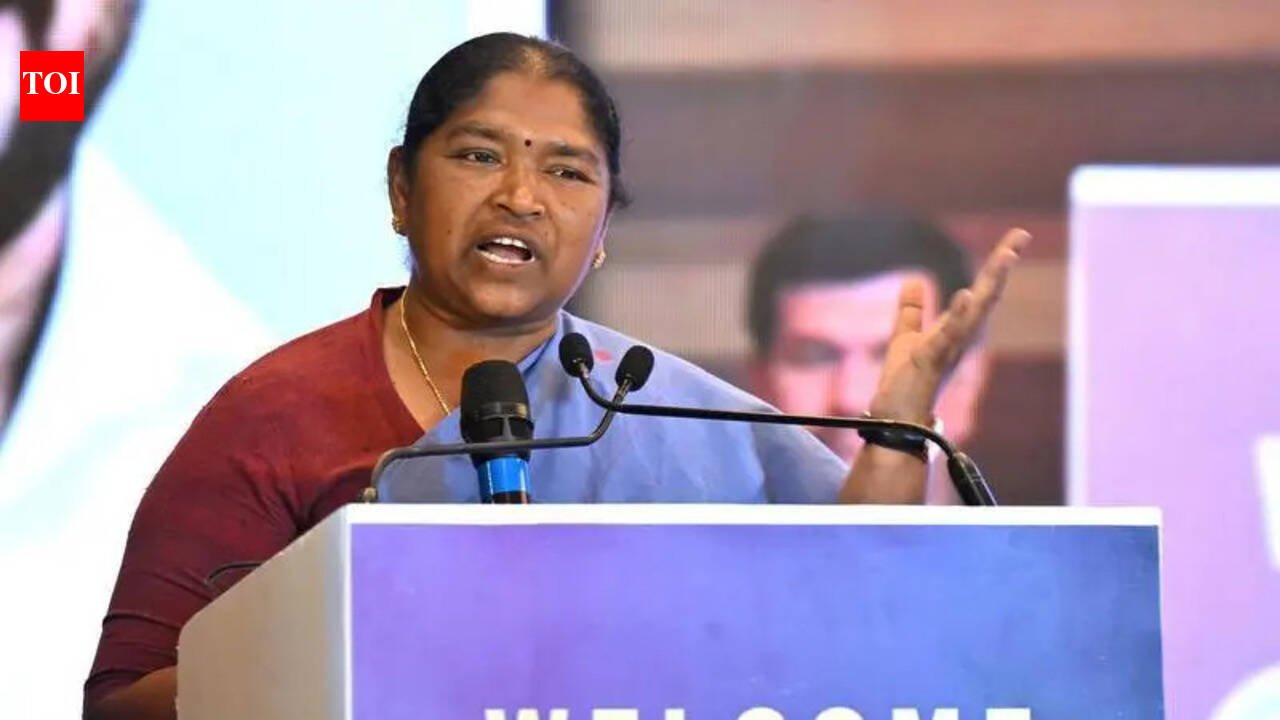
Hyderabad: Minister for women and child welfare D Anasuya (Seethakka) on Saturday said, “Human trafficking is not just a social issue; it is modern-day slavery that destroys dignity and freedom.” She stressed, “If we fail to act, we become part of the problem,” at a state-level convergence workshop on bonded labour and trafficking.The workshop, organised by the women safety wing (WSW) of Telangana police in collaboration with the International Justice Mission (IJM) at Marigold Hotel, brought together over 200 stakeholders, including senior govt officials, police, members of the judiciary, legal experts, civil society organisations and media representatives, to address emerging trafficking patterns and strengthen coordinated responses.Highlighting the scale and urgency of the issue, Seethakka pointed to both official data and grassroots realities, noting that trafficking continues to exploit poverty and migration. “In 2025 alone, Telangana registered 481 human trafficking cases and rescued 929 victims. However, these figures likely represent only a fraction of the actual scale due to under-reporting,” she said.She also underlined the govt’s preventive push, noting that over 57,000 crore in interest-free loans have been extended to women’s groups in the past two and a half years to reduce distress migration. “When livelihoods are created within villages, vulnerability to trafficking reduces significantly,” she added, while citing literacy initiatives that have reached nearly seven lakh women as part of broader empowerment efforts.Drawing from field experience, Anita Ramachandran, secretary in the women and child development department, emphasized that rescue operations alone cannot break the cycle. She pointed out that children rescued from labour often struggle to reintegrate due to language barriers and the lack of structured systems. “If we simply rescue and send them back, they are likely to fall into the same trap again. Rehabilitation must be meaningful, with education and sustained support,” she said, calling for institutionalised bridge schooling across states.Building on this, B Shivadhar Reddy, director general of police, Telangana, shared that trafficking operates through organised criminal networks rather than isolated incidents. He said, “Victims are lured through fraudulent recruitment systems and transported across states via established corridors. Rescue is only the starting point. Unless we dismantle the entire chain, from recruitment to exploitation, justice remains incomplete,” stressing the need for intelligence-led policing, digital evidence and financial tracking to secure convictions while ensuring victim-sensitive procedures.Reinforcing the need for institutional convergence, the DGP noted that trafficking thrives in systemic gaps between departments. “Coordination between police, labour and welfare departments is critical to prevent exploitation at every stage,” he said, calling for stronger monitoring of migration patterns, stricter labour inspections and sustained awareness campaigns in vulnerable regions.Meanwhile, Charu Sinha, additional DGP, women safety wing, Telangana, highlighted that bonded labour remains an under-recognised dimension of trafficking. “Bonded labour is not a contract; it is coercion. The focus must remain on investigating the entire chain while ensuring survivor dignity and safety,” she said, stressing that debt bondage must be treated as a serious criminal offence.
