


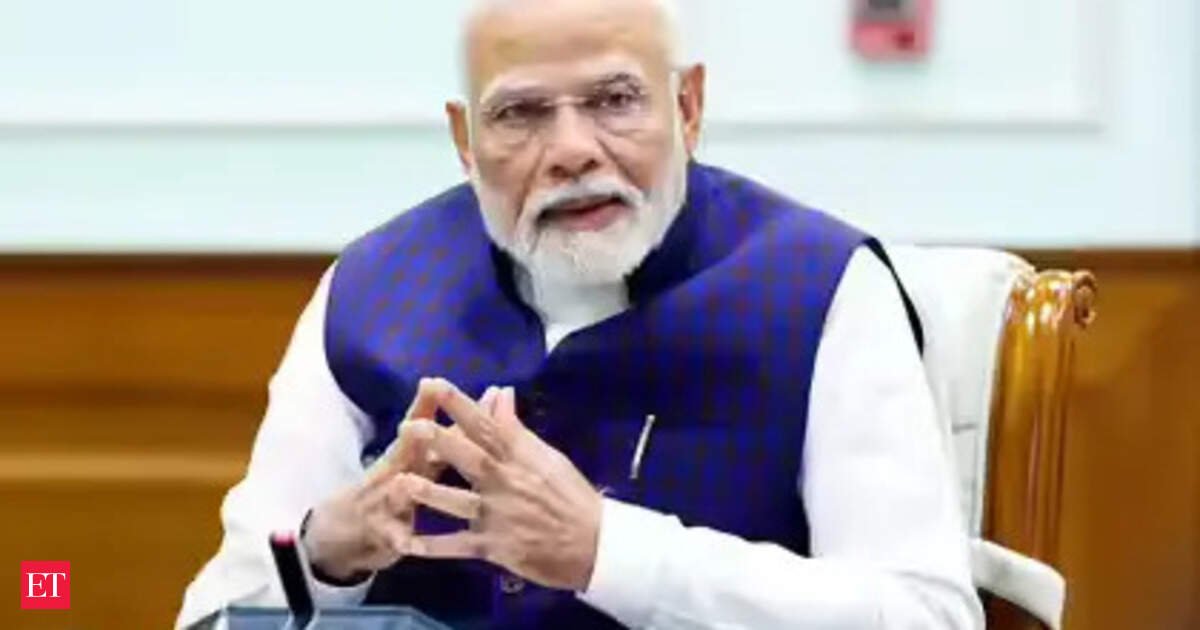
“There will be no change in that proportion… the increase will also be in the same proportion,” he said, seeking to address the concerns of the southern and eastern states, which fear that the north will have overwhelming sway over parliament and decide who governs India with the sheer weight of their numbers.
The opposition has said that the promise of representation remaining unchanged, which has been made verbally, hasn’t been specifically mentioned in the text of the legislation.
However, framing it as a matter of intent over semantics, Modi signalled flexibility even in language, saying he would call it a “guarantee” or a “promise” as required, reinforcing a central message: the reform will not come at the cost of federal balance.
He dismissed accusations of political gain, arguing that opposition would naturally benefit him electorally, while consensus would neutralise partisan advantage. He offered a “blank cheque” of credit to rivals, even suggesting he would publicly acknowledge them, positioning the legislation as a collective national step rather than a party victory. “We don’t want credit,” he said.
Intervening in the debate on three bills related to women’s reservation and delimitation, the prime minister drew a hard line on equity and accountability. He asserted that no region — north or south, big or small — would face discrimination in the delimitation process tied to the women’s quota rollout. Elevating the debate beyond parliamentary arithmetic, he framed women’s reservation as a right, not a concession, and issued a political warning: those who obstruct it risk judgment not from the treasury benches, but from the women of India.
Census exercise
Delimitation is the reworking of the constituency boundaries and is required to be conducted after every decadal census under Article 82 of the constitution to ensure representation. However, given the sensitive nature of the matter, seats were frozen based on the 1971 census — through the 42nd amendment of 1976 and the 84th amendment of 2001 — until the first census after 2026. India is currently holding its first census since 2011.
The government though wants to conduct the delimitation exercise based on that latter census, combining that with implementing 33% representation for women. The emergency session is being held ahead of polling in crucial state elections in Tamil Nadu and West Bengal.
The prime minister said the government was not seeking political credit for implementing the women’s quota law, which is tied to the next delimitation exercise.
Taking a swipe at the opposition, particularly the Dravida Munnetra Kazhagam — its members marked their protest with black attire — Modi said, “I thank you for coming wearing black clothes so that this work is protected from the evil eye.”
Emphasising that reservation for women is a right, not a concession, he cautioned against politicising the reform and said past resistance to such measures had carried consequences.
He warned that any attempt to block it would be judged by women across the country.
Broad support sought
Calling for broad support, Modi said the decision must be viewed in national interest, with global attention on India’s legislative choices. “Women will not only see the decision, but also judge our intent,” he said.
Referring to earlier discussions, he noted that while there were calls to expedite the women’s reservation law, the process required time. With the 2029 general elections as the target, he said further delay would be difficult to justify.
The Lok Sabha is considering the Constitution (131st Amendment) Bill, 2026, the Union Territories Laws (Amendment) Bill, 2026, and the Delimitation Bill, 2026, aimed at enabling implementation of 33% reservation for women in an expanded House of 850 seats, up from 543.
Under the provisions of the Delimitation Bill, the exercise will be conducted by the Delimitation Commission appointed by the central government. The commission’s orders can’t be challenged in any court, a provision that the opposition has protested. The Delimitation Commission will be chaired by a sitting or former Supreme Court judge and its members will include the chief election commissioner (CEC) or an election commissioner nominated by the CEC, apart from the state election commissioner of the respective state.
The move comes amid the controversial Special Intensive Revision (SIR) conducted by the Election Commission of India that has seen millions of people losing their right to vote, according to the opposition.
