


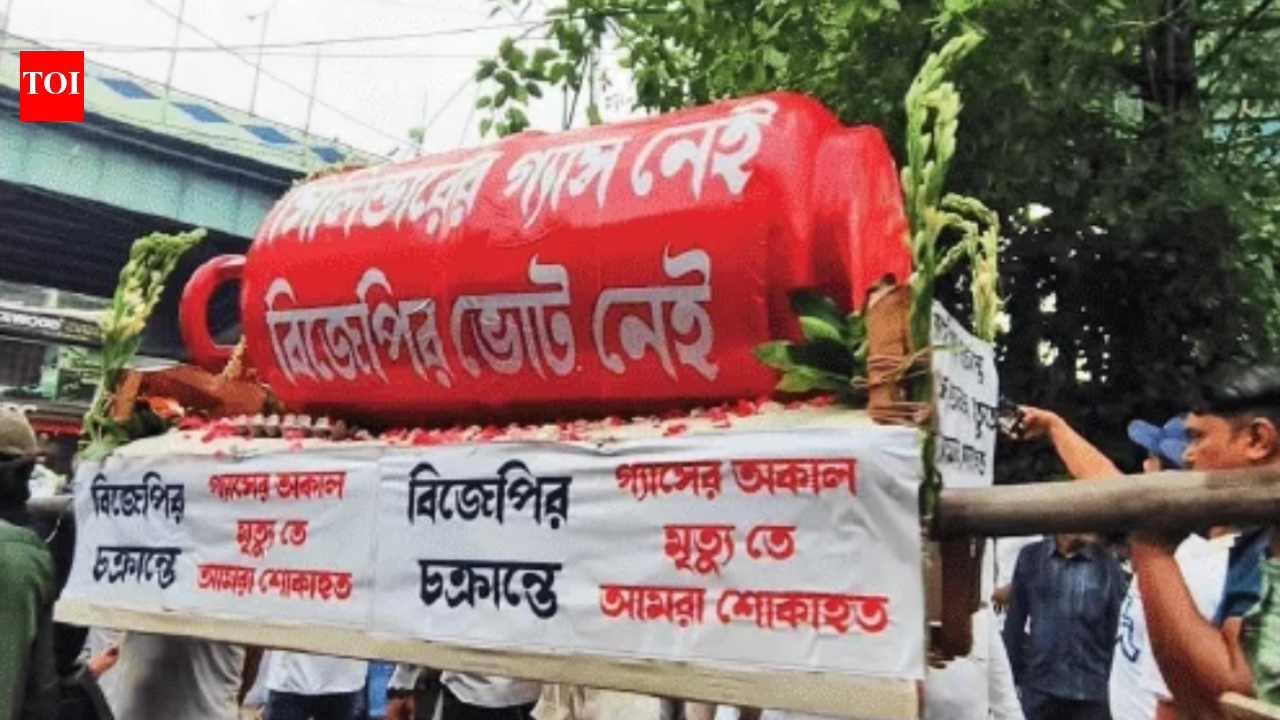
Replica LPG cylinders, cricket bats, bicycles, sacks of potatoes — in the Bengal theatre of assembly polls, such props have occupied centre stage, each of them carefully chosen to signal a message, trigger emotion, or to sharpen a political attack.Across constituencies, candidates have been relying on the symbolism of these objects to cut through the noise of traditional campaigns.In south Kolkata’s Kasba, Trinamool Congress candidate Javed Khan has been leading rallies, flanked by replicas of gas cylinders and LPG fuel dispensers, in a dig at the Centre over the rising price of cooking gas. The message is direct and visual: inflation as a household burden.A local Trinamool foot soldier explained the symbolism. “People may not always follow election speeches or go through party manifestos, but everyone understands what a gas cylinder means, and what we are protesting against,” he told TOI . “It is something every family relates to now.”In north Bengal’s Tufanganj, former cricketerturned-Trinamool candidate Shib Shankar Paul has been carrying a cricket bat and ball during campaigning. The symbolism, said a supporter, is of personal identity, sporting appeal, and youth outreach rolled into one. “Cricket is emotion in Bengal,” the supporter said. “Since he is new to politics, when he walks with a bat, people recognise him instantly. It makes our job much easier.”The cricket bat-as-prop has also been utilised by other candidates. Kunal Ghosh (TMC candidate from Beleghata), Vijay Ojha (BJP candidate from Jorasanko) and even Mamata Banerjee — who’s facing off against BJP’s Suvendu Adhikari — were all seen swinging a bat or two in campaigns.Young people are being wooed in other ways, too. In Keshiary, Trinamool’s Ramjiban Mandi, went to a rally addressed by Abhishek Banerjee — all of 12km — by running the distance.While not a ‘prop’ in the conventional sense, the act was a symbol — of stamina, dedication, and commitment, said a party worker who’s handling his campaign. “It sends the message across that he is one of us, willing to go the distance,” he said.In neighbouring Narayangarh, candidate Pratibha Rani Maity has returned to the basics — campaigning on a bicycle to access remote villages. The cycle, by far the most common mode of commute here, functions both as a practical tool and a symbol of accessibility, reducing the distance between the political ‘stage’, occupied by netas, and the ‘auditorium’, where potential voters sit, party workers told TOI .BJP candidates, too, have leaned into prop-driven campaigning, often linking objects with economic or cultural narratives. In Malda, Gopal Chandra Saha was spotted stepping into muddy fields, harvesting potato alongside farmers and even carrying sacks on his shoulders. The imagery is that of solidarity with farmers and an attempt to foreground agrarian distress. “It’s about showing that we understand their pain,” a BJP functionary said.One of the best use of props was seen during PM Narendra Modi’s rally at the Brigade Parade Grounds on March 14, where the dais background was a detailed cutout of the Dakshineswar Kali temple.BJP’s Rakesh Singh, who recently submitted his nomination from the Kolkata Port constituency carried a photograph of Ishwar Chandra Vidyasagar — the revered 19th century educator and social reformer — on his way to file his nomination.Singh had been arrested in 2019 in connection with vandalising a bust of Vidyasagar during an Amit Shah rally. “I carried the photograph as a mark of respect towards Vidyasagar, and to send the message across that I had been falsely accused in that case,” he said.Former state BJP chief Dilip Ghosh, in the fray from Kharagpur, meanwhile, has opted for highvisibility road presence, campaigning on motorcycles. The bike rallies — loud, mobile, and energetic — are designed to project momentum and organisational strength.The use of props reflects a broad shift in campaign strategy, where political communication is increasingly visual, immediate, and symbolic, analysts said.Political analyst Udayan Bandyopadhyay feels elections are as much about imagery as they are about ideology. “Props are cognitive shortcuts. Voters may not remember speeches, but they will remember a candidate walking with a potato sack. The advent of social media has amplified such behaviour.”Voters, however, remain divided on the efficacy of such tactics. In south Kolkata’s Golpark, 28-year-old marketing executive Riya Sengupta said the creativity involved made for more engaging campaigns. “It catches your eye. You stop, you watch, you sometimes even take a photo,” she said. “But, ultimately, I want to know what they will do about jobs.”There is also scepticism. “All of this sometimes feels like overacting,” said college-goer Oishi Banerjee. “Carrying props is fine, but governance is something else.”Campaigners defend the approach, saying many prop-driven moments are for digital amplification, where a candidate is not just performing for those physically present, but for a larger online audience.Perhaps the most succinct explanation was provided by the digital media campaign manager of a three-time Kolkata MLA. “In the age of social media, visuals travel faster than words,” he said. “And a strong image can define a campaign.”
