


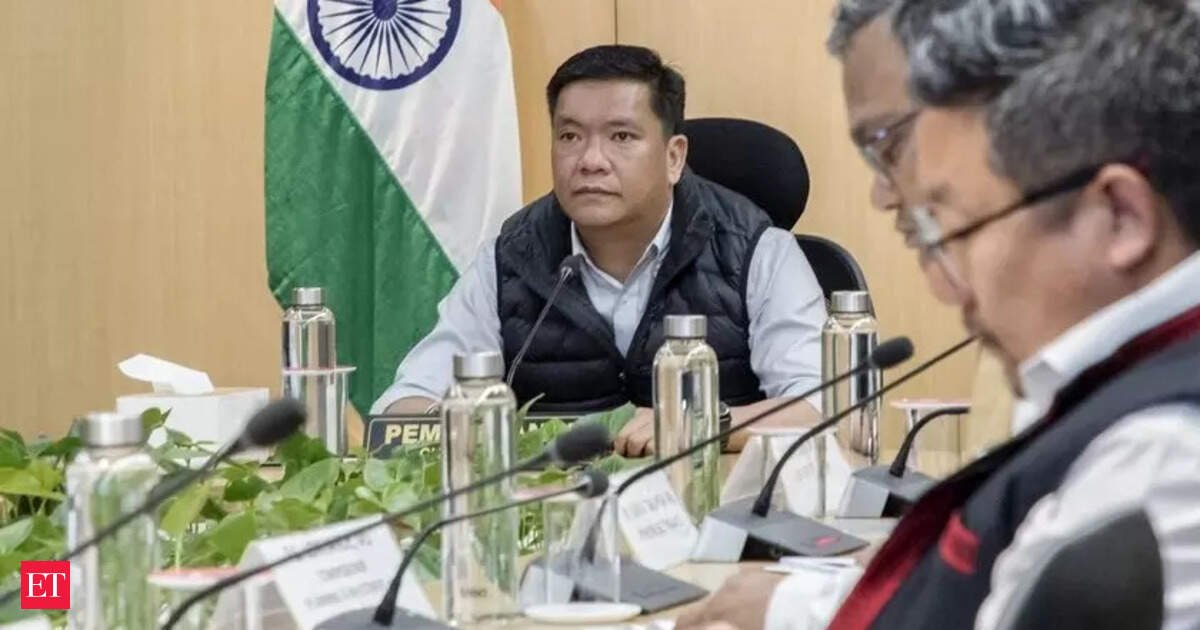
He attended a special programme celebrating the spirit of women empowerment and awareness on the Nari Shakti Vandan Adhiniyam, held under the theme “Celebrating Strength, Equality and Leadership.”
The Chief Minister described the legislation as a historic reform that will transform India’s political and governance landscape.
Highlighting the significance of the Nari Shakti Vandan Adhiniyam, Khandu noted that the legislation, passed in 2023 under the leadership of Prime Minister Narendra Modi, provides 33 percent reservation for women in Parliament and State Assemblies.
He said that women’s reservation has been a long-pending demand since 1996, with multiple attempts made over the years before finally being passed in 2023 following broad consensus across political parties.
The Chief Minister informed that a special Parliament session from April 16 to 18 will focus on finalizing rules and implementation modalities, with the objective of rolling out the reservation by 2029 elections.
He emphasized that women’s participation in policymaking is a key indicator of development, noting that developed countries often have 40-50 percent women representation in governance. In contrast, India currently has about 13.6 percent women representation in Lok Sabha and approximately 9 percent in State Assemblies. Arunachal Pradesh currently has four women MLAs, reflecting the need for greater participation.The Chief Minister urged women to go beyond the 33 percent reservation and actively participate in political leadership role.
He hailed Prime Minister Narendra Modi, Members of Parliament, and all stakeholders involved in passing the legislation, stating that the reform will significantly strengthen women empowerment and accelerate India’s journey towards Viksit Bharat 2047 and Viksit Arunachal 2047.
AJP Stand on the Proposed Delimitation Bill
The Assam Jatiya Parishad (AJP), under the leadership of Lurinjyoti Gogoi, president and Jagadish Bhuyan, general secretary, has expressed deep reservations about the proposed national delimitation, viewing it as a vehicle for “political and cultural colonisation” by the Hindi heartland.
While the AJP acknowledges the constitutional requirement for delimitation, their stance emphasizes that this process must not be used to dismantle the unique political identity of Assam. Here is a summary of the party’s position and the concerns:
The AJP argues that the BJP’s move to expand the Lok Sabha to 850 seats—based on the 2011 Census—is a deliberate strategy to consolidate power in Uttar Pradesh and Bihar. They worry that this “North Indian dominance” will turn the Northeast into a political footnote, where national parties can ignore regional interests if they sweep the Hindi heartland.
Gogoi and Bhuyan have repeatedly warned against the “Hindi-fication” of Assam. The party views the rising influence of candidates from Rajasthan or Bihar—who may not speak Assamese properly or understand local values—as a direct threat to the Assamese language and “Assanese” culture.
The AJP claims that by allowing non-indigenous individuals to contest in several Legislative Assembly Constituencies (LACs), the BJP is effectively “outsourcing” Assam’s leadership, making local people “second-class citizens in their own land.”
The party remains a fierce critic of the recent state-level exercise, specifically highlighting:
Role of Ashok Singhal: The AJP and other regional groups have alleged that Minister Ashok Singhal played a key role in influencing the 2023 map. They claim the boundaries were redrawn not for administrative ease, but to help the BJP’s electoral prospects by fragmenting “indigenous” vote banks.
Gogoi and Bhuyan have labeled the 2023 exercise as a “failed experiment” that sidelined the interests of Khilonjiya (indigenous) Assamese people. They point to the reduction of seats in Upper Assam (a regional stronghold) versus the retention of seats in migrant-heavy Lower Assam as evidence of this bias.
