


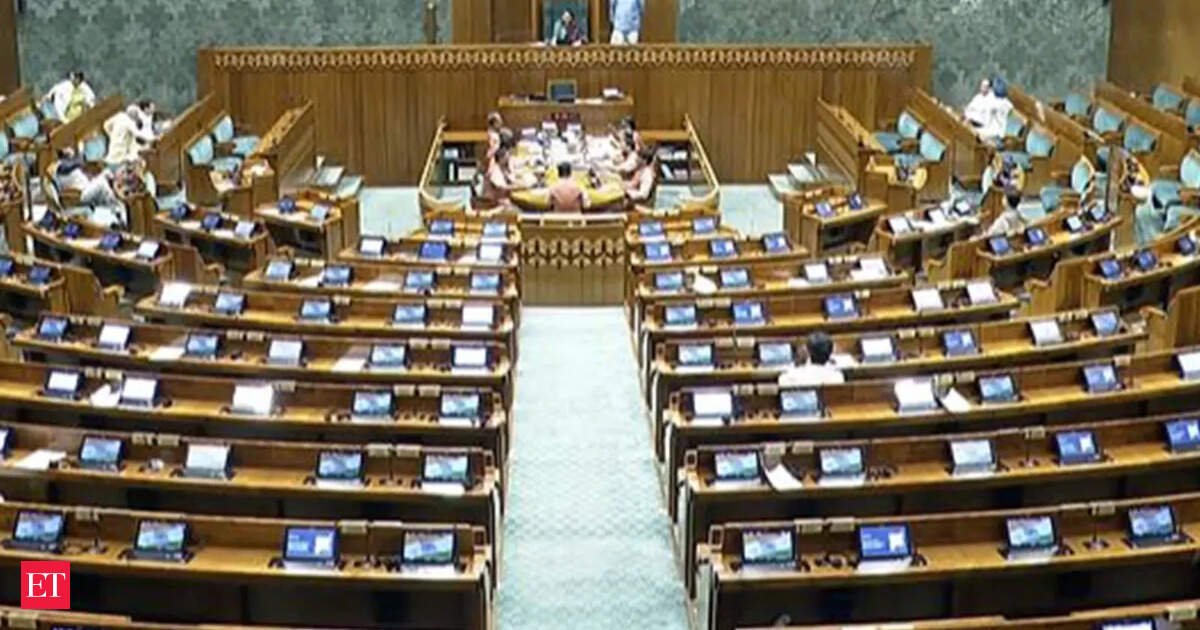
According to a bulletin issued on Wednesday, ‘The Constitution (One Hundred and Thirty-First Amendment) Bill, 2026’, ‘The Delimitation Bill, 2026’ and ‘The Union Territories Laws (Amendment Bill), 2026′ will be introduced and debated for passage in the Lower House.
While Union Law Minister Arjun Ram Meghwal will introduce the first two bills, Union Home Minister Amit Shah will introduce the third one.
Also Read: 48 hours to session, no bill in sight: Derek O’Brien on bills on women reservation, delimitation
The Business Advisory Committee of the Lok Sabha has allocated 18 hours for the debate, which may run into Friday.
The Rajya Sabha will later take up the bills as passed by the Lok Sabha.
According to the draft Constitution amendment bill, Lok Sabha seats will be increased to a maximum of 850 from the current 543 to “operationalise” the women’s reservation law before the 2029 parliamentary polls, following a delimitation exercise based on the 2011 Census.Seats will also be increased in state and Union territory assemblies to accommodate 33 per cent reservation for women.
The seats reserved for women in Lok Sabha and legislative assemblies “shall be allotted by rotation to different constituencies in a state or Union territory,” the draft bill circulated among Lok Sabha members said.
Among other provisions, the bill seeks to amend Article 81 of the Constitution.
“The House of the People (Lok Sabha) shall consist of not more than 815 members chosen by direct election from territorial constituencies in the states; and not more than 35 members to represent the Union territories, chosen in such manner as Parliament may by law provide,” it says.
Sources in the NDA, meanwhile, said the delimitation commission will determine the final number of seats, and hence the bill does not specify an exact seat count or a fixed percentage (such as 50 per cent).
The figure of 850 represents only the upper limit for the total number of Lok Sabha seats.
Seat allocation will be based on proportional representation, with the southern states likely to benefit under this formula.
The 2011 Census is being used as the reference point.
A special three-day sitting of Parliament has been convened from April 16 to 18, during which amendments to the ‘Nari Shakti Vandan Adhiniyam’, commonly known as the Women’s Reservation Act, mandating 33 per cent reservation for women in Lok Sabha and state Assemblies, will be brought for implementation in 2029.
