


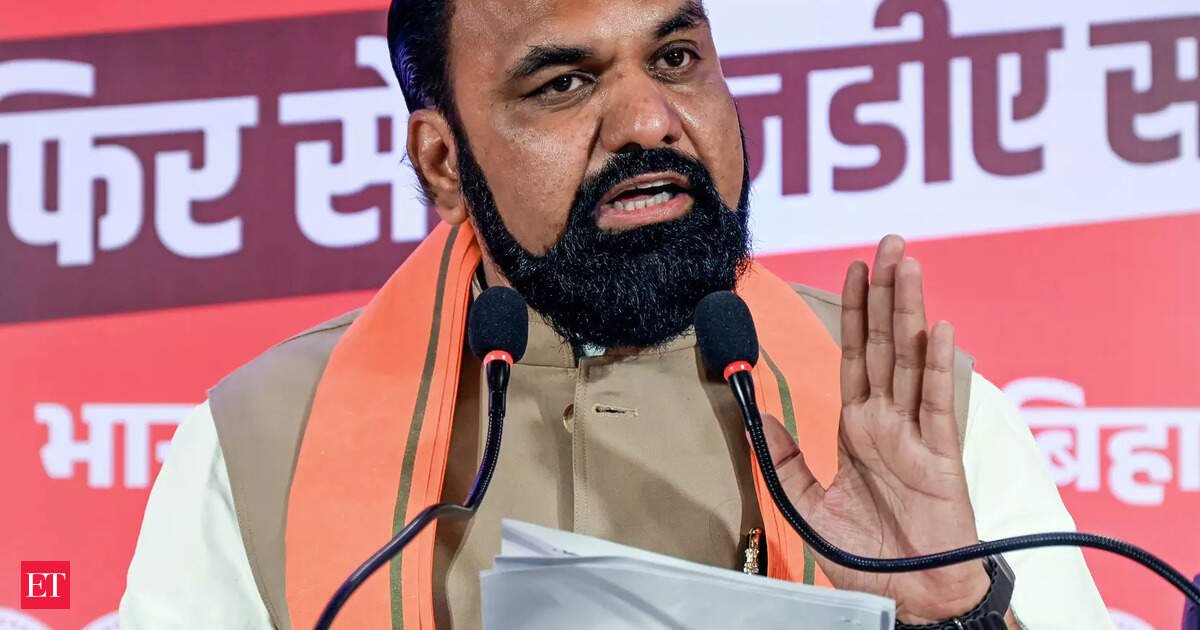
The 57-year-old was born on November 16, 1968, in Lakhanpur village in Munger district. He comes from a politically active family—his father, Shakuni Choudhary, was a six-time MLA and also served as a Member of Parliament, while his mother, Parvati Devi, represented the Tarapur constituency as an MLA.
Choudhary completed his early education in his hometown and later pursued higher studies at Madurai Kamaraj University.
He began his political career in 1990. In May 1999, during the Rabri Devi-led government, he was appointed Bihar’s Minister of Agriculture.
He was elected as an MLA twice from the Parbatta constituency, first in 2000 and again in 2010. In 2010, he also became the chief whip of the opposition in the Bihar Assembly.
On June 2, 2014, he took charge as the Minister of Urban Development and Housing.
In March 2023, Choudhary was appointed BJP’s Bihar state president, succeeding Sanjay Jaiswal. His elevation was seen as part of the party’s strategy to strengthen its outreach among OBC communities, particularly the Koeri/Kushwaha group.In January 2024, he became the BJP legislative party leader and was sworn in as Deputy Chief Minister of Bihar. He was given key portfolios including Finance, Health, Urban Development, and Panchayati Raj.
After joining the BJP, Choudhary rose quickly through the ranks. His appointment as state president in 2023 marked a significant turning point, reflecting the party leadership’s confidence in his ability to expand its social base.
He is considered a prominent OBC face within the BJP, representing the influential Kushwaha/Koeri community—an identity that has placed him at the centre of the party’s broader social outreach strategy.
Known for his combative political style, Choudhary has often taken an aggressive stance against rivals. His symbolic act of wearing a turban during the BJP’s split with JD(U)—pledging to remove it only after the party returned to power—reinforced his image as a determined leader.
Following political realignments in Bihar, he was elevated to the post of Deputy Chief Minister and assigned major responsibilities, including the Home department. His tenure has focused on administrative reforms, particularly in traffic management, policing efficiency, and institutional capacity-building.
He has also been associated with governance initiatives aimed at improving transparency and boosting investment, including efforts to streamline Corporate Social Responsibility (CSR) funds for development and welfare projects. Additionally, he has played a role in monitoring large-scale state projects to ensure timely execution.
Choudhary has remained an active electoral figure, contesting from constituencies such as Tarapur in Munger district. His political journey reflects a mix of grassroots engagement and statewide prominence.
