


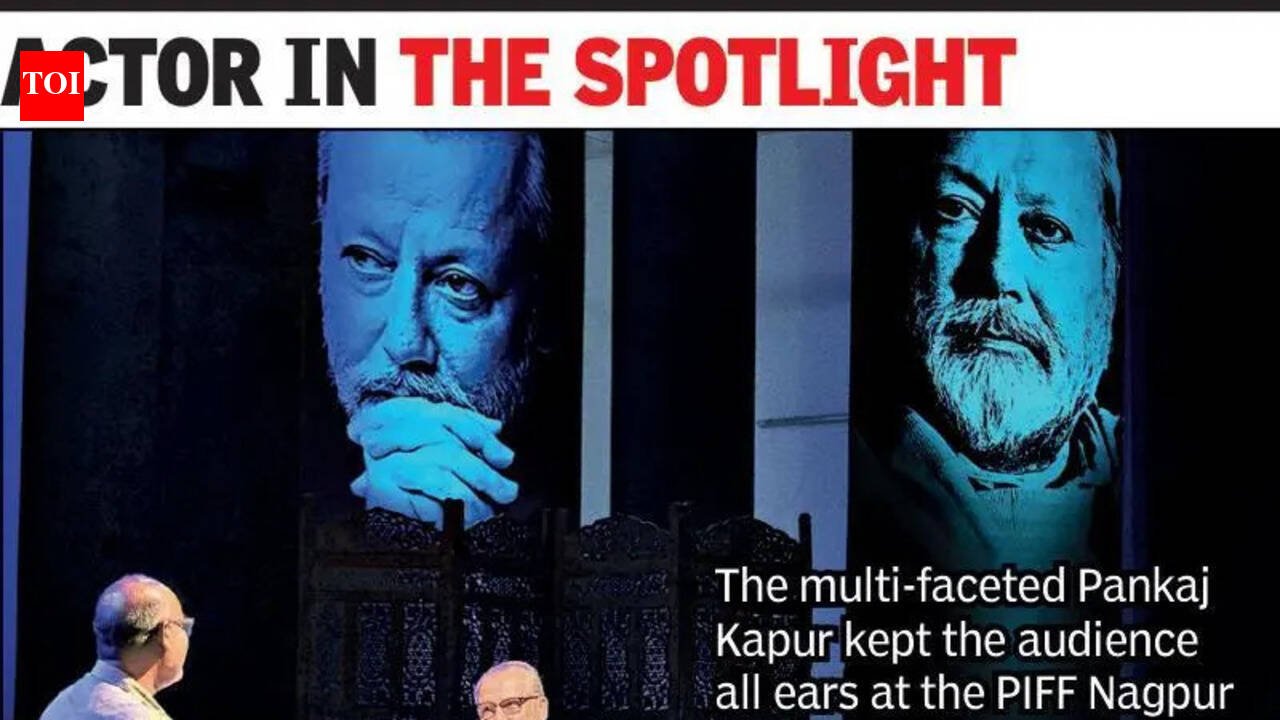
Nagpur: Veteran actor Pankaj Kapur, who has played some of the memorable comic roles in Indian cinema, on Saturday said that humour, when delivered with sincerity and innocence, is widely appreciated and does not hurt sentiments. Responding to a query on whether the iconic Mahabharat scene from film ‘Jaane Bhi Do Yaaron’ can be recreated in today’s times, Kapur asserted that intent plays a key role in how humour is received.The remarks came during an interactive session held at Vanamati as part of the PIFF Nagpur Edition. Titled “Stories, Frame & Perspective”, the programme featured an in-depth conversation with Kapur on life, relationships and the craft of acting. The session was conducted by Ajey Gampawar.Kapur also reflected on films like ‘Mausam’ and ‘Dharm’, emphasising themes of communal harmony and the value of human life. Kapur stressed that the central theme of the film was to underline that love between individuals transcends religion and sect. “The idea was to show that humanity comes above all divisions,” he said.Kapur also spoke at length about his journey from the National School of Drama and how he missed admission to the Film and Television Institute of India. He recalled his entry into the film and television world and attributed it to Saudi-Indian theatre director and drama teacher Ebrahim Alkazi. Kapur shared a series of candid and often humorous anecdotes from his early career, offering a glimpse into the struggles that shaped his journey from his first assignment in Gandhi to TV shows and films like ‘Maqbool’, ‘Matru Ki Bijli Ka Mandola’ and ‘Chameli Ki Shaadi’.He recalled working on the Hindi dubbing of Gandhi at the age of 22, describing it as a “rare opportunity” to lend voice to a character spanning decades of Mahatma Gandhi’s life. Recounting the making of ‘Karamchand’, Kapur said he initially insisted on a proper script before committing to the role. Eventually, after multiple auditions and negotiations, he came on board partly driven by financial necessity. He fondly remembered the moment he realised his growing popularity. While travelling to Darjeeling for a shoot, he was mobbed by fans at the airport. “That’s when it struck me how popular the show had become,” he said, adding with a smile that even roadside vendors began naming products after the character — like “Karamchand ki gajar” and “Karamchand ka halwa”.On the appeal of shows like ‘Office Office’, he said their success lay in relatability. “It reflected the common man’s everyday struggles. People could see their own experiences on screen and still laugh at them,” he noted.He also revisited ‘Neem Ka Ped’, revealing that he was initially offered just a two-episode role. It was his father who encouraged him to take it up despite limited scope and financial uncertainty. The decision proved pivotal, as his performance impressed writer Rahi Masoom Raza, eventually expanding his role to 48 episodes.Reflecting on his career trajectory, Kapur said television in its early years offered meaningful storytelling at a time when Hindi cinema largely confined actors to stereotypical roles. “Television gave me 10-15 years of strong, content-driven work,” he said. Later, as cinema evolved to embrace more nuanced characters and narratives, he gradually transitioned back to films.
