


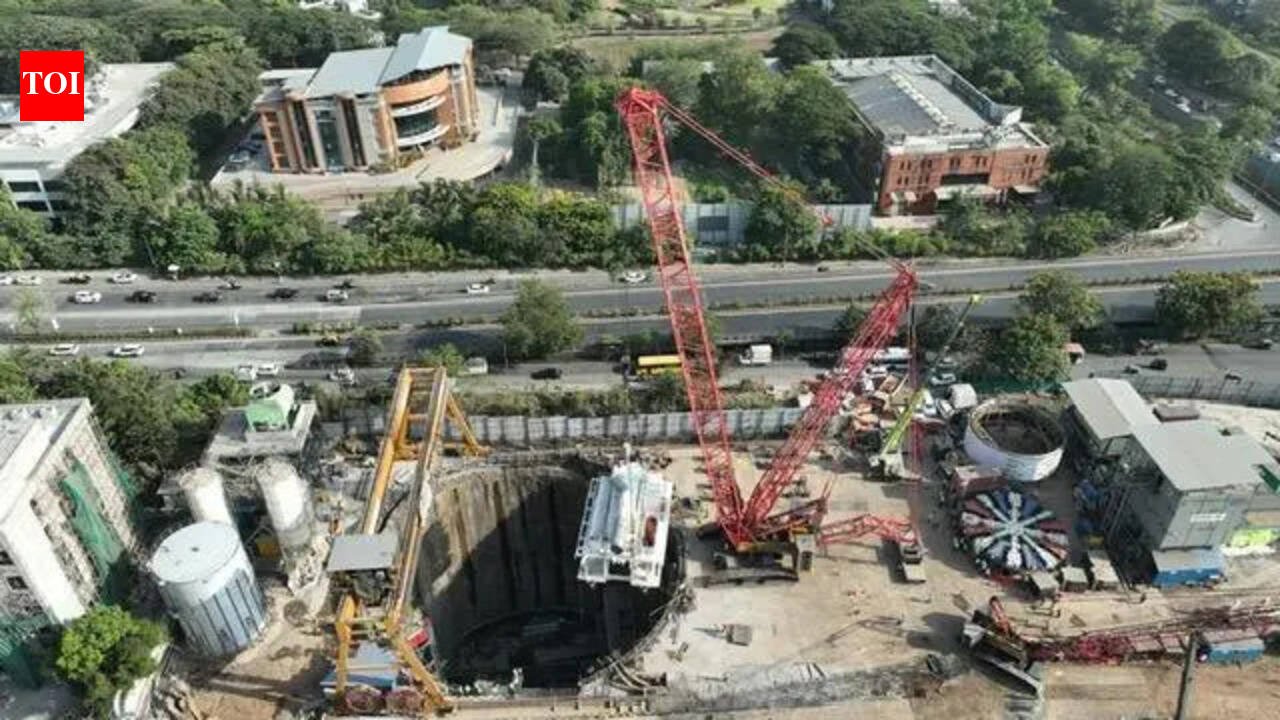
Mumbai: With tunnel boring for the Mumbai–Ahmedabad Bullet Train project’s underground section set to begin in July 2026, the project on Friday marked another key milestone with the assembly of the second tunnel boring machine (TBM) at Sawli near Ghansoli, two days after the first machine’s assembly began at Vikhroli.The second TBM is being assembled at the Sawli shaft, 39 metres below ground level, from where it will tunnel towards Vikhroli. On Friday, a 190-metric-tonne gantry, measuring 18 metres long, 10 metres wide and 9 metres high, was lowered into the shaft. On Wednesday, the first TBM’s assembly began at Vikhroli, where one of the six main shield segments weighing around 170 metric tonnes was lowered to a depth of 56 metres, equivalent to a 20-storey building.The two TBMs will excavate the 16-km tunnel stretch between Bandra Kurla Complex (BKC) and Sawli, part of the 21-km underground section between BKC and Shilphata, which includes India’s first 7-km undersea rail tunnel beneath Thane Creek. Of the total underground alignment, 5 km using the NATM method has already been completed, while the remaining 16 km will be executed using TBMs.The single-tube tunnel, 13.1 metres in diameter, is designed to accommodate twin tracks and will run at depths ranging from 25 metres to 57 metres below ground, with the deepest point reaching 114 metres below Parsik Hill.The machines can operate at a maximum cutterhead speed of 4 RPM, with an excavation rate of up to 49 mm per minute, ensuring controlled progress with high safety standards.Three shafts have been built for the tunnelling works — a retrieval shaft at BKC and launch shafts at Vikhroli and Sawli. Under the plan, TBM-1 will move from Vikhroli towards BKC, while TBM-2 will advance from Sawli towards Vikhroli.The machines, weighing 3,080 tonnes and 3,184 tonnes, use Mix Shield/Slurry technology for complex geological conditions. Each is 95.32 metres long with a 13.6-metre cutterhead diameter. Officials said the main tunnelling drive is expected to begin in October 2026, while monitoring instruments are being deployed extensively to ensure safe excavation and protect nearby structures.
