


Heated vests, gloves and socks. Trapper hat, puffer jacket and thermals.
I had packed for the harshest winter Ladakh might spring on me in March, which is typically one of the coldest months of the year — and one of the best times to catch the ghost of the mountains, the Shaan or snow leopard, the main attraction in my journey to the top of the world.
As it turned out, I could have packed lighter. “In my lifetime, I have not seen a March as warm as this,” said 62-year-old Tsering Dolker, sitting in a sunny courtyard in the union territory’s capital city of Leh. “And yet, it is good to not wear heavy winter clothes,” she added with a smile, as she guided younger colleagues weaving a woollen rug.
Dolker recently moved to Leh from her home in a village high up in Changthang, at an altitude of about 5,000 metres. There, herders graze goats and sheep who yield the world’s finest wools (pashmina, yes; but a range of other varieties too), which are then brought to dyers, weavers and spinners in Kashmir and beyond, who fashion from it the most coveted shawls and rugs.
Dolker now earns a living adding value to the wool in Ladakh instead, as entrepreneurs proudly reassert the weaves of the region. (Using, incidentally, the traditional backstrap loom, a mobile device used by nomadic communities that gets its name from the belt that attaches it to its user.)
Unlike Dolker, the snow leopards, wolves and blue sheep are moving in the opposite direction, higher up the mountains, as the weather becomes unseasonably warm.
There is less snow, and more rain, in this high-altitude desert region now, wreaking havoc on mud houses intelligently designed for a different and stable weather pattern. People and animals alike are dealing with landslides, floods and simultaneous water scarcity.
This Third Pole, home to thousands of glaciers, has the largest ice reserves outside the Arctic and Antarctic. It is warming at nearly twice the global average rate. No one can accurately predict what might come next. And the repercussions will be felt far beyond Ladakh.
SPOT CHECK
Climate is not the only change in the region. The sizeable presence of the army and police forces in this sensitive border area brings with it more roads and vehicles, more buildings and waste, and more demand for water and other resources. Add to that the post-pandemic tourism boom, driven by some of the new infrastructure links, and one now has urban noise that shatters the once-throbbing silence of this ancient land.
So it was with a deep feeling of gratitude for what remains that we made our way higher into the mountains, following the blue sheep and their predators. Along the way, our eyes fell on gleaming lilac and jade mountain slopes, capped by snowy white peaks. The unusual yet strangely familiar sight of stone-studded towers, undulating sheet rock and bizarre limestone formations rising above the Indus and Zanskar rivers roused an ancient sleeping memory in the bones. Perhaps that’s why they call it the Magic Land.
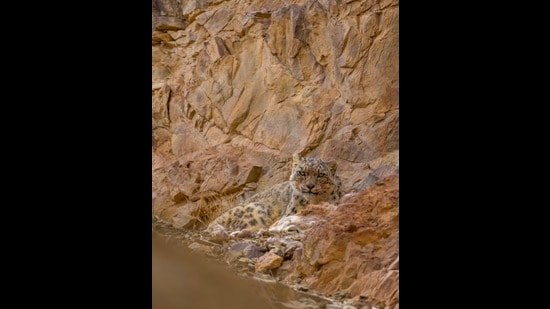
Most magical was the sight of our first snow leopard, silhouetted on the ridge of a hill in Rumbak Valley. Oblivious to our presence, his distance turned intimate by the giant lens of our camera, we watched the Shaan mark his territory, cast his gaze over the blue sheep grazing on precipitous slopes below, and silently disappear.
We were doubly lucky the following day, as we drove into Wari La to spend time with a family of Eurasian lynx, the rarest of rare wild cats (known to be even harder to spot than the snow leopard). We sighted a mother and two cubs, so well-camouflaged against the slopes that one had to refocus the eyes multiple times to identify the distinctive ears and light movement that gave away their presence. High above them, golden eagles soared and dived on the wind, while yellow-billed choughs and brilliantly tinted magpies hopped on the ground, looking for food.
TRAIL MIX
Ladakh is home to creatures found nowhere else in India, and preserving their habitats becomes increasingly crucial yet more difficult by the year.
One of the largest threats comes from feral dogs that wander freely across hills and human settlements. They hunt in packs, and transmit canine distemper to wild animals. Snow leopards are not immune to the disease, or to attacks. In just the three days I spent in Leh, a snow leopard assaulted by dogs died at the local government rescue centre.
Animal birth-control programmes have done little to control the feral-dog population. Amid bitter, polarised debate, and a Wildlife Protection Act penned in different circumstances, in 1972, India stands unresolved when it comes to the question of how to deal with unchecked population growth in certain species across the country.
Ladakh, for now, remains a land of culturally embedded co-existence. Even when wolves and snow leopards kill the sheep and goats on which so much of the region’s pastoral economy depends, there is typically no anger or grandstanding. Farmers hand the animal over to the forest department, unharmed, and claim compensation for the sheep killed, at half the market rate.
This is a land of harsh terrains and gentle people, still deeply influenced by the teachings of the Buddha, a senior police officer explained.
Reluctantly back in Bengaluru, I unpacked my unused winter gear, breathing in lungsful of air that held more oxygen but far more pollution too. A paradox quite like the one facing Ladakh, caught between the weft of ancient wisdom and the warp of modern ambition.
Like its famous blue sheep, the region now stands at a precipice. Which way will it choose to leap?
(Rohini Nilekani is chairperson of Rohini Nilekani Philanthropies and author of Samaaj, Sarkaar, Bazaar: A Citizen-First Approach)
