


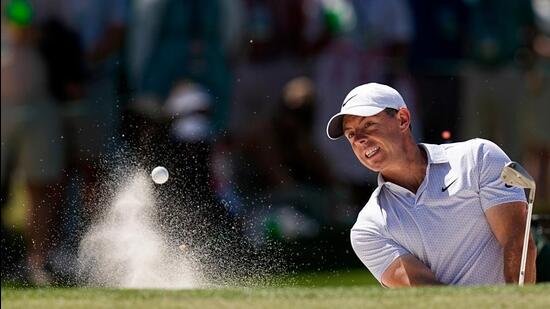
Augusta: The weekend is yet to transpire, but it would be a splendid idea if Augusta National Golf Club already starts etching Rory McIlroy’s name on the trophy. Why wait for the inevitable?

The defending Masters champion produced a second round that was so imperious and so ethereal in shot-making that it has launched McIlroy into a stratosphere that appears beyond reach for mere mortals. From here on, Golfing Gods will have to connive in the most sinister fashion to deny him back-to-back Green Jackets.
McIlroy, at 12-under, led by six shots over Americans Sam Burns (71) and Patrick Reed (69). It is the highest margin of lead in the tournament’s 90-edition history. Of the five players who held a five-shot lead after 36 holes, four went on to win the title. The only instance a five-shot lead at the halfway stage got overtaken was way back in 1936 (Harry Cooper).
The 67 on the opening day was an unbelievable effort, but the seven-under 65 was a willing suspension of disbelief. There have been better rounds at the Alister MacKenzie-designed masterpiece, but rarely has Augusta National’s famous back nine been ripped apart in such ruthless fashion. The lowest Masters score on the back nine is 29 (by Mark Calcavecchia in 1992 and David Toms in 1998), and McIlroy was six-under for his last seven holes.
That 29 could have been matched easily, even obliterated. On the par-4 10th hole, his 8-iron second shot sailed slightly right into the greenside bunker, and he missed a short putt for par. Probably, that was what fuelled his fire. On the 11th, he bombed a 359-yard monster, but it only yielded a par.
After that, it was a masterclass on a golf course that wasn’t playing easy. England’s Tyrrell Hatton needed to hit all 18 greens in regulation to compile a 66, the day’s second-best score.
The only hole he did not birdie was the par-4 14th, where he imparted too much backspin with his second shot. And the only hole where he looked like in deep trouble, the 17th, he nonchalantly chipped-in from 30 yards for a birdie instead.
“I’ve always felt like this golf course can let you get on runs if you allow it. I talked last year about how I really won the tournament in a 14-hole stretch, the second nine on Friday and the first five holes on Saturday. I knew I had some chances coming in when I was standing on the 12th tee, but I didn’t think I’d birdie six of the last seven,” said McIlroy.
“It just shows what you can do around here. My wedge play today was really good. My short game the first two days has been amazing.”
There is something about the current state of McIlroy’s game, it has some of the greatest legends of the game going ga-ga. Even before he started his run on the back nine, Fred Couples, the 1992 champion, said at his post-round chat: “By the way, Rory may never lose this thing again after last year.”
Jack Nicklaus, one of the elder statesmen of the sport at the age of 86, resorted to rather unparliamentary language in giving him advice. Referring to the three double bogeys McIlroy made last year, the 18-time major champion messaged him: “Don’t make a f***ing double bogey this year.”
When Nicklaus speaks, even in that language, golfers usually listen. McIlroy hasn’t made a double bogey yet. And the way he is striking the ball, the chances of him making one over the weekend looks extremely bleak.
World No1 Scottie Scheffler uncharacteristically made bogeys on par-5 13th and 15th to slip to even par, while Justin Rose and Shane Lowry climbed to tied fourth place at five-under with rounds of 69 each.
Among the big names to miss the cut was pre-tournament favourite Bryson DeChambeau, who made a triple bogey on the last to finish on seven-over par for the two rounds.
