


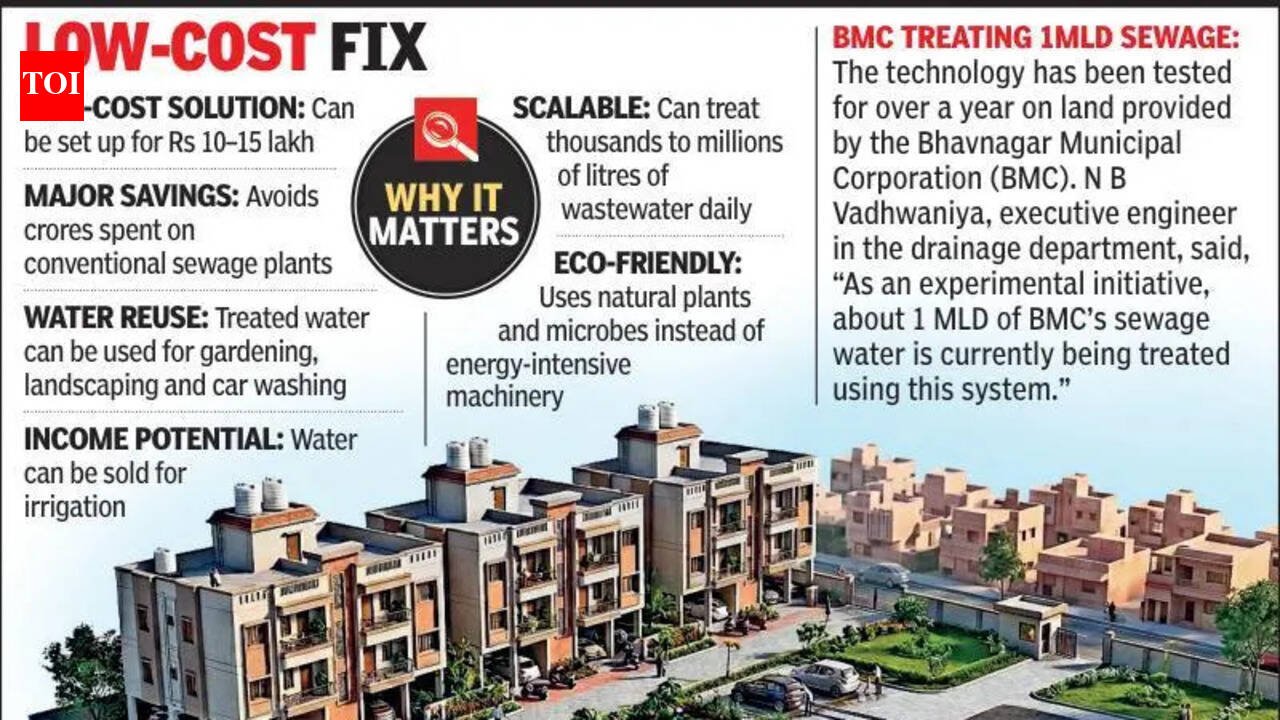
Rajkot: As cities and towns struggle with increasing sewage water and the enormous cost of treating it, scientists in Gujarat have developed a simple, nature-based solution that could change how wastewater is managed. The technology allows housing societies to treat their own sewage at a fraction of the usual cost, without using electricity, and reuse the water for daily needs like gardening and car washing—potentially saving crores in municipal expenditure.Scientists at the CSIR-Central Salt & Marine Chemicals Research Institute (CSMCRI) in Bhavnagar have developed an innovative nature-based sewage treatment system that works much like a natural wetland. Instead of relying on expensive machinery and power-intensive processes used in conventional sewage treatment plants, the system uses plants, microbes and specially designed beds to naturally clean wastewater.The “smart wetland system” can be installed with a one-time capital cost of around Rs 10 lakh–15 lakh, far lower than traditional sewage treatment plants that often cost several crores to build and operate. In simple terms, wastewater flows through different treatment zones where natural microbes and specially selected wetland plants purify the water. Plants such as Juncus rigidus (sea rush) and Canna indica (Indian shot) play an important role in absorbing pollutants while naturally occurring microbes break down contaminants.“The system works as a self-contained, nature-based treatment setup,” said senior scientist Sanak Ray. “Wastewater passes through multiple stages including filtration, electroactive wetlands and constructed wetlands before reaching a final polishing stage.”One of the most remarkable features of the technology is that it does not consume electricity. Instead, the electroactive wetland generates a small electric potential during the treatment process. The system can treat different types of wastewater including domestic sewage, aquaculture effluent, stormwater and even slightly saline water.For residential societies and apartment complexes, the technology offers a practical way to manage wastewater locally. Treated water can be reused for gardening, car washing and landscaping, or even sold for irrigation, turning what was once a waste problem into a resource.The project was funded by the Biotechnology Industry Research Assistance Council (BIRAC), and the technology has already been transferred to a private company for commercial deployment so it can be adopted by municipalities, real estate developers and environmental start-ups across the country.Experts say the system can be scaled to treat anything from a few thousand litres to several million litres of wastewater per day, opening the door for housing societies, NGOs and local bodies to adopt a low-cost, sustainable approach to sewage recycling.
