


Is it the driver or is it the car? This burning question has dogged motor racing and its recognition as a bona fide sport since the European Grands Prix of the 1920s morphed into Formula 1 in the 1950s.
Before we get into it, allow me to throw a few more questions at you: What does it take to build the fastest machines in the world? How does one maximise the potential of these machines and squeeze an extra three-tenths of a second from them around a 3.5-mile circuit while battling 21 similar behemoths?
Now what if that machine is the pinnacle of German automotive efficiency? And what if the man in it is a 19-year-old Italian prodigy?
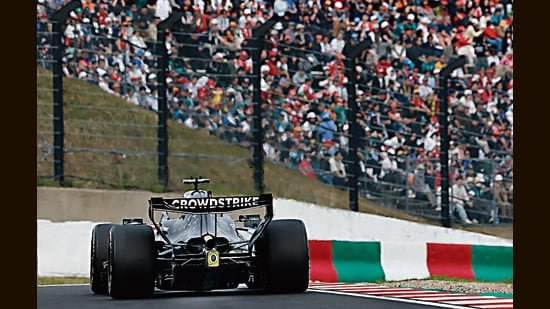
The new Mercedes W17 car with Kimi Antonelli in the cockpit has darted across Melbourne, Shanghai and Suzuka, in the first three races of the 2026 Formula 1 season, in a manner that has brought all these discussions to the front of the starting grid.
The list of records Antonelli has notched up so far is mindboggling.
At 19 years, six months and 17 days old, in the Chinese Grand Prix last month, he became the youngest driver ever to secure pole position. The next day, he became the youngest in F1 history to win a race from pole.
Two weeks later, in Japan, he was the fastest in Saturday qualifying again. On Sunday, he became the youngest to win two Grands Prix; the youngest to complete a pole position / fastest lap / race win hattrick; and, most importantly, the youngest ever leader of the Formula 1 World Championship.
There was another first: Antonelli was given a magnum of rose water instead of the traditional champagne to spray from the top of the podium. He is not yet of legal drinking age in Japan.
A YEAR OF UPHEAVAL
2026 was always going to be a season of upheavals in Formula 1, propelled by a series of technological changes that have fundamentally altered the way the cars behave.
The new alterations — at a scale seen roughly once in two decades in the sport, putting both mechanics and drivers to the test — are principally on three fronts.
First, F1 cars are now lighter, shorter and narrower, with a smaller wheelbase, clipped wings and a raised floor that make them completely different beasts aerodynamically. These machines are more agile, easier to follow closely, faster on the straights and slightly slower in the corners.
Second, the new hybrid machine has a 50-50 power split between an internal combustion engine and electrical energy. The driver will now be able to harvest energy during quiet moments on the track and then press a boost button to harness that extra energy for a burst of speed. While this potentially makes passing easier, it also means the car may lag at crucial times, making it harder to defend tight positions. The choice of when to harvest and when to harness this finite amount of energy is up to the driver, making it a tactical weapon that offers high reward at high risk.
Third, the Drag Reduction System — an adjustable flap on the rear wing that opened to reduce friction and offer 10 kmph to 12 kmph extra straight-line speed — has been replaced by an Overtake Mode that allows drivers to use additional electrical power if they are within one second of the car ahead of them.
The Mercedes team led by team principal Toto Wolff has been the quickest to get a grip on these changes, both in terms of efficiently integrating them into the machine and allowing the men behind the wheel, 28-year-old George Russell and Antonelli, to simulate them over multiple race scenarios. This is what has set the W17 cars apart this season, though McLaren (they use a different Mercedes engine) and the Ferrari will eventually catch up.
SO, CAR OR DRIVER?
Back to the question that began this piece: Is it the car or the driver?
There is a long-held belief in Formula 1 that the car accounts for 80% of a team’s success and the driver, 20%. The key argument in this theory is that the machine has a limit that cannot be breached; and the difference in times between the fastest and slowest cars on the circuit can be up to three seconds per lap, which is impossible for any driver to bridge.
The theory gained further credence when former Formula 1 champion Nico Rosberg echoed the 80/20 principle after he won the 2016 title in a Mercedes car that dominated the season.
But not everyone was convinced.
A 2021 study by professors Duane Rockerbie (University of Lethbridge) and Stephen Easton (Simon Fraser University), published in the journal Applied Economics, tested this theory through statistical modelling and data from the intensely competitive 2011-19 seasons, to emerge with a dramatically different answer.
Their findings put driver skill at just 15% and team technology at just 20%, while introducing a new element: the interaction between the two complementary inputs (or how a team and driver combine with each other). This plays a decisive role, the researchers said, in determining race outcomes.
“The simple 80/20 rule is found to be an over-simplification of the shares,” they wrote. “More skilled drivers improve the return to team technology and vice-versa. After all, F1 cars do not drive themselves and drivers cannot ply their trade without an F1 car. Drivers do not just drive cars but also provide valuable input to car development and testing. [For] F1 world champion Nico Rosberg… [to say] that drivers contribute 20% is a vast underestimate given the critical complementarity between driver and team.”
This unique harmony between man and machine, between engineer, mechanic and driver, is perhaps what makes F1 a bone fide sport.
With that in mind, three races into the season, the challenge will be for the engineers of the other 10 teams to catch up with Mercedes, and for the 21 other drivers to narrow the gap with Antonelli.
(The views expressed are personal)
