


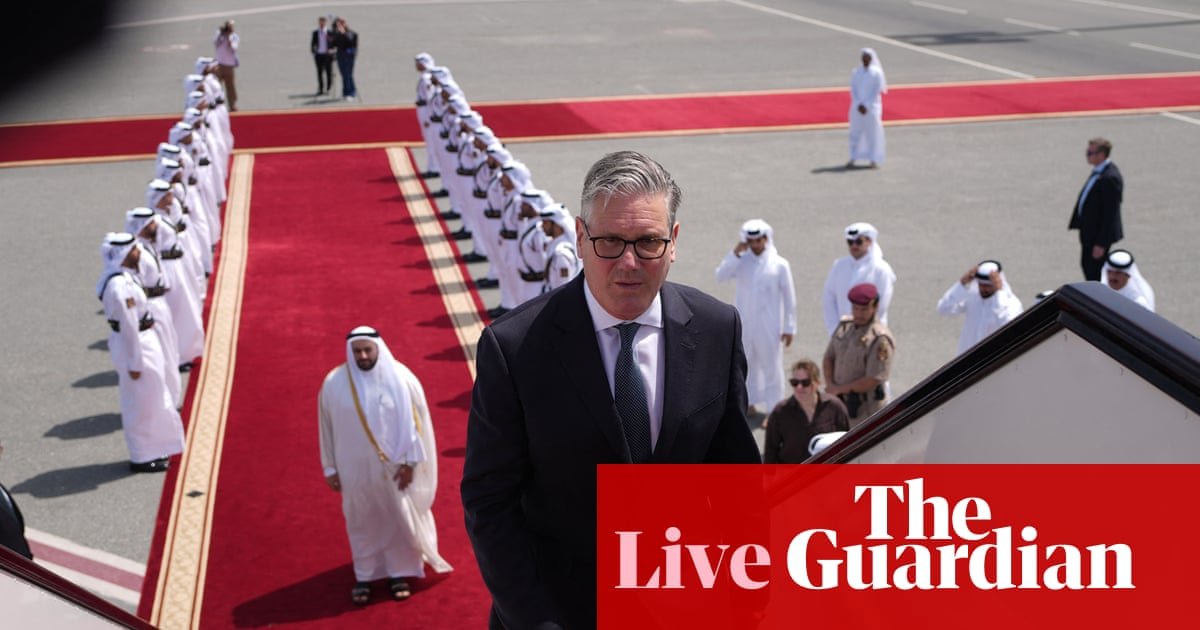
Starmer implies he did not tell Trump in person how ‘fed up’ he is about president’s impact on UK energy bills
Keir Starmer has recorded a short pooled TV interview in Qatar this morning. It did not really add much to what we have heard him say before but, for the record, here are the main lines.
-
Starmer implied that he declined the opportunity to tell Donald Trump in person how “fed up” he is about the president’s impact on UK energy bills (see 9.01am) when they spoke last night. He said their focus in the call was on the need for a “practical plan” to open the strait of Hormuz. He also said he had told the president that leaders of the Gulf countries stressed to him that, if the ceasefire is to hold, they should be involved in the plan for the region’s future. Starmer was being interviewed by Robert Peston, who conducted the interview yesterday in which the PM said he was “fed up” with energy prices going up in the UK because of wars started by Trump and Vladimir Putin. Peston asked if Starmer raised this in his call with Trump, but the PM did not address that point and said they spent “most of the time on the call talking about the practical plan”. (He did not say what that practical plan was.)
The overarching impression here is the importance, as they see it, of us standing with them as an ally, as a friend of theirs at a point of need.
And there’s been reflection on the work that we’ve done with them over the last six to seven weeks, on collective self-defence.
Here in Qatar, we’ve got a joint squadron, so a real sense of ‘here we are as an ally, standing with our allies when it matters most to them’.
-
He restated his belief that European members of Nato need to spend more on defence. He made this point when asked about Trump’s threats to withdraw from Nato. Asked if raised these threats in the call, Starmer did not answer directly, but said he was continually saying that Europe needed to do more for Nato.
Key events
Allowing Rosebank and Jackdaw oil and gas fields to be drilled in North Sea ‘essential’ for UK, Blair’s thinktank says
Tony Blair, the former Labour prime minister, has joined those saying the government should allow drilling for oil and gas in the Rosebank and Jackdaw fields in the North Sea.
Both applications were approved by the last Conservative government, but then overturned by a court ruling. Ed Miliband, the energy secretary, has to make a decision about the revised applications operating in a quasi-judicial capacity, which means he has to follow due process and can’t take the decision purely on political ground.
In saying both developments should go ahead, Blair – or, to be more accurate, his thinktank, which has published a paper on this today – is lining up with Reform UK, as well as the SNP and Scottish Labour. The UK government is waiting for Miliband to complete the quasi-judicial process; as the leading champion of net zero in government, it is assumed he is opposed to the developments, but Labour is under increasing pressure to allow at least one of them.
In its report, the Tony Blair Institute says:
The current debate [on energy policy] is deadlocked between two incomplete responses. The government argues the answer is to accelerate Clean Power 2030, focusing on decarbonising the electricity system as quickly as possible. The opposition argues that the answer is to expand domestic oil and gas production. Both positions contain elements of truth, but neither addresses the core strategic problem: outside the power sector the UK economy remains overwhelmingly dependent on fossil fuels, and electricity is still too expensive to support mass electrification.
The UK is caught in a self-reinforcing high-cost, low-electrification trap. High electricity costs suppress demand, slowing the uptake of electric vehicles, heat pumps and industrial electrification. Weak demand growth, in turn, means that the fixed costs of the system – from networks to long-term contracts – are spread across a smaller base, keeping prices high. The result is a system that is too expensive to electrify and therefore remains dependent on fossil fuels and exposed to global shocks …
In the near term, the UK must reduce its exposure to immediate shocks. This requires accelerating domestic energy supply where viable. Pursuing production at the Jackdaw and Rosebank oil and gas fields can help meet demand, and would have been good policy even before the war in Iran – the current conflict makes the opening of these sites essential.
This is not the first time Blair and his thinktank have criticised Miliband’s energy policy. In part, this could be seen as a continuation of a feud going back more than a decade. Blair was alarmed by the way Miliband disowned parts of the New Labour legacy when he became party leader in 2010 and their relationship has been strained every since.
As Fiona Harvey reported last week, experts say allowing both fields to be drilled would make almost no difference to the UK’s reliance on gas imports.
Ministers toughen anti-porn measures in crime bill, with tech bosses risking jail if they don’t remove revenge porn
Ministers will legislate so that tech bosses who fail to remove nonconsensual intimate images posted online will be held personally liable and risk fines or even jail.
The Ministry of Justice has announced that it is going to include the sanctions in the form of an amendment to the crime and policing bill, which has nearly finished is passage through parliament.
The MoJ is also going to table last-minute amendments ensuring that possessing or publishing pornography depicting incest or adults pretending to be children to be criminalised. In doing so, it is in effect accepting amendments that were passed by opposition peers, without government support, when the bill was going through the Lords.
Commenting on these changes in a news release, the MoJ says:
The first of these vital measures will ban anyone from possessing or publishing harmful pornography that shows incest between family members, and sex between step or foster relations where one person is pretending to be under 18.
A further amendment will criminalise the publication and possession of pornography where an adult is roleplaying as a child.
Delivered with the support of many brave campaigners and advocates for change, both amendments recognise that this revolting online content risks normalising child sexual abuse. Each new offence comes with a maximum penalty of five years’ imprisonment for publication.
Tech company exectutives will be held personally liable, under the revenge porn amendment announced today, “if platforms fail to comply with Ofcom’s enforcement decisions to remove people’s intimate images that have been shared without consent,” the MoJ says. “This would mean senior execs who commit the offence without a reasonable excuse could be liable to imprisonment or a fine, or both.”
Liz Kendall, the technology secretary, said:
This government is uncompromising in our mission to protect women and girls online, and we have taken action to stop tech firms from publishing this abusive content.
In February, we told platforms that they must remove reported non-consensual intimate images within 48 hours.
Now we are going further by introducing measures meaning that senior tech executives could be criminally liable if their companies fail to act when required to do so by Ofcom.
Protecting women and girls online is not optional, it is a responsibility that sits squarely with every tech company’s leadership.
Today’s announcement was welcomed by Gabby Bertin, the Tory peer who tabled the step-incest and mimicry of child abuse amendments that were passed by the Lords without government support. She said:
I greatly welcome the government’s plans to fully address harmful pornographic content such as incest, step-incest and the mimicking of child sexual abuse. This content that is freely and widely available online is deeply harmful, normalising child sexual abuse and abusive relationships within families …
Today the government has answered our calls for change, and I am delighted that once again the UK is leading the way on regulating this high harm industry.
Starmer implies he did not tell Trump in person how ‘fed up’ he is about president’s impact on UK energy bills
Keir Starmer has recorded a short pooled TV interview in Qatar this morning. It did not really add much to what we have heard him say before but, for the record, here are the main lines.
-
Starmer implied that he declined the opportunity to tell Donald Trump in person how “fed up” he is about the president’s impact on UK energy bills (see 9.01am) when they spoke last night. He said their focus in the call was on the need for a “practical plan” to open the strait of Hormuz. He also said he had told the president that leaders of the Gulf countries stressed to him that, if the ceasefire is to hold, they should be involved in the plan for the region’s future. Starmer was being interviewed by Robert Peston, who conducted the interview yesterday in which the PM said he was “fed up” with energy prices going up in the UK because of wars started by Trump and Vladimir Putin. Peston asked if Starmer raised this in his call with Trump, but the PM did not address that point and said they spent “most of the time on the call talking about the practical plan”. (He did not say what that practical plan was.)
The overarching impression here is the importance, as they see it, of us standing with them as an ally, as a friend of theirs at a point of need.
And there’s been reflection on the work that we’ve done with them over the last six to seven weeks, on collective self-defence.
Here in Qatar, we’ve got a joint squadron, so a real sense of ‘here we are as an ally, standing with our allies when it matters most to them’.
-
He restated his belief that European members of Nato need to spend more on defence. He made this point when asked about Trump’s threats to withdraw from Nato. Asked if raised these threats in the call, Starmer did not answer directly, but said he was continually saying that Europe needed to do more for Nato.
Healey says contract for ‘Skyhammer’ interceptor missiles shows defence investment plan delay not holding up deals
John Healey has also announced that the Ministry of Defence is buying ‘Skyhammer’ anti-drone interceptor missiles and launchers to the UK armed forces and Gulf allies. These are designed to counter the Shahed-style kamikaze drones launched by Iran.
In a news release, the MoD says:
Subject to contract, the substantial first tranche of missiles and launchers will be delivered to the Ministry of Defence in May, with more missiles and associated launchers set to be supplied within the first six months of the agreement.
This innovation demonstrates how the UK defence industry can deliver at pace – learning lessons from the ongoing conflicts in Ukraine and the Middle East to deliver cost-effective air defence solutions for the UK and its partners.
Cambridge Aerospace’s new missile, known as ‘Skyhammer’, has a range of 30km and a maximum speed of 700km/h. The deal will further boost British business by creating over 50 new jobs and supporting 125 current jobs at Cambridge Aerospace, making defence an engine for growth.
Speaking at the London Defence Conference this morning, Healey said this announcement showed that the absence of the long-delayed defence investment plan, which was originally due last year, has not stopped the MoD signing new contracts.
The investment plan would be published “as soon as we can”, he said.
Defence secretary John Healey says some help given by UK to US during Iran war has been ‘invaluable’
John Healey, the defence secretary, has said that some of the help offered by the UK to the US during the Iran war has been “invaluable”.
He made the comment in a Q&A this morning at the London Defence Conference where he was asked about Donald Trump’s anger, expressed repeatedly on social media, about the UK and other Nato allies not fully supporting the US military effort.
Britain has not joined attacks on Iran. But it has allowed the US to use British bases for missions deemed “defensive” because they were targeting Iranian missile sites. And British forces in the Middle East have helped to shoot down Iranian drones and missiles aimed at allies in the region.
Asked about Trump’s criticisms, Healey said:
In the end I’d rather our actions spoke for themselves.
And if you look, even in this current conflict, the basing permissions that we in the UK have agreed with the US have been invaluable to their military operations.
When it was put to him that, despite this, Trump still seemed furious about not getting more help from Britain, Healey accepted this. But he went on:
In northern Iraq, our RAF regiment has been, almost daily, taking down drones and jointly protecting US forces and that joint base we’ve got with them.
If we focus on our actions rather than just simply the exchange of words and social media posts, then the fundamentals for me remain.
The fundamentals for me remain that America is absolutely locked into, with benefits as well as massive contributions, to Nato.
We have to do more – we are, and we will – on the European side. And there are, there are deep values that our nations share, that in the end, will see us through the ups and downs of the political cycles, as as they have done both sides of Atlantic in previous decades.
Healey’s comment is likely to anger those who argue that even the limited support offered by the UK to the US in the Iran war has been too much. This is a Green party argument.
One person who will be disappointed by the Labour party cooling on the idea of a leadership contest later this spring (see 10.02am) will be Nigel Farage. He is announcing Reform UK’s election slogan later and reportedly it will be: “Vote Reform. Get Starmer Out.” He has explained his thinking in an article for the Daily Mail where he says:
After what I predict will be a wipe-out in the May elections in Scotland and Wales, the Conservatives might find it hard even to claim that they are still a national party. If Reform UK win these elections, Keir Starmer will have to resign. It will only be a matter of time …
The British people want Starmer out. We are the party that is best placed to beat Labour and give the people what they want.
This analysis may be confusing to Ben Delo, Reform UK’s new tech billionaire donor, who told the Telegraph this week that, being on the autistic spectrum, he cannot cope with the way normal politicians are routinely dishonest and so, as someone “wired for truth-seeking”, has decided to support Farage. In these elections, voters will get the chance to elect new first ministers in Scotland and Wales, several new mayors and around 5,000 new councillors. But Farage is wrong; they won’t get the chance to remove Starmer directly. And increasingly it looks as if there is little or no prospect of the elections indirectly leading to his removal either.
Labour members firmly against leadership challenge to Starmer after May elections, deputy leader Lucy Powell says
Four weeks today Keir Starmer, and all his ministers and MPs, will be starting to assess the results of the Scottish parliament, Welsh Senedd and English local elections. The elections are on the Thursday, but most of the counting will start on the Friday and the full picture may not emerge until the weekend. No one expects the results will be anything other than grim for Labour.
At one point it was assumed that the election results would trigger a Labour leadership challenge. But increasingly that seems unlikely. Wes Streeting, the health secretary and a likely future contender, recently told the Guardian that a leadership contest shouldn’t, and probably won’t, happen. And Lucy Powell, the Labour deputy leader, has now said Labour members are firmly against the idea.
In an interview with the Financial Times, Powell said she probably spends more time talking to Labour members than anyone else, and that they did not want a contest. She said:
Some kind of messy, bloody internal contest is not going to help us address [the issues that matter to voters] … I think the membership would take a very dim view of [a leadership contest].
Powell said that members were impressed by Starmer’s handling of the Iran war, and that at party events she gets most applause when she mentions this.“We need calm, stable, sensible, grown-up leadership to take us through this,” she said.
But she also the party had to do a much better job telling voters about the “radical” things it has been doing.
Starmer discusses need for ‘practical plan’ to reopen strait of Hormuz in call with Trump
Keir Starmer has spoken to Donald Trump about the need for a “practical plan” to get shipping going through the Strait of Hormuz in the wake of the Middle East ceasefire, the Press Association reports.
Starmer spoke to Trump from Qatar, where he arrived last night ahead of talks this morning. In a readout of the call, a No 10 spokesperson said:
The prime minister spoke to President Trump from Qatar this evening.
The prime minister set out his discussions with Gulf leaders and military planners in the region on the need to restore freedom of navigation in the Strait of Hormuz, as well as the UK’s efforts to convene partners to agree a viable plan.
They agreed that now there is a ceasefire in place and agreement to open the strait, we are at the next stage of finding a resolution.
The leaders discussed the need for a practical plan to get shipping moving again as quickly as possible.
Yesterday Keir Starmer met with the king of Bahrain, Hamad bin Isa Al Khalifa, and the crown prince and prime minister, Salman bin Hamad bin Isa Al Khalifa. This is what No 10 said in the readout from their talks.
The prime minister strongly condemned the Iranian attacks on Bahrain and reflected on his conversations so far with other leaders in the region.
He reiterated the importance of ensuring the ceasefire is upheld in order to pave the way for lasting peace. He said that the UK would continue to stand shoulder to shoulder with Bahrain and other allies in the region.
They underlined their commitment to restoring freedom of navigation in the Strait of Hormuz and the need to consider and pursue viable plans to deliver this.
The prime minister and crown prince also reflected on the long held strong links between their countries and the depth of the relationship, including the strong defence collaboration between the UK and Bahrain and their desire to work on this further.
Starmer says he’s ‘fed up’ with energy bills going up for Britons because of actions taken by Trump and Putin
Good morning. Keir Starmer is wrapping up his three-day tour of Gulf states today, and we are starting some conclusions. What we have not got is any sort of plan for a resolution of the Iran war; Starmer is not one of the main protagonists in this conflict, what he has said publicly about his talks with Gulf leaders has consisted largely of platitudes, we still have no idea about when, if or how the strait of Hormuz will fully open, and the outcome will be determined by Iran and a rash and unpredictable US president.
But Starmer has been giving some thought to how the UK should respond to the era of global uncertainty we now find ourselves in and he has set out some of his thinking in an article for the Guardian. The full piece is here.
And here is our story about it, by Peter Walker and Jamie Grierson.
Starmer’s argument is that this crisis shows why the UK needs to be more resilient, in terms of having a robust economy, energy security, a closer economic relationship with Europe and more European defence cooperation. Of course, these were all Labour priorities anyway, but Starmer says the Iran war has highlighted why they are so important. He says this crisis must be a defining moment that results in Britain deciding to “forge a new path”. (But he did, though, say exactly the same thing about the Covid pandemic when he was in opposition.)
Starmer has also talked about these ideas at length in an interview with Robert Peston, ITV’s political editor, for his Talking Politics podcast. In the interview, contrary to what some headlines are saying, Starmer did not say he was fed up with Trump (even though he almost certainly is – and “fed up” would be an understatement). But he did say that he was fed up with energy bills going up in the UK because of the president’s decision to go to war.
I’m fed up with the fact that families across the country see their bills go up and down on energy, businesses’ bills go up and down on energy, because of the actions of Putin or Trump across the world, and saying to families across the country, saying to businesses across the country, ‘we’ve just got to … put up with being on the international market”.
Starmer is always diplomatic when talking about Trump; even in the face of extreme provocation, he is never overtly critical and he never says what (presumably) he really thinks. But he will signal disagreement, and by the standards of Starmer remarks about Trump, this is quite strong. He is explicitly blaming him for British consumers having to pay higher bills. And, in this context, he is linking him to Vladimir Putin.
Here is the agenda for the day.
9am: John Healey, the defence secretary, speaks at the London Defence Conference.
Morning: Keir Starmer is in Qatar where he has meetings before he concludes his Gulf tour and returns to the UK.
10am: Anas Sarwar, the Scottish Labour leader, unveils his party’s campaign battlebus at an event in Glasgow.
11am: Nigel Farage, the Reform UK leader, is unveiling his party’s election slogan at a campaign event.
If you want to contact me, please post a message below the line when comments are open (between 10am and 3pm), or message me on social media. I can’t read all the messages BTL, but if you put “Andrew” in a message aimed at me, I am more likely to see it because I search for posts containing that word.
If you want to flag something up urgently, it is best to use social media. You can reach me on Bluesky at @andrewsparrowgdn.bsky.social. The Guardian has given up posting from its official accounts on X, but individual Guardian journalists are there, I still have my account, and if you message me there at @AndrewSparrow, I will see it and respond if necessary.
I find it very helpful when readers point out mistakes, even minor typos. No error is too small to correct. And I find your questions very interesting too. I can’t promise to reply to them all, but I will try to reply to as many as I can, either BTL or sometimes in the blog.
