


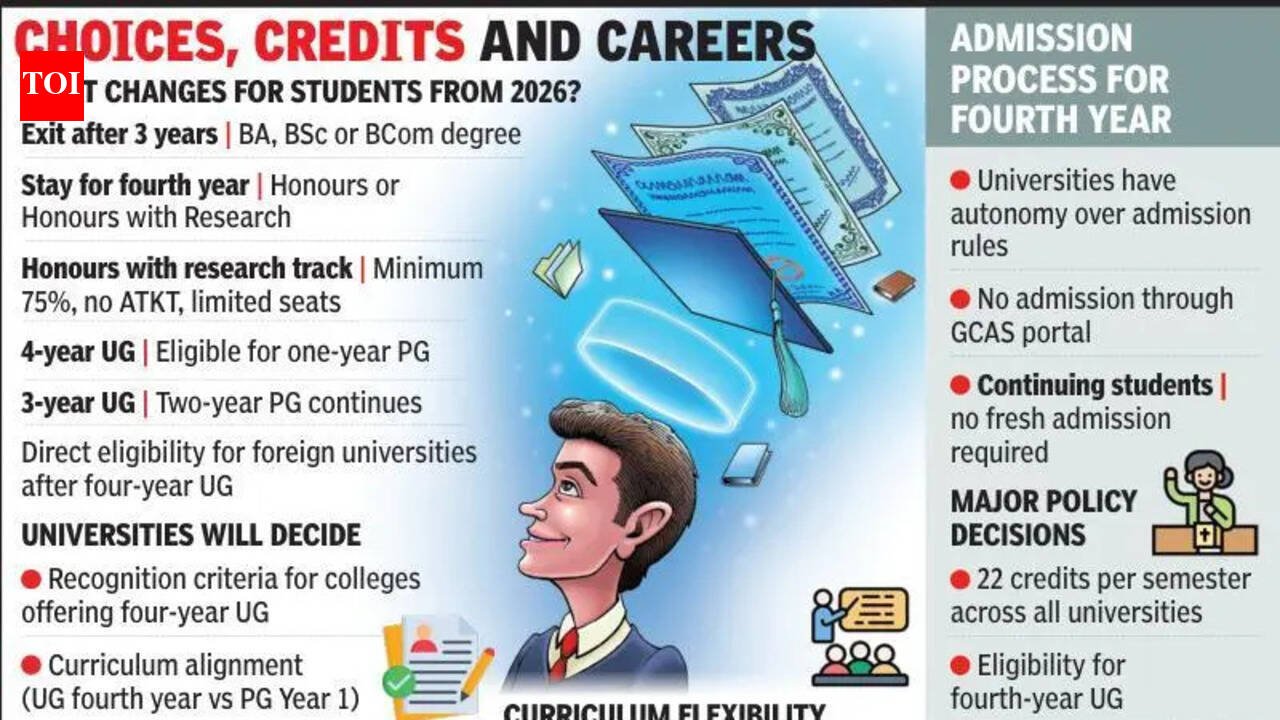
Vadodara: From June 2026, students at Gujarat’s public universities will face a defining academic choice — exit after three years with a standard bachelor’s degree or stay on for a fourth year to earn a bachelor’s degree with honours or a bachelor’s degree with honours with research — as the state rolls out the undergraduate overhaul under the National Education Policy (NEP) 2020.Implementation of NEP 2020 in public universities across Gujarat, with multiple entry and exit options, has seen considerable delay so far. The state education department has now circulated guidelines to universities after a committee of vice-chancellors (VCs) approved the framework. Dr Pratapsinh Chauhan, VC of Bhakta Kavi Narsinh Mehta University (BKNMU), Junagadh, who was part of the committee, confirmed the development. The Knowledge Consortium of Gujarat (KCG) has begun consultative rounds with state universities. One meeting was held at Maharaja Sayajirao University (MSU) on Wednesday, while another is scheduled at Maharaja Krushnakumarsinhji Bhavnagar University later this week. “As the framework needs approval of the respective boards of studies and universities also need to make changes to their ordinances, consultative meetings are being held,” said another VC who is a member of the committee. The new system will apply across arts, science, commerce, fine arts, social work, performing arts and business administration streams. At the heart of the reform is flexibility. After completing six semesters, students can either graduate with a BA, BSc or BCom degree or continue into the fourth year. Those opting to stay will have two pathways: a regular honours degree, open to all eligible students and a highly selective honours with research track, limited to about 5%-10% of students. To qualify for the research track, students must secure at least 75% aggregate across all semesters with no ATKT. Those completing honours with research gain a significant academic advantage, as they become eligible to apply for PhD programmes and appear for eligibility tests such as NET and GCET. The most significant shift lies in global mobility. At present, Gujarat students often need to complete a year of postgraduate study in India to meet eligibility criteria for master’s programmes abroad. With the introduction of a four-year undergraduate degree aligned with international standards, students completing honours — especially honours with research — will be able to apply directly to foreign universities. The new structure also reshapes postgraduate education. Students completing four years of undergraduate study will be eligible for a one-year master’s programme, while those exiting after three years can continue with a conventional two-year postgraduate course. A uniform 22-credit system per semester will be implemented for the fourth year and postgraduate programmes, with greater emphasis on research and interdisciplinary learning. Universities have been given autonomy to design curricula, set admission criteria for the fourth year and decide alignment with postgraduate courses. NEP implementation in state universities, particularly those with affiliated colleges, has remained challenging. Nearly 60% of colleges cited faculty shortages, inadequate infrastructure and the requirement of at least two PhD-qualified guides in a department to offer the honours with research programme. “To bridge this gap, universities will prioritize their own departments and adopt a cluster approach, allowing students from multiple colleges to access honours programmes at selected centres,” Chauhan said. Preparations are underway at MSU, where the board of studies is expected to finalise syllabi later this month.
