


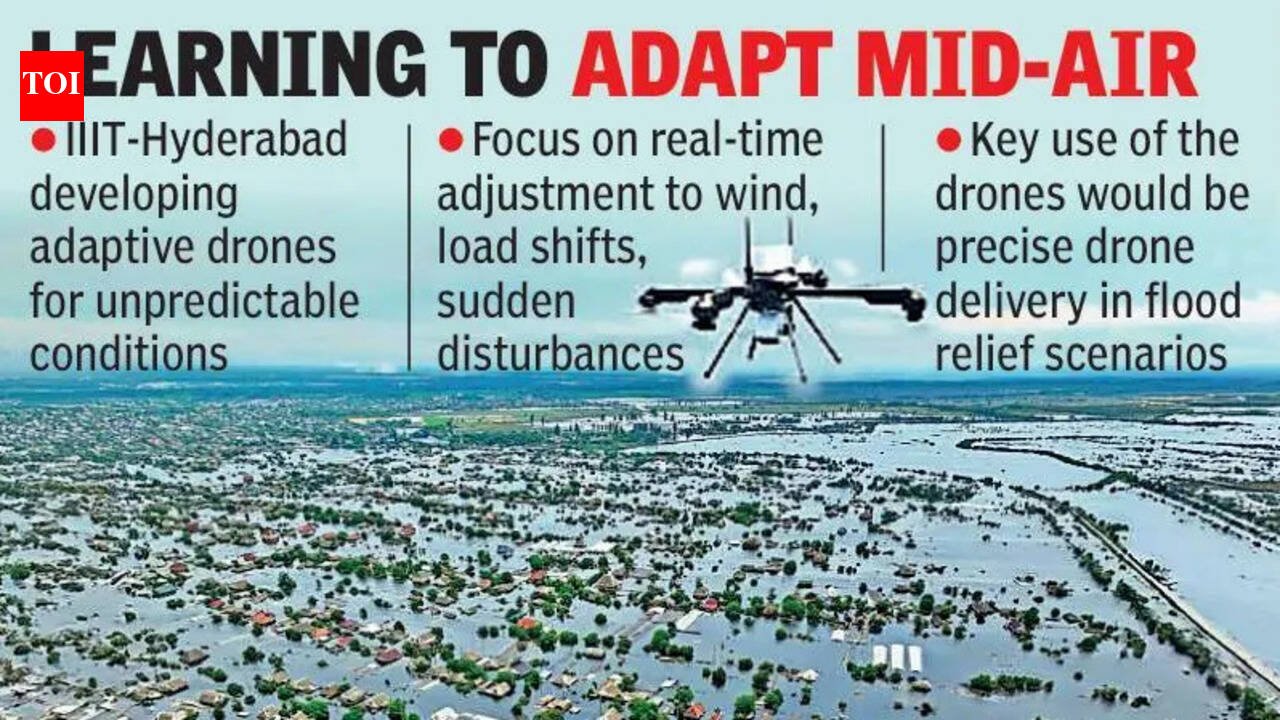
Hyderabad: At the International Institute of Information Technology, Hyderabad (IIIT-H), a robotics lab is working on a critical challenge – building drones that can function under unpredictable conditions. Led by Professor Spandan Roy, the research focuses on enabling drones and robotic systems to adapt to real time environment, wind, shifting loads and sudden disturbances.“Even if you don’t fully know the system, can you still control it,” Roy said, outlining the central idea behind his work.One of the lab’s key areas of research is drone-based delivery in emergency situations such as flood relief. Dropping supplies accurately onto moving targets requires the drone to constantly adjust its position. “A major challenge arises the moment a payload is released. When the load drops, the drone’s dynamics change instantly. It suddenly becomes lighter and shoots upward, and the system has to stabilise itself immediately,” Roy explained adding, “This will help ensure that relief materials can be delivered accurately and safely even in difficult and rapidly changing situations like floods.” The team is also working on drones carrying suspended loads – such as medical kits or food packages hung by a cable – which can swing unpredictably and pose safety risks.Their approach focuses on stabilising the system despite these disturbances rather than eliminating them entirely, meaning the drone learns to balance and stay steady even if the load keeps swinging.In another project, drones are equipped with robotic arms to pick and place objects. However, this adds complexity and affects stability by increasing the drone’s weight and disturbing its balance in the air, making it harder to control. The researchers have experimented with a motor-free gripper design inspired by a slap band mechanism, similar to a snap bracelet that wraps around the wrist without using motors. According to Roy, the challenge lies in ensuring that the gripping force is strong enough to hold objects without destabilising the drone, meaning it must grip firmly while still allowing the drone to remain balanced and steady in flight.The lab is also exploring drone-based pollination in agriculture. In field trials, the system has shown improved efficiency compared with traditional manual methods.“With applications ranging from disaster response to farming and defence, we want to shift the focus towards adaptive systems that can operate effectively despite uncertainty,” he said.
