


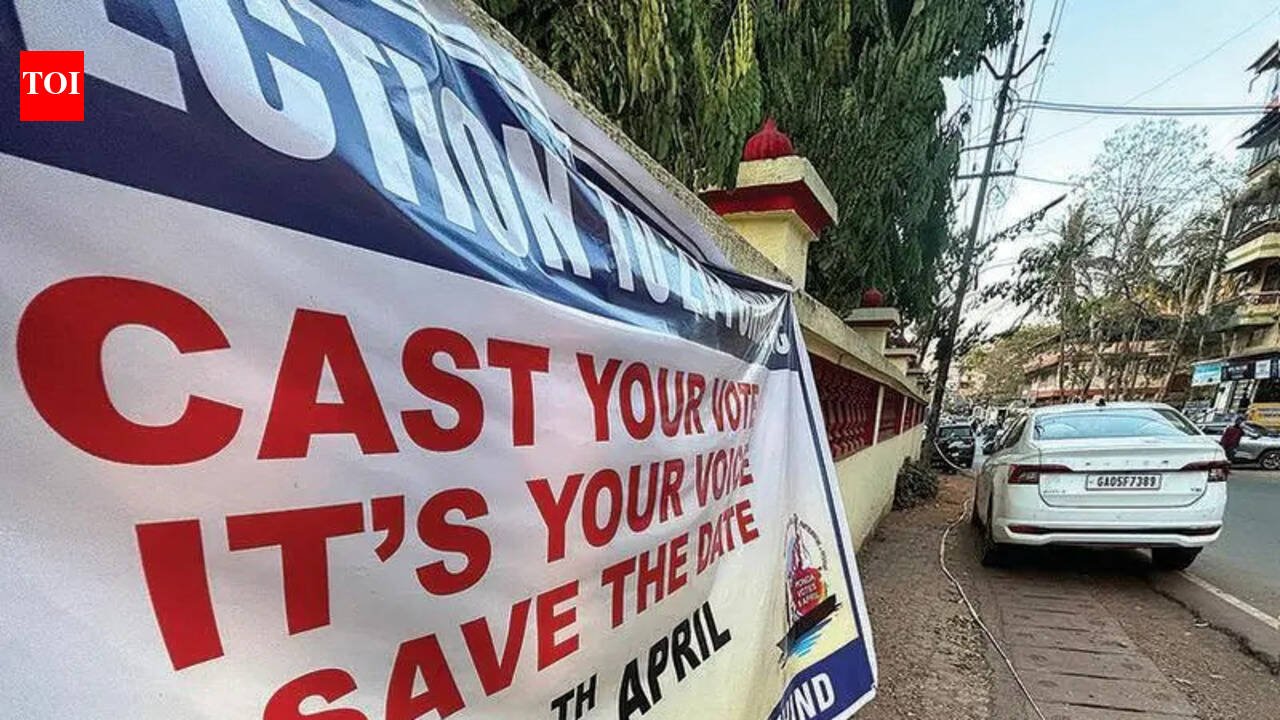
Panaji: The Bombay high court on Wednesday stopped the Election Commission (EC) from proceeding with the Ponda bypoll scheduled for Thursday, the first time in Goan political history that an assembly election was cancelled on the orders of a court.After pronouncing the judgment, the division bench of justices Valmiki Menezes and Amit Jamsandekar rejected the EC’s plea to stay its order for two weeks on the grounds that the election process had started, 171 voters already voted via postal ballots, and the entire machinery is at the site. The bench told the commission that it declared its notification to be contrary to provisions of the Representation of the People Act, and hence it doesn’t consider it tenable to stay its order.The high court held that the EC’s March 16 notification declaring the Ponda bypoll was “arbitrary” as it contravened proviso 151A(a) of the Representation of the People Act, 1951, which exempts the EC from holding elections if the remainder of the term of a legislator in relation to the vacancy was less than a year.Two voters from Ponda constituency—social worker Pritam Harmalkar, 49, and advocate Ankita Kamat, 32—approached the high court challenging the holding of the election on the ground that the newly-elected MLA would not be able to complete a mandatory minimum tenure of one year according to the RPA.The petitions were filed on March 18 and 23, the court began hearing arguments on March 30, and completed hearings and reserved its order on April 2.The petitioners told the HC that the incoming member would hardly get a term of 10 months as the term of the assembly expires on March 14, 2027, and hence the election is contrary to provisions of the RPA.The EC, represented by senior advocate S R Rivankar, told the court that the interpretation of the phrase “remainder of the term” mentioned in clause (a) of the proviso to Section 151A relates to an outgoing member and not an incoming member.The EC further submitted that the Nagpur bench of the same high court misinterpreted the view taken by Supreme Court, which was a binding precedent, holding that the period of one year referred to in clause (a) of the proviso to Section 151A is to be calculated from the date when the seat for which the byelection is to be held fell vacant.The court relied on the judgment of Sandeep Yashwantrao Sarode and stated that it is a “binding precedent and therefore binding on this bench”. The court also considered that the date on which the result of the upcoming election would be announced is May 4, 2026, and observed that the remainder of the period from this date till March 14, 2027, when the term of the assembly expires, is just about nine months, and therefore, the election is in contravention of the bar under clause (a) of the proviso to Section 151A of the Act.The high court also rejected the EC’s argument that there are conflicting views on the issue and that the case needs to be referred to a larger bench. “…We must observe that this is not a case where there are two conflicting decisions of coordinate benches of the Bombay high court. All decisions of the Bombay high court on the interpretation of clause (a) of the proviso to Section 151A are consistent,” it stated.Harmalkar was represented by senior advocate Akshay Naik with advocate Chaitanya Padgaonkar, while petitioner Ankita Kamat was represented by senior advocate Nitin Sardessai with advocate Terence Sequeira.
