


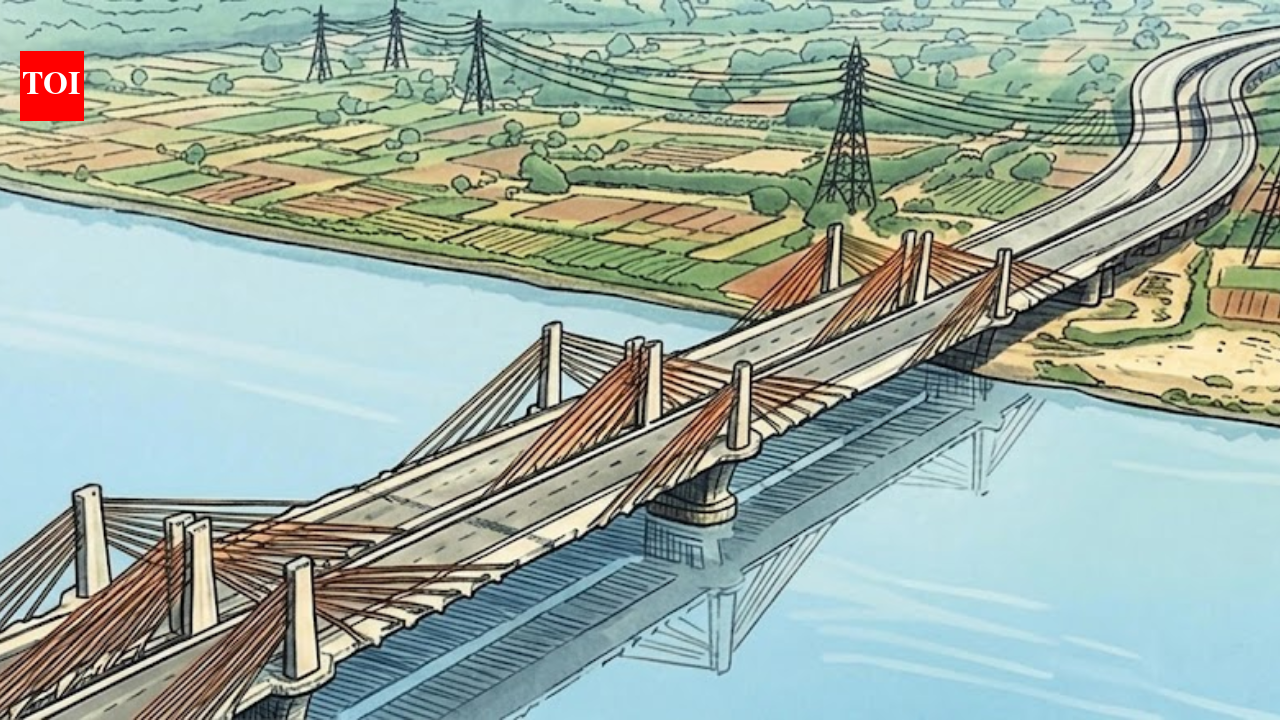
A project meant to save minutes for commuters has wasted years instead — exposing how poor planning, piecemeal clearances and serial delays make public costs far greater than what official files showThe stop-start journey of Delhi’s 10th road bridge over the Yamuna shows how big pub-lic projects often go wrong: not because of one dramatic setback, but because one lapse leads to another — first over land, then permis-sions, then engineering, and finally accountability. Here is how each of those delays unfolded.The first failure — Building on land not fully acquired: The most strik-ing reason for the delay is also the most basic. Less than a year after construction began, a group of people from Nangli Razapur village — located be-tween Nizammuddin bridge and DND, adjoining Sm-riti Van — turned up at the site demanding that work be stopped because it was being carried out on land they owned. This came as a surprise even to officials in-volved in the project.
The dispute over roughly 8.5 acres of land took nearly seven years, from 2016 to 2023, to resolve, primarily because of back and forth over compen-sation. The land had been classi-fied as ‘riverine’ for which the gov-ernment-notified rate is Rs 17 lakh per acre. The landowners demanded 17 times more — Rs 3 crore per acre. A year into the dispute, Ambed-kar University was asked to conduct a social impact assessment to gauge the project’s impact on local com-munities. All this while the work on a crucial 700 metres of alignment and a key pillar couldn’t begin. Fi-nally, in 2024 the compensation of Rs 17.6 lakh per acre was accepted as the market value and paid. Then came the surprises that should not have been surprises: Nearly a dec-ade after the project was approved, project officials in 2023 identified nearly 300 trees along the alignment that needed to be transplanted, pruned or felled. The trees were on a piece of land acquired years after the construction began. This meant fresh permissions, additional com-pliance — and more waiting. The Delhi Preservation of Trees Act and approvals from the Supreme Court-appointed Central Empow-ered Committee came into play. A new survey showed that only 85 trees needed to be cut; the rest could be transplanted or pruned without affecting the alignment. In July 2025, the approvals came for around 170 trees.A similar pattern appears across other issues: things that should have been known at the planning stage surfaced after construction was un-der way. High-tension lines had to be shifted. Clearances had to be revis-ited. Surveys had to be redone. Each issue may sound manageable in isolation. Together, they tell a story of a project that moved faster on paper — the initial estimate for completion was 30 months — than in preparation. Hard engineering, then the pandemic: To be fair, the project was never simple. Building across the Yamu-na floodplain involves difficult soil, deep foundations and unusual engi-neering demands. Floods affected work, and even a suspected pier tilt had to be stabilised before progress could resume.The foundations for the piers had to go nearly 50 metres deep, with wells of around 14 metres in diame-ter — a reminder that this was never a routine flyover job. And then the world stopped dur-ing the Covid pandemic, which came more than two years after the origi-nal completion deadline. It disrupted labour and logistics. Between 2019-20 and 2022-23, the project moved from about 80% to 82%.An inauguration without completion: This project also reflects a now-fa-miliar Indian infrastructure habit: inaugurating pieces of a larger work with fanfare while the full public benefit remains far away. In August 2021, two small loops were opened, with state politicians promising speedy completion of the remaining 90%-plus project. This is not the only public pro-ject in India to go through mul-tiple inaugurations. The politics of repeated ribbon-cutting — one project, several moments of photo oppos, but no word on final delivery — is now almost a national norm.The official overrun is not the real cost: Depending on which figure is taken as the original benchmark — the tender cost or the original sanctioned estimate — the 10-year delay will add roughly Rs 400 crore to Rs 600 crore. But that’s only a fraction of what commuters in Delhi have already paid. Factoring in the thou-sands of tons of extra CO2 pumped into the air by idling engines at DND and Nizammuddin bridge, the pro-ductivity hours lost in gridlock, and the stress and fuel wasted in daily congestion, the real cost of this delay becomes several times higher.This is in a city that’s already short of bridges by global stand-ards. London and Paris have more than twice as many bridges across the Thames and Seine as Delhi has across the Yamuna — despite hav-ing populations that are half or less than that of the capital region. In the 10 years that Barapullah III has overshot its schedule, the popula-tion of Delhi, Noida and Greater Noida has grown by millions, with much higher vehicle-to-population ratio than before.By late 2025, the story had be-come serious enough to trigger an anti-corruption inquiry into the de-lay, cost overruns and arbitration payouts linked to the project. When TOI visited the construc-tion site in mid-March, at least eight concrete piers were yet to be connected to the elevated stretches near the Yamuna. Work was mov-ing at full pace, though, raising hopes that the eighth deadline for completion — June this year — may not be missedCome late, come good Delhi’s smartest yamuna crossing?Designed with non-motorists in mind too: Unlike most Delhi bridges, this bridge promises to have dedicated cycle tracks and footpaths/walkways, giving it a more complete mobility design 9 loops to smoother exit: The project includes nine loops — four at Sarai Kale Khan and five at Mayur Vihar — to distribute traffic efficiently instead of dumping all vehicles at one or two choke points A distinctive engineering element: Officials have described the river section as an ‘extradosed bridge’ with a pier-supported elevated structure, intended to reduce the number of piers in the Yamuna’s active flow zone
