


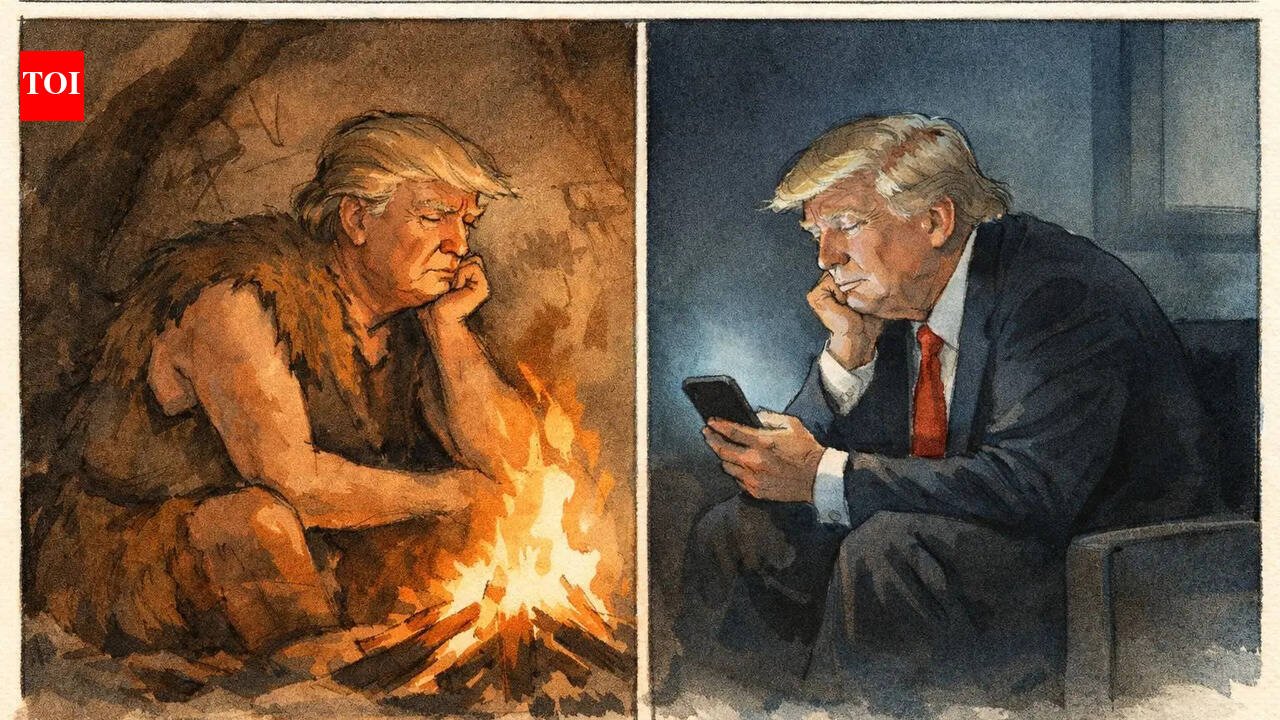
We are all familiar with the adage of the boy who cried wolf, whose modern storytelling equivalent is the president who posts threats on social media. On Easter Friday, Donald Trump threatened Iran with words that are not even publishable in most mainstream outlets, promising that Tuesday would be “Power Plant Day and Bridge Day”, asking Iran to open the “f**** Strait, you crazy b********”, and signing off with a “praise be to Allah”.On April 7, the D-Day of his threats, Trump followed it up with another warning: “A whole civilization will die tonight, never to be brought back again.”Perhaps we should be glad he didn’t write, “This is Sparta”, the catchphrase from 300—which showed a society built on CGI abs and corporal punishment—in which King Leonidas battles the Persian “god-king” Xerxes, who seems to be leading an army of mutants. Based on Frank Miller’s graphic novel and made by Zack Snyder, it’s one of the finest anti-Iranian propaganda films Hollywood has produced, one that can hold its own with more cinematically feted movies like Argo.Since the war started, Trump has threatened to bomb Iran into the “stone age” numerous times, and unfortunately for us, and unlike the boy who cried wolf, Trump has at his disposal the greatest war machine ever assembled by the human race and with acolytes who are willing to carry out his wishes irrespective of the consequences.Trump isn’t even the first US president to make that particular threat. George W Bush famously threatened to bomb Pakistan “back to the stone age” after the 9/11 attacks if it didn’t cooperate with America’s war in Afghanistan. Pakistan’s erstwhile president, General Pervez Musharraf, revealed that Richard Armitage, Bush’s assistant secretary of state, had made that particular threat.But what would life be like if we did end up back in the stone age? It surely wouldn’t be as Francis Fukuyama predicted in The End of History: a world of liberal largesse backed by democracy and capitalist excess. Even Fukuyama came to cast scorn upon that particular vision, but let’s try a different one: what would life be like as a troglodyte in the Stone Ages?For starters, it would be nothing like The Flintstones. In fact, the best way to imagine this is to think of yourself as the protagonist of The Man from Earth. For those who haven’t seen the film, the plot revolves around a university professor who is 14,000 years old, who has lived through Sumerian and Babylonian times, and eventually becomes a disciple of the Buddha. To stop people from figuring out that he doesn’t age, he moves locations every ten years.
Temporally speaking, the Stone Age isn’t one linear MCU phase but captures much of human history, starting from 3.3 million years ago to 3000 BCE. It can be divided broadly into three phases: Palaeolithic (Old Stone Age), Mesolithic (Middle Stone Age) and Neolithic (New Stone Age). Now it would be too much to expect the POTUS to tell us which era he is referring to, so for the reader, let’s break down the various eras and their top features.
1) Palaeolithic Era
c. 3.3 million years ago – c. 10,000 BCE
The first was till 10,000 BCE, when humans were still hunter-gatherers and did something that Anu Malik had been threatening for eternity: light a fire. All our evolutionary marvels wouldn’t have been feasible without that first spark, a tale so remarkable that our myths actually had to make it seem like a Titan had to defy the gods to get it for us. Fire helped us cook, and cooking helped us develop the human brain, an organ so fantastic that it named itself.For those a little confused, the brain is a remarkably calorie-heavy organ, and it was only cooking that allowed our digestive systems to process enough food to power it. After that, it was all uphill (or philosophers might say downhill).The things we take for granted—electricity, sliced bread, medicine, comfort—were still millennia away. Comfort meant a cave that sheltered us from predators and extroverts. For those who were slightly better off, that meant makeshift huts made of wood, bone and animal hides. There was no hailing an Uber; wheels were still millennia away. On the bright side, cardio and hitting your 10,000-step targets were pretty easy, since the only way to move was to walk. Sometimes it was seasonal, and you had to follow animals, water sources and edible plants.Many years later, the basic needs were roti, kapda and makaan, but in that era it was just about roti. Everything revolved around food. Hunting large animals required coordination, risk and skill. Gathering fruits, nuts and tubers was slightly easier. Storage was out of the question, so on some days you ate, and on others you went hungry. On the bright side, following a Keto diet is easy peasy.Entertainment largely involved tales around the fire, some early musical hits involving bone flutes, and painting cave walls, which would provide livelihoods for PhDs millennia later. Relationships were messy, and polyamory probably was a given. Pair bonding might have existed, but not in the rigid, institutional sense we understand today.
2) Mesolithic Era (Middle Stone Age)
c. 10,000 BCE – c. 8,000–6,000 BCE
Next came the Mesolithic Age, history’s awkward in-between phase, when the great Ice Age finally packed its bags and left, and humans found themselves in a world that was warmer, greener and slightly less committed to killing them every morning. The hunt was still on, but there were some rules. The biggest difference was not that humans stopped being hunter-gatherers but that they developed managerial traits like gustatory portfolio diversification, as fish, birds, small game, nuts, berries and wild grains entered the menu.Tools got smaller and sharper; blades were fitted into arrows, and humans became sharper. The wolf was retrofitted into its modern role, becoming a win-win for both. Humans got help with hunting and protection, while wolves discovered free food and emotional manipulation. Humans became better at putting down their markers. Entertainment became a little more decadent, relationships a little more stable, and humans became a little more community-oriented and less bloodthirsty.
3) Neolithic Era (New Stone Age)
c. 10,000 BCE – c. 3000 BCE
Then came the Neolithic Age, and this is where humanity stopped being a wandering consumer of nature and decided, with breathtaking audacity, to become its project manager. If the Palaeolithic was about survival and the Mesolithic was about adaptation, the Neolithic was about becoming earth’s Rehman Dakait: its apex predator.We finally decided to stop chasing dinner and started growing dinner near the house. The biggest update to the operating system was agriculture, the original subscription model. Crops and livestock meant food could be produced, stored, and planned for.Houses became permanent, with the old rhythm of seasonal movement giving way to boundary disputes. In other words, civilisation had begun.With agriculture came surplus, and with surplus came all the things that still define modern life: planning, storage, labour division and inequality. Once food could be stored, not everyone had to spend all day hunting or gathering. Some people could make tools, pottery, clothing, or sing songs. Social hierarchy began to creep in, and with it the greatest human invention: showing off.Amenities improved, relatively speaking. Homes became sturdier. Pottery allowed storage. Tools became more polished and efficient. But let us not get carried away. This was still not luxury living. There was no plumbing, no medicine, no electricity, and definitely no food delivery apps.Entertainment and culture also grew more rooted. Rituals became more elaborate, religious thinking more structured, and community life more organised. Relationships were likely less fluid than before because land, inheritance and settlement have a way of making human bonds more bureaucratic. As a bright young German living in England warned centuries later, once property enters the picture, romance is no longer romance.It was the first look of the modern world we know today.
And now…
The Bronze Age came next (3300 BCE to 1200 BCE). Humans learned to mix copper and tin, and we had started dressing for the office. Cities grew, writing appeared, trade networks expanded, and soon it was the Iron Age. After that, history stops being neatly packaged by metals and starts becoming a parade of civilisations, religions, empires and collapses.Then came the so-called modern age, ostensibly powered by science, reason, coal, steam, electricity, oil, industry, antibiotics, computers, satellites, and the internet. In material terms, it was a huge leap. We conquered distance, lit up the night, refrigerated food, cured infections, built aircraft, split the atom, flew to the moon, and placed the sum of human distraction inside a rectangular screen. Which brings us to our current predicament: the distraction inside a rectangular screen wrought by a megalomaniac with unlimited power who is threatening to bring back the Stone Age. Time will tell if this is a case of mendacious obfuscation or if the world will return to simpler times.
And yet, for all that progress, one wonders what exactly improved. We moved from the Stone Age to bronze, from bronze to iron, from iron to silicon, but human impulse seems to have survived every upgrade untouched. The cave gave way to the city, the spear to the missile, the tribal chief to the president with a social media account, and still the instinct remains—to threaten, to dominate, to destroy.Which brings us back, unexpectedly, to The Man from Earth. A man who has lived through every age, watched civilisations rise and collapse, gods invented and discarded, only to find that the human story keeps repeating itself with better tools and the same instincts.The Palaeolithic human sat around a fire imagining monsters in the dark. The modern human sits before a glowing screen and threatens to create them. Perhaps the only difference between the two is not progress but scale.And so when a modern president threatens to send a nation “back to the Stone Age”, one wonders whether he is imagining a regression… or simply revealing how thin the veneer of civilisation really is.Civilisation, it turns out, is easy to build in metal, concrete and code. It is much harder to build in the human mind.
