


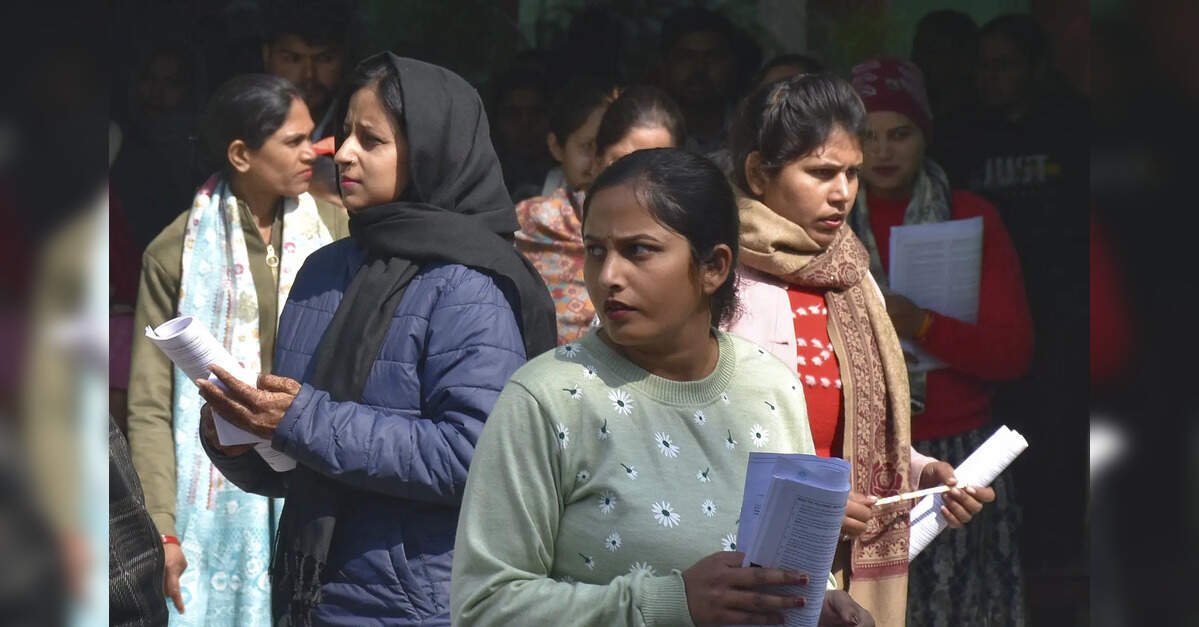
Every year, millions of young Indians holding B.Ed degrees line up to take a single standardised test that asks them to score 60 per cent. Year after year, three in four fail.
The CTET 2026 results, declared by the Central Board of Secondary Education (CBSE) on March 30, confirm the pattern has not broken. Of the 23,24,625 candidates who appeared for the Central Teacher Eligibility Test (CTET) February 2026 exam – conducted on February 7 and 8 across 132 cities only 5,97,061 qualified. The overall CTET pass percentage in 2026: 25.68 per cent.
For every four people who want to teach India’s children, three are being told they are not ready.
What were the CTET february 2026 results paper-wise?
The CTET Paper 1 pass percentage for candidates seeking to teach Classes I to V stood at 33.69 per cent, with 3,58,937 qualifying out of 10,65,410 who appeared.
The CTET Paper 2 pass percentage for Classes VI to VIII teachers was significantly lower at 18.56 per cent, with 3,46,738 qualifying out of 18,67,428 who appeared.
The gap between Paper 1 and Paper 2 is not new. Upper primary teachers who teach children during the critical transition years where foundational gaps either consolidate or deepen have consistently posted lower pass rates than their primary-level counterparts.
Is the 25% pass rate a new low or a new high?
Counterintuitively, 25.68 per cent is among the better CTET pass rates of the last five yearsand that context matters enormously.
According to CBSE’s own official public notice, the CTET December 2024 pass percentage was just 16.31 per cent overall. Paper I saw 24.17 per cent qualify; Paper II only 12.31 per cent. In January 2024, the numbers were worse: an overall pass rate of approximately 10.5 per cent, with Paper II hitting a historic low of 7.56 per cent meaning fewer than 1 in 13 aspiring upper primary teachers cleared the exam.
The five-year picture:
| Session | Paper I Pass % | Paper II Pass % | Overall |
| July 2019 | 15.79% | – | 16% |
| Dec 2019 | 26.8% | 29.74% | 28% |
| Dec 2022 | 40.75% | 22.5% | 29% |
| Jan 2024 | 15.9% | 7.56% | 10.5% |
| Dec 2024 | 24.17% | 12.31% | 16.31% |
| Feb 2026 | 33.69% | 18.56% | 25.68% |
Sources: CBSE official public notice CBSE/CTET/Dec./2024; ctet.nic.in official result notice March 30, 2026
The highest Paper I pass rate on record is 40.75 per cent (December 2022). Paper II peaked at 29.74 per cent (December 2019). In no single year, in either paper, has a majority of aspiring teachers managed to score 60 per cent on a standardised test designed around the subjects they want to teach.
Why is the CTET pass percentage so low? the STET comparison
Here is where the data becomes structurally revealing. While CTET measures teacher eligibility at the national level, 28 states and Union Territories run their own State Teacher Eligibility Tests (STETs) for government school appointments – and their pass rates look nothing like CTET’s.
Bihar STET 2024 recorded a pass rate of 73.77 per cent for Paper I and 64.44 per cent for Paper II. Bihar STET 2025 posted an overall 57.96 per cent across 4,42,214 candidates.
The same B.Ed graduates. The same teaching aspirants. Pass rates that are two to three times CTET’s – in a state that consistently ranks among the lowest on National Achievement Survey scores for student learning outcomes.
The structural reason is straightforward. Bihar STET requires a qualifying score of just 50 per cent for general category candidates. CTET requires 60 per cent. That 10-percentage-point difference is a policy choice about the minimum standard India considers acceptable for a government school teacher.
Across India, there are over 30 TET variants – UPTET, REET, MAHA TET, HTET, KARTET, TNTET, and many more – each with different syllabi, difficulty levels, and passing thresholds. A candidate who fails CTET can clear their state TET and be appointed to a government classroom. There is no single national floor for teacher quality. There are 30 different floors, and states facing the greatest learning deficits often maintain the lowest ones.
The B.Ed quality problem: broken before the exam
The CTET low pass rate is not simply an exam problem. It points to a crisis that predates the test itself: the quality of India’s teacher training institutions.
India has thousands of B.Ed colleges – many privately run, concentrated in states like Uttar Pradesh, Bihar, Rajasthan and Madhya Pradesh, which account for the bulk of CTET registrations. The National Council for Teacher Education (NCTE), which regulates B.Ed colleges, has repeatedly flagged substandard institutions, cancelled the recognition of hundreds, and warned of “mushrooming” colleges with inadequate infrastructure, unqualified faculty, and curricula built for rote memorisation rather than pedagogical competence.
CTET is not an advanced examination. It tests elementary mathematics, environmental science, language proficiency, and child development and pedagogy – subjects aspiring teachers should command comfortably after a two-year B.Ed programme. When 75 per cent of B.Ed graduates cannot score 60 per cent on these subjects, the inference is difficult to avoid: the training did not prepare them to teach.
NEP 2020 acknowledged the problem explicitly, mandating a four-year integrated B.Ed programme and promising to overhaul NCTE’s regulatory architecture. Five years on, most teacher training still runs through the old two-year B.Ed system. The NCTE Act restructuring remains pending.
Ravi Kumar, CTET aspirant from Uttar Pradesh said: “I’ve given CTET three times now, and honestly, the Child Development part is where most of us struggle. In B.Ed, we mostly studied theory and wrote exams, but CTET asks you to apply concepts. It feels like what we were taught and what is being tested are not the same.”
Supreme Court TET ruling 2025: what it says and what it means
For years, the TET requirement coexisted with a systemic workaround. States allowed teachers appointed before 2011 when NCTE made TET mandatory under the Right to Education Act – to continue in classrooms without ever clearing the test. Hundreds of thousands of in-service teachers had never sat a TET.
On September 1, 2025, the Supreme Court’s Division Bench of Justices Dipankar Datta and Manmohan ended that arrangement. In its landmark TET mandatory ruling, the Court held that all in-service teachers for Classes I to VIII with more than five years of service remaining must clear the TET by August 31, 2027, or face compulsory retirement. Those with less than five years to retirement are exempt but cannot be promoted without qualifying.
The Court grounded its ruling in Article 21A of the Constitution – the fundamental right to free and compulsory education – stating that the right to quality education cannot be separated from the right to a qualified teacher.
The TET mandatory Supreme Court order was not an administrative directive. It was a constitutional statement: unqualified teachers in government classrooms are a violation of children’s fundamental rights.
Which states are challenging the Supreme Court TET order?
The review petitions that followed reveal the scale of non-compliance that had been quietly tolerated for over a decade. Tamil Nadu filed a review petition warning of “empty classrooms” if lakhs of unqualified teachers were disqualified. Punjab disclosed that the order affects nearly 40,000 of its one lakh government school teachers- a figure that implies 40 per cent of Punjab’s government school teaching workforce never cleared a basic eligibility test. Education Minister Harjot Bains said the state would seek Supreme Court review and legislators floated potential legislative remedies.
Uttar Pradesh Chief Minister Yogi Adityanath directed the Basic Education Department to challenge the ruling. West Bengal warned that given its existing vacancies – 13,421 in primary schools and over 35,000 in secondary schools- the mandate would devastate its already stretched teaching workforce. Meghalaya, Tripura, and teacher associations across multiple states joined the challenge.
The School Teachers Federation of India (STFI), filing its own review petition, argued experienced teachers should not be re-evaluated through a paper test. It is a position that carries human weight – decades of classroom service deserves dignity. But it also raises an uncomfortable corollary: if a teacher who has spent years teaching Class V mathematics cannot score 60 per cent on a test of Class V mathematics, what does that imply about those years in the classroom?
S. Lakshmi, government school teacher from Tamil Nadu, who was appointed before 2011 shared her challenge: “I have been teaching for more than 15 years, so going back to writing an exam now is stressful. It’s not that we don’t want to qualify, but balancing school work and exam preparation at this stage is difficult. There is also worry about what happens if we are not able to clear it.”
CTET 2026 and student learning outcomes: the downstream connection
The CTET 2026 pass percentage measures one thing: whether aspiring teachers can score 60 per cent on a standardised paper. It does not measure what is currently happening in India’s classrooms.
For that, the Annual Status of Education Report (ASER) has, for two decades, tracked learning outcomes in rural government schools. Its findings are consistent year on year: a significant share of Class V students cannot read a Class II text; a significant share of Class VIII students cannot solve basic division. The teacher quality crisis and the student learning outcomes crisis are not parallel problems they are the same crisis, measured at different ends of the same pipeline.
India produces roughly 1.5 million B.Ed graduates annually. If three in four cannot clear a basic eligibility threshold, and the STET system offers a lower-bar alternative for state government appointments, then the pipeline supplying teachers to 250 million school-going children has a systemic quality failure at its source – one that NEP 2020 acknowledged but has not yet structurally addressed.
“The issue is not just about pass percentages, but about inconsistent standards. When CTET and state TETs have very different benchmarks, it creates uneven expectations of teacher quality across the system. Over time, that directly reflects in unequal learning outcomes for students,” said a senior official from NIEPA, who did not wish to be named.
What happens next: the August 2027 deadline
The Supreme Court TET deadline of August 31, 2027 is now less than 17 months away. Review petitions are pending before the Court. States are caught between the constitutional mandate to provide quality education and the administrative reality that enforcing quality standards at scale could leave thousands of classrooms without a teacher.
The CTET 2026 result of 25.68 per cent offers a preview of the challenge. If in-service teachers – many of whom have not studied or sat a standardised exam in years – are required to clear the same test, the pass rates could be lower still.
But the alternative, a permanent exemption for a large cohort of unqualified teachers – would cement in place exactly the two-tier system the Supreme Court found constitutionally untenable: where children in government schools are legally entitled to a qualified teacher but practically guaranteed one who has never been tested.
Whether the review petitions succeed, whether the deadline is extended, or whether India’s teacher training machinery can produce meaningfully different outcomes by 2027 – these are the questions now before the courts, the states, and the Ministry of Education.
For 250 million children in India’s schools, they are not abstract policy questions.
The clock is ticking
Three in four fail the test to teach. States are fighting to protect those who never took it. And a Supreme Court deadline is 17 months away.
India has known the shape of this problem for fifteen years. The CTET pass percentage history- from 2011 to 2026, is a fifteen-year ledger of what happens when the pipeline is broken and the political will to fix it is rationed. The courts have now forced the question. The answer, for India’s children, cannot wait another decade.
