


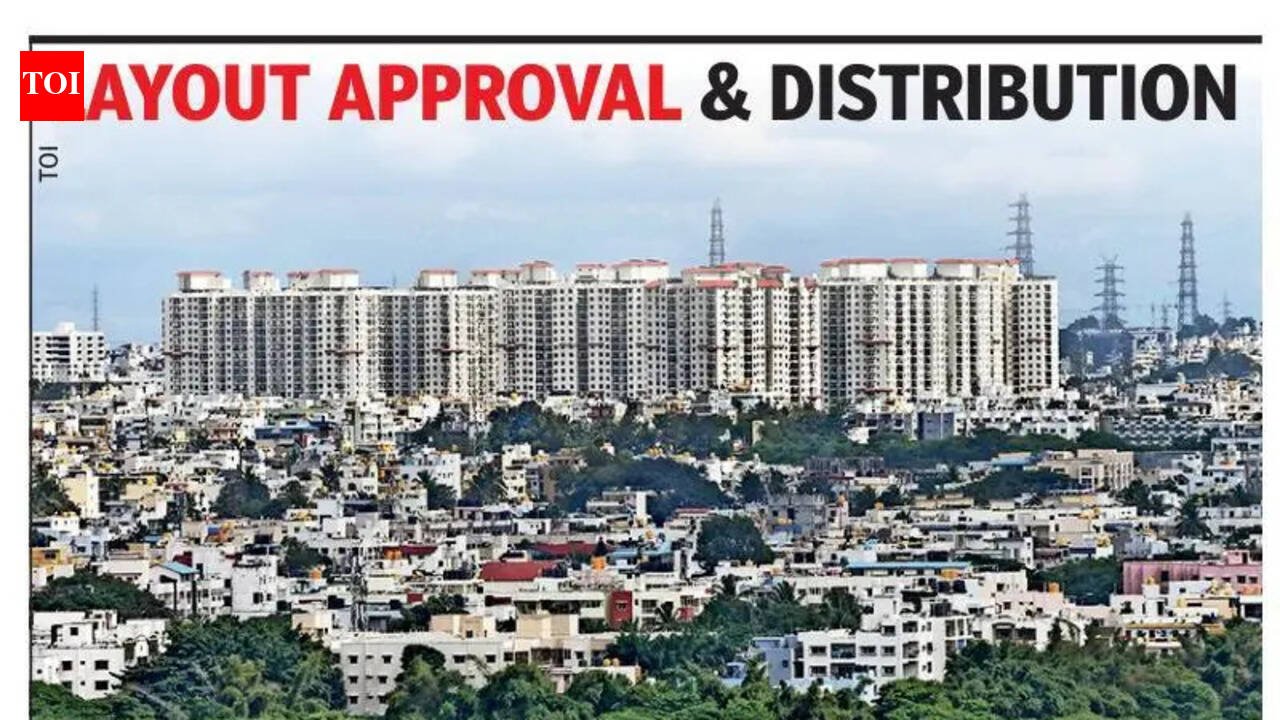
Bengaluru: The evolution of the city’s urban sprawl can be traced not only through skylines, but also through layouts on paper. Data from Bangalore Development Authority (BDA) shows how the city’s growth has steadily moved across regions over the past five decades, following land, jobs, and infrastructure changes.Between 1972 and 2025, BDA approved 1,017 layouts across the city. In the early decades, development was firmly rooted in south Bengaluru, which still accounts for 40-43% of all approved layouts.Neighbourhoods such as Uttarahalli, Begur, and Kengeri became the first major hubs of planned expansion, together accounting for hundreds of layouts. Large parcels of land, coupled with proximity to the city’s older core, made the southern belt a natural starting point for organised growth.But by the 1980s and 1990s, the city’s expansion had begun to shift. North Bengaluru, particularly Yeshwantpur and Yelahanka, saw a rise in layout approvals, driven largely by cooperative housing societies. This marked a phase where organised residential planning began to spread beyond the southern base.The next major shift came after 2000, when the city’s growth tilted eastwards. With the rise of the IT corridor, areas in east Bengaluru and Anekal taluk began witnessing increased layout activity. What had once been peripheral zones with limited presence in BDA records emerged as key sites of new development, reflecting the pull of employment hubs and improved connectivity.A senior BDA official said the pattern of approvals closely mirrors demand and infrastructure. “Applications are placed before the town planning committee. After the committee’s approval, a plan is issued. We go through all the documents to ensure that the plan approvals are in line with the rules and regulations,” the official said, adding that applications are now coming in from across the city.Despite these geographic shifts, one constant stands out: the dominance of residential growth. Nearly 90% of all approved layouts — about 900 — are residential, while industrial and commercial layouts together account for fewer than 20. Officials attribute this to the large land requirements of industrial projects, which limit their spread within city limits.Denser developmentsMore recently, pressure on land has begun to reflect in vertical expansion. In 2025-26 alone, BDA received 179 plan approval requests for single and multiple plots, indicating a gradual move towards denser development even as new layouts continue to emerge.The data also points to a dynamic planning process. At least one in 10 layouts has undergone revisions after initial approval, often to accommodate changes in design or infrastructure as demand rises.Taken together, the numbers sketch a clear trajectory: from south-led expansion to northward spread, and then an eastward push shaped by the IT economy. In doing so, BDA’s layout approvals offer a blueprint of how Bengaluru has grown — and continues to reshape itself.
