


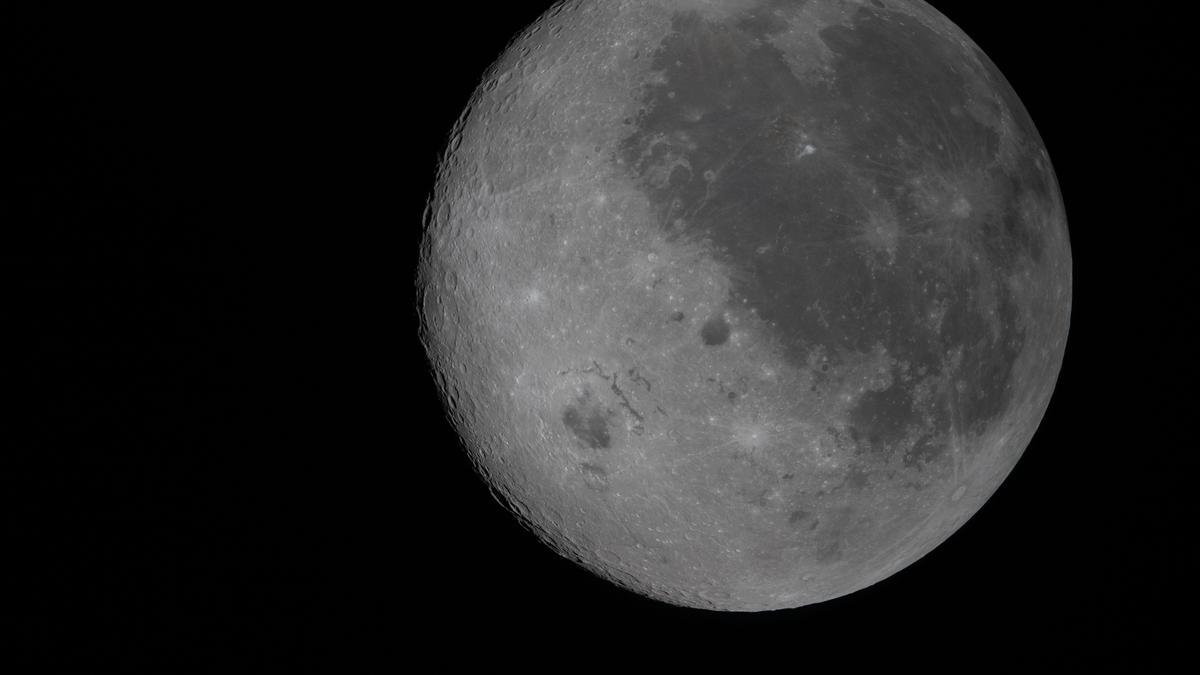
This image provided by NASA Monday, April 6, 2026, shows the Moon, the near side (the hemisphere we see from Earth) visible at the right side of the disk, identifiable by the dark splotches. At lower left is Orientale basin, a nearly 600-mile-wide crater that straddles the Moon’s near and far sides. Everything to the left of the crater is the far side
| Photo Credit: AP
Artemis astronauts at the outer edge of human space travel had an emotional moment Monday (April 6, 2026) as they named a crater in honour of the deceased wife of mission commander Reid Wiseman.
“It’s a bright spot on the Moon. And we would like to call it Carroll,” Canadian astronaut Jeremy Hansen told a live broadcast.
The crater can be seen “at certain times of the Moon’s transit around Earth,” he said.
As Mr. Wiseman and others wiped away tears, the four astronauts pulled together in a silent, floating embrace.
The Artemis II crew baptised another crater “Integrity,” the name they have given their spacecraft.
The four astronauts became on Monday (April 6, 2026) the humans to travel furthest from Earth, as they prepared to view areas of the Moon never before seen by the naked eye as part of NASA’s historic lunar flyby.
“We most importantly choose this moment to challenge this generation and the next, to make sure this record is not long-lived,” Mr. Hansen said.
Carroll Taylor Wiseman died of cancer in 2020, and Reid Wiseman, a former fighter pilot, has been raising their two daughters on his own since then.
Published – April 07, 2026 01:40 am IST
