


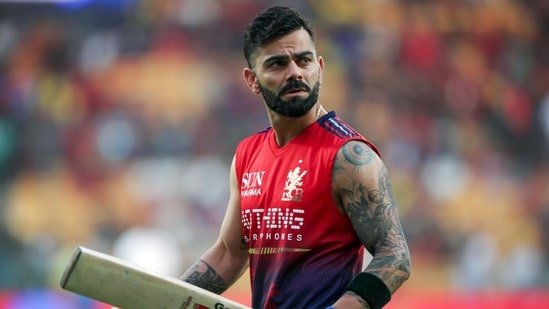
It’s been almost a year since Virat Kohli retired from Test cricket, but the decision continues to remain a mystery. Some feel Kohli saw it coming and opted out before fingers could be pointed at him. Another line of thought believed Kohli felt his time was up after he was ruthlessly exposed in the Border-Gavaskar Trophy. Once the BCCI selectors pushed Rohit Sharma out of the Test scheme of things, it was Kohli’s turn next. For the longest time – five years – Kohli was drifting away from the format that made him the apple of everyone’s eyes. With his average dropping and centuries shrinking, if Kohli had to play the 2027 World Cup, he knew he couldn’t do it while playing two formats at 37. Kohli had a choice to make, and he did.
Look at his numbers in ODIs. In nine matches, he’s amassed 616 runs, including three centuries and three fifties. However, as it turns out, the Royal Challengers Bengaluru is the one benefiting the most. Just the way Kohli is batting: with full freedom, and without an ounce of worry in the world. He’s playing no-look shots and bringing his power game to the fore, a trait that had eluded him for the longest time. In many ways, Kohli’s decision to retire from the format he loved most is helping him flourish in ODIs and the Indian Premier League. A winner of two Orange Caps, Kohli is fiercely determined to win a third, and with the kind of form he is in, nothing – barring an injury – can stop him.
Also Read: Virat Kohli breaks record against CSK; Goes past Rohit Sharma in elite list
To gauge Kohli’s batting renaissance, former India spinner and teammate Ravichandran Ashwin explained the technical nuances of Kohli’s batting, which, as per him, have evolved thoroughly since he gave up Test cricket in May last year.
“Virat was still playing Test cricket in 2024. He was very still; the bat wouldn’t move much. But now, here in 2026, the bat is down initially and later he brings it up, which we call potential energy, or the constant movement of the bat, and he is getting into lovely positions. In 2024, his head was so still that even the movement of his feet was balanced, because he was still playing Test cricket then. In 2026, since he doesn’t play Test cricket anymore, he doesn’t have to control his hands as much and is letting them go, going for more shots,” Ashwin said on the ‘Champions vali Commentary’ on JioStar.
Kohli batting at his finest
Mind-bogglingly, this IPL, Kohli is striking at 173.21 – his best in a single season – compared to his overall league strike rate of 133.20. Of course, it’s still early days, and a sample size of two matches doesn’t quite paint the full picture. But the signs are ominous. In ODIs too, his strike rate has jumped to 106.4, up from a career mark of 93.82.
“Because of that backlift, he is getting that momentum, more power, and that is why the strike rate has gone up. When you are standing still in the prelude, before the bowler bowls, you don’t get the momentum that you want to create to go for big shots. But when you bring the bat down, then up again, you already have that momentum,” former India all-rounder Irfan Pathan said on the same platform.
The result is evident. Kohli’s decision to retire from Test cricket may not have been the most popular. He was still 36 and possibly had more to offer. But now that he has stepped away and is firing on all cylinders, is it even a bad call? Kohli was well past his prime in Tests, and contrary to the idea of ring rust, he appears to benefit a world of good from breaks. If a fully fit Kohli can light up the IPL and help India lift the ODI World Cup next year, giving up whites may well be worth it.
