


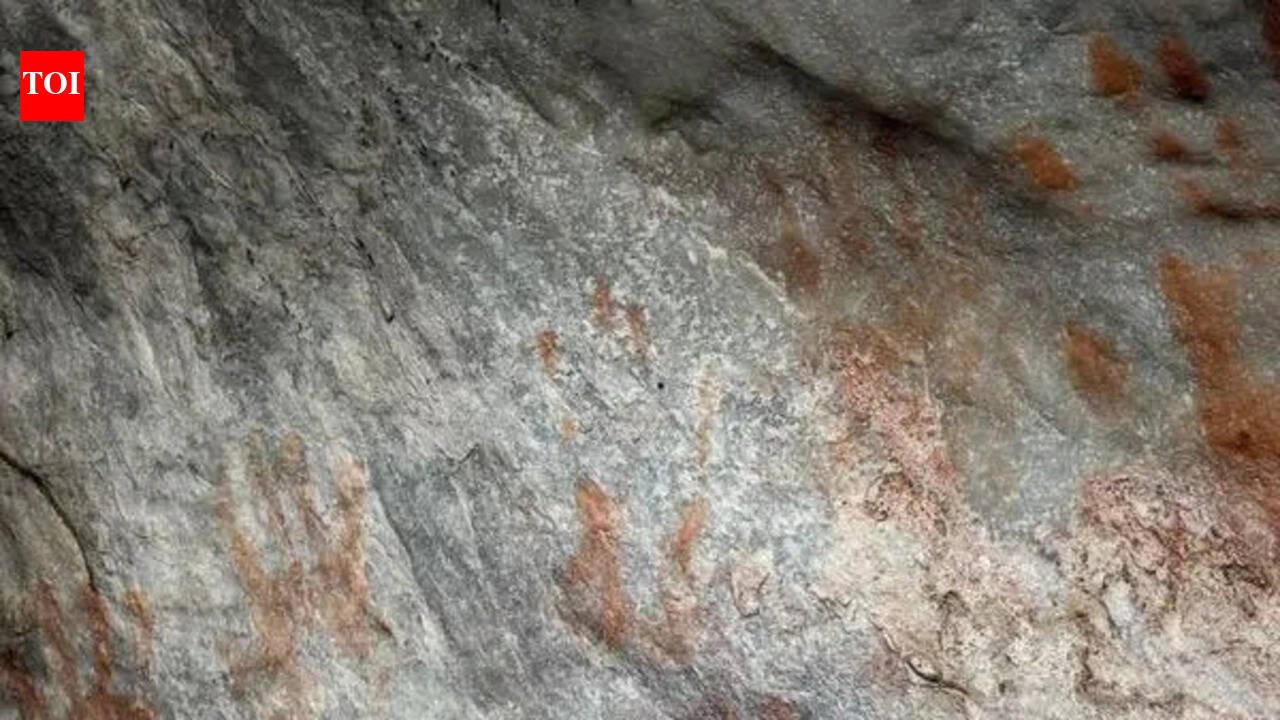
Jaipur: Prehistoric rock paintings believed to date back 5,000 to 10,000 years have been discovered in a cave near Jamwa-Ramgarh, in what officials say could be the first documented find of its kind in Jaipur district.The paintings were spotted in Jan this year by Bharat Singh, an independent archivist, while exploring the Ramgarh Fort area. The cave, about 100 feet above ground and surrounded by dense vegetation, had remained largely unnoticed. Singh reported sighting three human figures and eight bull motifs inside.Superintendent of Rajasthan’s department of archaeology and museums, Neeraj Tripathi, said the site is neither listed in state archives nor protected by the Archaeological Survey of India (ASI). “The artwork, done in red ochre, likely belongs to the Mesolithic period (Middle Stone Age), roughly between 5,000 and 10,000 years ago, although similar rock art traditions in Baran, Bundi and Kota in Rajasthan and other parts of India have been dated even earlier,” he said.Initial assessments indicate late Stone Age cultural activity at the site, he added. “The style and subject of the paintings match Mesolithic rock art traditions seen across Rajasthan and central India. Similar rock paintings have been found in Rajasthan’s Chambal and Mahi river basins and across the Aravalli hills, with some of the most well-known examples coming from the Bhimbetka Rock Shelters in Madhya Pradesh,” he said.One of the paintings appears to show a human figure — possibly a hunter — holding a bow or curved weapon and facing a large animal, likely a humped bull or wild bison. Archaeologists have interpreted it as a hunting scene, a common motif in prehistoric art.Tripathi said the paintings were made using natural mineral-based pigments. “Red ochre (iron oxide or geru) dominates, while traces of white pigment, possibly from lime or clay, could have been used for detailing. These colours were typically mixed with natural binders such as water, plant sap or animal fat and applied using fingers or primitive tools,” he said.He added that scientific studies have been planned to establish the age and context of the artwork. “We will use pigment analysis, radiocarbon dating and detailed 3D documentation to establish the age and context of these paintings. That will help us understand not just when they were made, but also how people of that time lived,” he said.Tripathi anticipates that further exploration could uncover stone tools or other artefacts at the site, which would indicate that the cave was part of a larger prehistoric settlement.
