


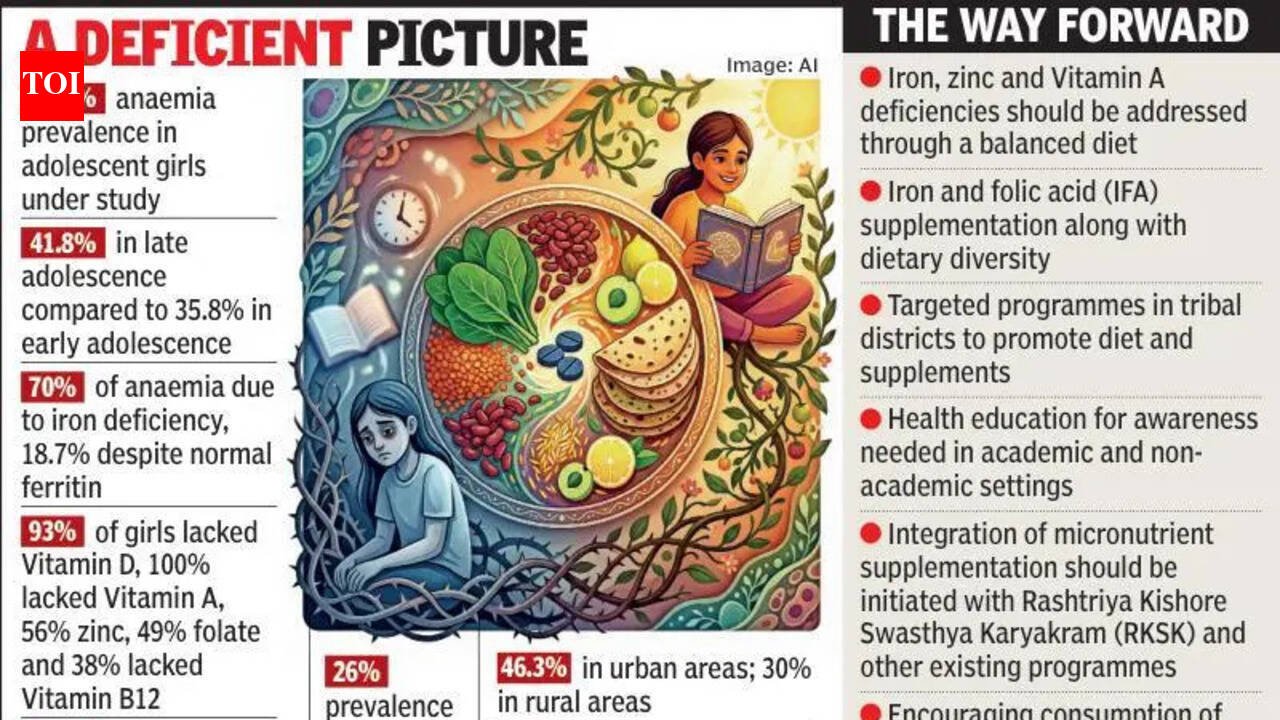
Ahmedabad: A study on the health of adolescent girls in Gujarat paints a pale picture. Out of the 750 girls aged between 10 and 19 years from five districts surveyed, 39.6% were found to be anaemic. Anaemia is understood as a common blood disorder where the blood lacks enough healthy red blood cells or haemoglobin, reducing oxygen transport to tissues. The study indicates that poor dietary habits and food that lacked micronutrients are the primary causes behind the condition.‘Anaemia Prevalence and Its Determinants Among Adolescent Girls in Gujarat, India: A Cross-Sectional Study’ was published recently in the Indian Journal of Community Medicine. The authors include Shalu Chaudhary, Varsha Gadhavi, Somen Saha, A M Kadri and Deepak Saxena, among others from the Indian Institute of Public Health (IIPH) Gandhinagar, and State Health System Resource Centre of the state health and family welfare department.The authors took into account two rural districts (Kutch and Junagadh), two tribal districts (Valsad and Banaskantha), and one urban centre, Ahmedabad, for their analysis. The researchers understood parameters such as food diversity, WASH (water, sanitation and hygiene) and blood sample analysis to understand the underlying issues.Their results showed that anaemia in about 70% of the cases was due to iron deficiency, whereas 18.7% of the girls were found to have anaemia despite having normal ferritin levels. Micronutrient deficiency — lack of vitamins D, A and B12 — was found to be a major issue. About 56% of the girls surveyed had lower than prescribed zinc levels and 49% low folate levels.The study also indicated that anaemia prevalence was slightly higher among tribal populations at 50% compared to 46.3% in urban and 30% in rural areas. About 62% of the girls did not meet prescribed dietary diversity, the findings show.Prof Somen Saha, one of the authors and a nutrition expert, said that historically, intervention for anaemia prevention has focused on iron deficiency. “Yet, evidence is now conclusive towards addressing key micronutrient deficiency. This needs to be part of our broader strategy to bring about a lasting change in anaemia prevention,” he said.Dr Chetan Trivedi, a paediatrician in Ahmedabad, said that anaemia from childhood can cause complications in adulthood for women that can affect both their overall health and pregnancy. “Awareness about iron deficiency should be more primary to ensure it from natural sources through food,” he added.
