


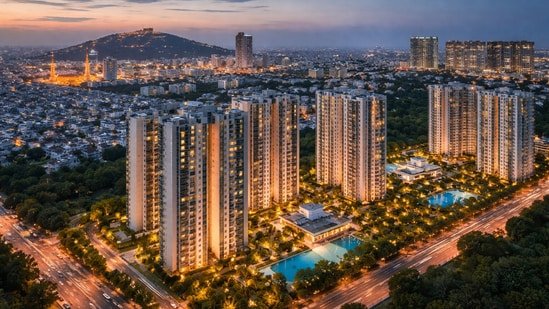
Hyderabad’s housing market has surged sharply over the past six years, with average home prices rising 81% between 2019 and 2025 to ₹8,326 per sq ft, according to NoBroker. This makes it the second-fastest growing market after Gurugram, which topped the list with an 85% increase. As new launches become increasingly expensive, the report notes that buyers are shifting toward the resale segment, which continues to offer relatively affordable options and a broader price range.

However, even as prices surged, home sizes have shrunk. In Hyderabad, the average apartment size declined by about 4%, from 1,068 sq ft to 1,025 sq ft, reflecting a ‘shrinkflation’ across major cities.
The sharp price rise has impacted affordability, with nearly 84% of homebuyers in Hyderabad feeling priced out of the sub- ₹1 crore segment, the report noted.
“This is largely due to a structural shift in supply. Developers are increasingly focusing on premium and luxury housing, driven by higher margins and rising land costs. As a result, supply in the affordable and mid-income segments has shrunk, even as demand in these categories continues to rise,” the report said.
“Demand remains strongest in the entry-level segment even as new supply is migrating up the price curve,” the report said, highlighting a widening mismatch between what buyers want and what is being built.
Demand shifts to resale, key micro-markets gain traction
With new launches becoming increasingly expensive, NoBroker said that buyers are turning to the resale market, which continues to offer relatively affordable options and a wider price mix. The resale segment has maintained a more balanced distribution across price categories, catering to first-time buyers and mid-income households.
Within the city, areas such as Kukatpally, Miyapur, Kondapur, Manikonda, and Kokapet have emerged as demand hotspots, driven by a mix of infrastructure upgrades, metro connectivity, and proximity to employment hubs.
Interestingly, Hyderabad also stands out for its unique buyer preference trends. Unlike other cities, standalone properties command higher per-square-foot prices than gated communities in some areas, indicating that buyers prioritise location and connectivity over amenities, NoBroker said.
Also Read: MBA or home purchase? A 24-year-old Hyderabad professional asks if the dream house can wait
The Western corridor leads the housing real estate segment
NoBroker said that the western corridor, anchored by the Financial District, accounted for about 25% of new supply, reinforcing its position as the city’s premium housing hub. Areas such as Tellapur, Kokapet, Neopolis, Narsingi and Rajendra Nagar are witnessing over 20% year-on-year growth, as development spills over from saturated IT micro-markets like Madhapur, Kondapur and Gachibowli. With limited land availability in core hubs, both developers and buyers are shifting toward these western extensions, where larger land parcels and luxury-led projects are driving the next phase of growth. The premiumisation trend here is comparable to the trajectory seen in Jubilee Hills and Banjara Hills a decade ago.
“South Hyderabad, led by the airport corridor, has emerged as the largest contributor, accounting for 33% of total launches. Positioned as an extension of the Financial District, this zone is attracting IT professionals seeking affordable, mid-range housing. Its growth is driven by improved connectivity via the Outer Ring Road and proximity to employment hubs, making it a preferred destination for both end-users and investors targeting medium-term appreciation,” the report said.
In contrast, East Hyderabad, covering Uppal and LB Nagar, continues to anchor the budget housing segment, contributing 13% of new supply. However, growth is expected to moderate to 3% in 2025 as the market absorbs the significant supply added over the past few years. Strong metro connectivity remains a key demand driver, enabling a predictable commute to IT hubs despite longer road distances, thereby sustaining interest from budget and mid-income buyers, NoBroker said.
