


Team selection in sport is often a balancing act between flair and solidity, individual brilliance and collective effort, and the entire focus is on forging a unit that will triumph. In cricket, with its essential skeleton resting on the twin arms of batting and bowling, the whole exercise of picking a playing eleven is to get the right juxtaposition of these two elements.
The dream is to have enough batting depth, adequate bowling options and also hope that these players will field well. Often, it is fire and ice, salt and pepper, glorious sunshine and sweaters to shield from the cold, rugged beards and clean jawlines, as cricketing outfits are a diverse blend. Maybe these days you can throw in some tattoos as well.
Heady mix
Even the West Indies of the 1980s had this sense of equity. If the battering rams were Gordon Greenidge, Vivian Richards and Clive Lloyd, solidity was lent by Desmond Haynes and Larry Gomes, and the bowling was made in heaven: Andy Roberts, Michael Holding, Joel Garner and Malcolm Marshall.
Interestingly, within these well-demarcated zones of batters and bowlers, there was a demand for this adhesive called all-rounders, so vital in cricket. In Jeff Dujon, the Caribbean men had a brilliant wicketkeeper, who could bat too, and in Gus Logie, they had an outstanding fielder and also a batter.
If they still needed spin, there was always Richards, chewing gum, with efficient off-spin emanating from his right hand. On some days, Roger Harper was picked; he would bowl spin and field well. In cricketing history, most teams that prospered, besides having fine batters and bowlers, always had these dual-skilled all-rounders.
When India won the 1983 World Cup, it was a side that was high on all-rounders starting with the mercurial skipper, Kapil Dev. Mohinder Amarnath could bat and bowl, Roger Binny could bowl and bat, and there were many others on this list. Even wicketkeeper Syed Kirmani had batting credentials.
Emergency option: Sarfaraz Khan was pressed into service when Chennai Super Kings was experiencing the batting horrors against Rajasthan Royals.
| Photo Credit:
PTI
At times, this yearning for an all-rounder also causes a needless twist, and forces a compromise. When India toured South Africa for the 2003 World Cup, Dinesh Mongia, batter and part-time spinner, was preferred over V.V.S. Laxman. Even if Sourav Ganguly’s men made the final before succumbing to Australia, in retrospect Mongia’s selection was a flawed move.
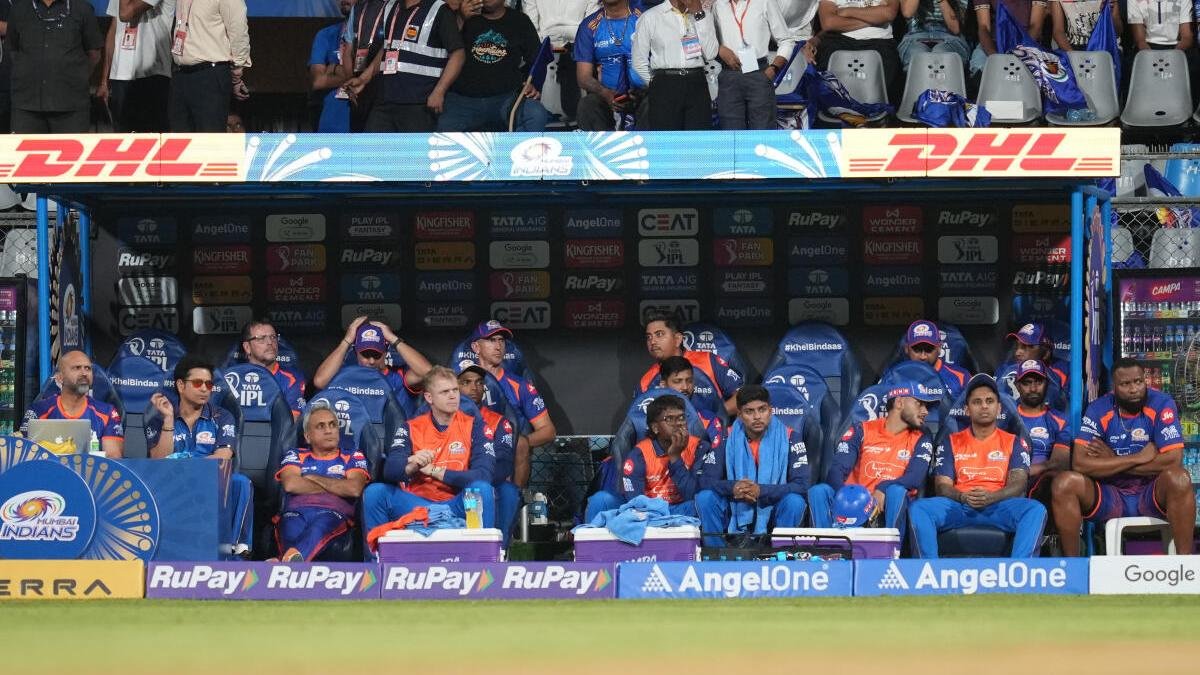
But this quest for an ideal playing composition continues with success, and the odd flop. It is in this backdrop that the Indian Premier League (IPL) has proved to be a disruptor, with its Impact Player rule that allows teams to make a substitution during natural breaks in an innings.
Often an extra batter, after he has wielded the willow, is replaced by a bowler, the reverse also happens, all this in a bid to keep the team’s balance intact. This is almost like those basement bargain sales, buy jeans and get an extra pair free. It is also a ruse to get more star-value infused into a league that offers an annual summer high equally to fans and marketing executives busy hyping multiple brands.
Introduced in 2023, the Impact Player rule came under scrutiny during a recent captains’ meeting ahead of the latest IPL edition. Reportedly, most leaders were not in favour of this ‘sporting’ legislation. Even if some of the latest games witnessed the Impact Player walking in, ranging from Suryakumar Yadav to Sarfaraz Khan, in the long term it subtly alters the narrative towards favouring specialists in either batting or bowling.
Convenient switch
A unit that feels that it is one batter or bowler short would always employ this switch. And it would mean that the much coveted all-rounder stands diminished. At times, a team that is going through the batting horrors would rather press an extra batter in, as it happened when Chennai Super Kings (CSK) used Sarfaraz against Rajasthan Royals at Guwahati.
One aspect of having an Impact Player is perhaps to stretch the games into last-over humdingers, but there is no guarantee that this will happen. It also helps a franchise to use a legend in his twilight to still turn up for a few overs. This may happen with M.S. Dhoni and CSK, as and when he recovers from his calf-strain.
The beauty of sport is its unpredictability. Captains, coaches and selectors often take a punt, factoring in the opposition, the ground conditions and the weather patterns. Putting out a playing eleven after weighing various options is an exercise largely vested in hope and mildly smudged with the fear, ‘what if things go wrong?’.
But having an Impact Player substitution becomes an insurance policy that could hinder regular players from improving their weaker skill. For instance, seamer Arshdeep Singh should feel the urge to improve as a batter and post handy lower-order runs. A top-order batter equally has to be invested in turning his arm over. But these motivations, both from the individual and team, will shrink once the Impact Player is set in stone.
In these frenzied times of Twenty20s, when a batter can shuffle across and scoop one over fine-leg or reverse-hit past third-man, no captain has the luxury of hiding inept fielders in these positions. Having an Impact Player option would mean a poor fielder can be substituted once his batting stint is over.
Instant impact: Prasidh Krishna came off the bench to help Gujarat Titans give Punjab Kings a scare.
| Photo Credit:
ANI
Playing the nationalism card that the Impact Player ‘has to be an Indian’ — unless the team starts with fewer than the maximum allowed quota of four foreigners — does widen the bouquet of opportunities for local players.
Yet, it undermines the highs and lows of sport. A captain getting his unit wrong, or a star player suddenly losing form are inexplicable quirks. A Roberto Baggio can miss a penalty in sport — it happened in the 1994 football World Cup final that swung Brazil’s way while the Italian great wilted in despair.
Age of multi-tasking
Even though the Impact Player rule will be assessed again in 2027, a rollback would mean that think-tanks would focus on nurturing all-rounders. Wriddhiman Saha, one of India’s finest wicketkeepers, lost his Test spot to Rishabh Pant, thanks to the latter’s additional skill as a maverick batter.
Surely, it is not a fair world but in this age of multi-tasking, the conveyor belt of all-rounders cannot be left emasculated. Especially from India where once Sachin Tendulkar, Ganguly, Virender Sehwag and Yuvraj Singh doubled up as effective part-time bowlers, be it as spinners or dibbly-dobblers, and Rahul Dravid kept wickets in ODIs.
Cameos in films may work like Suriya’s Rolex in the Kamal Haasan starrer Vikram, but its equivalent in sport, the Impact Player, seems a greedy thought to infuse more players into cricket’s shortest format. A concussion substitute is essential and has a medical basis, but an Impact Player in the IPL seems like a needless band-aid.
