


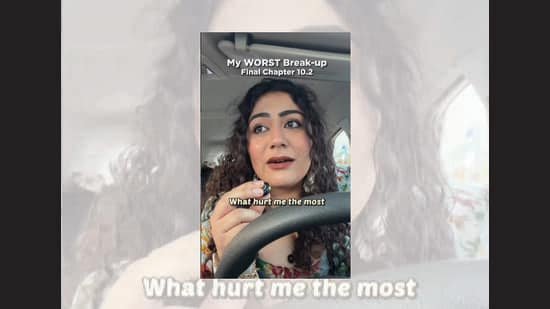
If ‘90s romcoms have taught us anything, it’s that people broke up differently in the pre-smartphone era. Jilted lovers nursed their solitude in dark rooms, with Chris Isaak playing in the background. There was ice-cream, maybe Chardonnay. They cried into the night and achieved closure by sunrise. But they were quiet and dignified about it. Talking about breaking up was cringe and brought on unsolicited advice. So, heartbreak, even when dramatic, was rarely documented.
Today, that dark room has a ring light. The sad song is a Bollywood ballad shrieking through a Reel. The broken-hearted cry on the shoulders of their audience. They post videos titled, “POV: It’s been a year and you still can’t move on.” The ugly crying is camera-ready. When engagements fall through, fan engagement steps in. When hearts break, sometimes, the internet does too.
Here’s what we’ve learnt from the genre.
Tears are a moveable asset. In 2009, Jonah Berger and Katherine Milkman at The University of Pennsylvania analysed around 7,000 New York Times articles over three months to understand what makes content go viral. They found that articles that trigger anger were shared 34% more. Pieces that brought on anxiety were shared 21% more. Essentially, emotionally charged content goes farther, faster on social media.
Bengaluru creator Prachi Agrawal (@SmileWithPrachi_SuperWowStyle) built a YouTube following with DIY nail art before moving into beauty, self-discovery and healing content on Instagram. She found that despite having over a million YouTube subscribers, her viewership was dwindling. Audiences were turning away from preachy repetition. Then, in August last year, she dropped news of her divorce. “I was obviously miserable,” she says. “Like they say, misery loves company.” Posts of her crying, with captions referencing the split, crossed 10 million views, pulling her back into relevance and sparking Reddit threads, where older audiences returned to discuss and support her.
When hearts break, content spills out. No one knew New York socialite Belle Burden outside of her gilded circle until recently. But when she went public with the abrupt collapse of her 20-year marriage (in a column, a book, a podcast, on Insta) she became an overnight sensation. Millions have responded to her story of being abandoned, with her three kids, at the start of the pandemic, while her husband left to be with another woman, without preamble or remorse (he even asked her to fix him a sandwich after they broke the news to their kids). Gwyneth Paltrow is playing her in the Netflix adaptation.
Delhi creator Jeet Rathore, 31 (@BabaKsrOfficial on YT), mined his 2016 college breakup in a 2021 video that has 1.5M views and has followed it up with a stream of similar posts. He would previously post relationship advice and Hindi shayari. Now his page has videos titled “Ex Ko Regret Kab Hota Hai” (When Does An Ex Feel Regret?) with an exact timeline, or “Jab Koi Block Kare Toh Ye Karna Mat Bhulna” (When Someone Blocks You, Don’t Forget To Do This). “The voice of my channel comes from someone who has already gone through these problems,” he says. “I turned my scars into a roadmap so others wouldn’t have to get lost.”
The comments are the point. “My DMs are filled with people sending their whole love story,” says relationship content creator Shanky Singh (30, @_The_Backstory) from Mumbai. This is because confessionals, even anonymous ones, are up for public viewing and interpretation. So, creators take the stories their followers contribute and turn them into multi-episode Reels.
Creator @Soberyashi turned someone’s three-year-long blind dating fiasco into a skit that got over 870K views. @TheFeelingShwarma got a barrage of DMs (and views) after she shared the very explicit story of a woman who dated a man with complicated feels for his mother. Viewers send in so much material, she now has a series titled 30 Days, 30 Ugly Breakup Stories.
Everyone loves a litany. Lists explain everything, even heartbreak. “Avoidants Suddenly Leave Relationships For These 3 Reasons “ or “9 Red Flags You’re Ignoring If They’re Hot”. The appeal is obvious because lists offer neat conclusions for messy experiences. They also perform well on platforms designed for quick, repeatable content. As Rathore puts it, “Nothing new is ever truly said in the world. Everyone just has a different way of saying it.”
Why go vengeful when you can go viral? Vaishnavi Thakur (@ThakurVaishnaviOfficial) has built a following of almost 50K recounting dating disasters on the themes of “No one dates a fat girl,” or “This is why I don’t date kiddos.” She usually informs the men involved before posting. “They get very excited,” she says. “They share it with their friends.”
Psychiatrist and addiction specialist Anna Lembke explains in her 2021 book Dopamine Nation, that digital platforms deliver high-reward stimuli that trigger dopamine release in the brain, encouraging repeated engagement. No wonder we can’t break up with breakup content.
The validation flows both ways. Viewers see their own unresolved chapters reflected back at them; creators see engagement, loyalty and growth. So, comments are either “You deserve better,” or “This was my story too.” As Singh says, “Yes, I started creating this content to help people, but the by-product is brand collabs, podcast collabs, there is money coming in.”
