


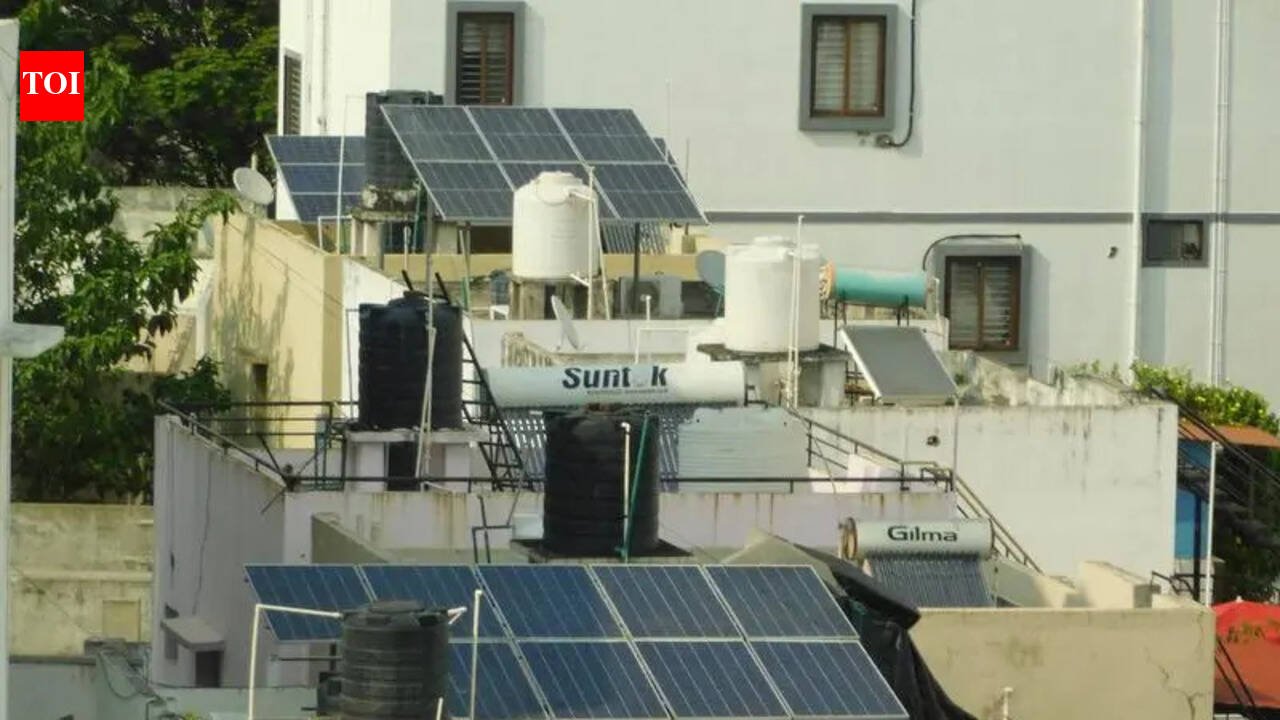
Hyderabad: The PM Surya Ghar: Muft Bijli Yojana, aimed at accelerating rooftop solar adoption, is yet to gain momentum in Telangana. Since its launch in Feb 2024, the state has recorded just 32,600 installations, far behind neighbouring Andhra Pradesh’s 1.1 lakh-plus and states such as Gujarat and Uttar Pradesh, where numbers have crossed four lakh each.Stakeholders attribute the gap to a combination of policy limitations and on-the-ground constraints. The biggest drag is coming from apartment complexes and gated communities. Rooftops here are shared assets, not individually owned, making solar installations both a regulatory and practical challenge.“As a result, solar adoption in apartments is largely limited to common utilities such as lifts, lighting and water pumps, while individual households struggle to come on board. Installation is difficult in apartment complexes mainly because terraces are common property,” said Dr Sai Ravi Shankar, president of the Federation of Gated Communities, Cyberabad. “If one household tries to use it exclusively, it creates resistance.” He added that for individual consumption, systems must be linked to each flat’s meter, requiring separate panels, an arrangement that is neither practical nor typically permitted by RWAs.Structural issuesTelangana’s policy framework remains a limiting factor. Current rules allow only individual homeowners to install solar systems and benefit from them, including net metering (where houses use solar power and send excess to the grid for bill credit) “Developers cannot roll out solar at a community level unless ownership is transferred to individual buyers, making large-scale implementation commercially unviable. The result is partial adoption, even in large housing projects,” said Srinivas Murthy, chairperson of the Indian Green Building Council, Hyderabad chapter, flagging both policy and structural issues.“While subsidies exist, a lack of awareness and limited govt push remain gaps,” he said. He also pointed out that Telangana’s surplus power reduces urgency. “The grid may not be able to absorb additional power from large private solar plants. A coordinated approach involving discoms, govt, RWAs and industry is needed,” he said. Infrastructure readiness is another concern. Without grid upgrades and clear direction, scaling rooftop solar, especially from private producers, could strain the system. In contrast, independent houses are seeing steady uptake. According to Freyr Energy’s data, the residential segment now drives 50% to 60% of new solar demand. Commercial establishments account for 25% to 30%, while industrial installations contribute 10% to 15%, though with larger system sizes. The push is coming from central subsidies and rising awareness of savings. Most installations fall in the 3 kW to 5 kW range, depending on consumption and rooftop space. A 3 kW system is common for smaller households, while 5 kW systems are increasingly preferred in higher-consumption homes.Financing has become a key enabler for individual houses. “Solar adoption is picking up because banks are financing the upfront cost after subsidy,” said BT Srinivas, general secretary of the United Federation of Resident Welfare Association. A typical 3 kW system costs around Rs 1.25 lakh, with about Rs 50,000 covered through subsidy. The remaining amount can be financed, reducing the upfront burden. “In many cases, the loan is offset by savings on electricity bills, making it a near-zero-investment option within five years,” he said. SavingsThe savings are significant. A 3 kW system generates about 15 units per day, cutting electricity bills to around Rs 1,800 to Rs 2,000 in summer with AC usage, and Rs 200 to Rs 500 in other seasons. “During monsoon and winter, generation may drop to about 5 units per day, but lower consumption balances the impact,” Murthy added. Even so, gaps remain. Limited awareness of long-term savings, hesitation around upfront costs despite financing options, and procedural delays in approvals continue to slow adoption.In apartment complexes, the next phase hinges on policy innovation. “Apart from common area usage, adoption can scale through shared models like group or virtual net metering. These models allow solar power generated on a shared rooftop to be distributed across multiple flats, bypassing ownership constraints,” said Radhika Choudary, co-founder and director of Freyr Energy. “Simplified approvals, stronger awareness among RWAs, and incentives for larger systems can make apartments viable for solar,” she added.The National Solar Energy Federation of India noted that Telangana has historically been slower in rooftop solar adoption, and the current trend is not new. “However, demand exists, especially in smaller towns and independent homes where rooftop space is not a constraint. This indicates that awareness and policy push remain the bigger gaps,” said Subrahmanyam Pulipaka, CEO of the federation. He further said that the distribution companies need to step up. “Discoms must play a more proactive role by engaging directly with consumers and building awareness,” he said. Citing Uttar Pradesh, which has recorded around 4.2 lakh installations, he noted that stronger DISCOM involvement has been key to higher adoption.Impact of free electricty schemeAccording to the Telangana Renewable Energy Development Corporation Ltd (TGREDCO), one of the key factors slowing rooftop solar adoption in the state is govt’s provision of 200 units of free electricity, which reduces the immediate incentive for households to switch to solar. “However, in recent times, we have initiated the Pradhan Mantri Kisan Urja Suraksha evam Utthaan Mahabhiyan (PM-KUSUM) scheme in Telangana and a subsidy that has yielded results,” said Anila V, managing director, TGREDCO“Under the PM-KUSUM, the govt aims to set up 4,000 MW of decentralised, ground-mounted, grid-connected solar power plants, ranging from 500 kW to 2 MW. These will be installed on barren, uncultivable, and agricultural land. So far, around 1,100 farmers have benefited from the scheme. We are also providing subsidies and creating awareness about solar energy to encourage greater adoption among residents,” Anila added.
