


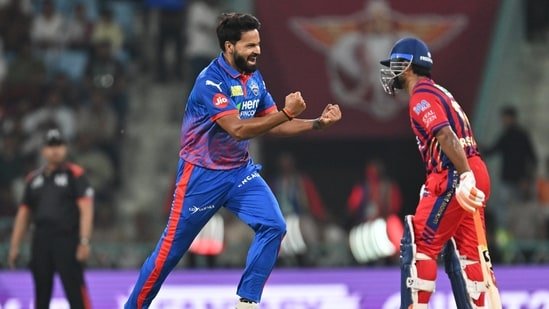
In a surprising move right at the start of the match, Rishabh Pant walked out to open the innings for Lucknow Super Giants alongside Mitchell Marsh. Amid all the pre-season chatter around whether the skipper should bat at No. 3, Pant rolled the dice with a bold tactical call, one that eventually backfired in a six-wicket defeat, leaving behind more questions than answers.
While Pant’s batting position was not the sole reason behind the loss, it inevitably became the focal point of post-match analysis, turning into a classic case of what might have been.
Why Rishabh Pant opened for Lucknow
As expected, the move was purely tactical. Speaking after the match, Pant explained that promoting himself was aimed at creating a left-right combination at the top, thereby disrupting Delhi’s bowling plans, particularly denying captain Axar Patel the new ball.
“Nicholas Pooran is taking charge in the middle overs. He’s not batting in the top order anymore because I’m batting up the order. And that’s why it happened because, you know, we wanted to explore that lefty-righty option at the top, so they couldn’t bowl a left-arm spinner. Unfortunately, I got out at the wrong time. Otherwise, Axar Patel still had to bowl one over in the power play, and that gives us the edge over them,” he said.
Why did the move backfire?
Pant began positively, stroking a regal on-drive early on while allowing Marsh to settle into his rhythm. But the gamble unravelled quickly due to a freak dismissal. Marsh drove a fuller delivery from Mukesh Kumar straight back, and although the bowler failed to complete a return catch, the deflection off his hand ricocheted onto the stumps at the non-striker’s end, catching Pant out of his ground.
Pant departed for just seven off nine balls.
What followed was a collapse. Aiden Markram, Ayush Badoni and Nicholas Pooran failed to capitalise, while Marsh fought a lone battle before eventually falling. Abdul Samad and Shahbaz Ahmed provided brief resistance, but disciplined bowling from Delhi saw Lucknow implode at the death, losing their last four wickets for just three runs.
Why Pant shouldn’t have opened
On paper, Pant’s record as an opener in T20 cricket is surprisingly strong. Across 23 innings at the top, he has scored 672 runs, including a century and five fifties, at a strike rate of 158.49—significantly higher than his overall career rate of 144, and also better than his returns at No. 4 and 5 (combined average strike rate of 141).
However, context matters.
Sixteen of those innings came early in his career, primarily in the Syed Mushtaq Ali Trophy and during his initial years with Delhi Daredevils. More recently, when India experimented with him as an opener in 2022 alongside Rohit Sharma, Pant managed just 71 runs in five innings at an average of 14.2.
In fact, his last standout performance as an opener dates back to a 69 against Gujarat Lions in IPL 2016.
Last season, during a phase when Pant struggled for form and experimented with multiple roles, including batting outside the top six, he briefly opened against the Gujarat Titans, scoring 21 off 18 in Marsh’s absence. That was Lucknow’s sixth game of the season, with the captain managing just 40 runs at an average of eight. In the very next match, Pant made the shocking call to bat outside the top six, a move that sparked widespread disbelief.
The larger tactical dilemma
The frequent changes in his batting position, however, may be linked to a shift in his effectiveness against different bowling types. Over the last four seasons, Pant has scored at over nine runs per over against pace, but that rate drops to around seven against spin. In fact, it dipped below seven during the 2025 season, a notable decline for a batter long regarded as a middle-overs enforcer and an exceptional player of spin.
While batting outside the top six never appeared a viable long-term solution, a move to the top order seemed more logical, offering him greater exposure to pace early in the innings. However, that option wasn’t feasible last season, with Lucknow boasting an in-form top three of Marsh, Markram and Pooran.
With no T20 cricket since the previous IPL season, Pant may have been wary of repeating those struggles, prompting the decision to open this time. By pushing himself up the order and handing middle-order responsibilities to Pooran, he attempted to reset his role. However, the move came at the cost of displacing Markram, who has recently showcased his credentials as an opener, including during last month’s T20 World Cup.
While Pant has not confirmed whether he will persist with the role, a more balanced approach could see him slot in at No. 3—anchoring the innings while allowing flexibility in a line-up that still features several uncapped players.
