


Rising geopolitical instability in West Asia is forcing a reassessment of how India’s macroeconomic strength is measured.
As of March 2026, this instability has translated into active macroeconomic stress. The rupee has depreciated to a record low of ₹95 per dollar, the Indian basket of crude oil hit $156.29 per barrel, and the Reserve Bank of India has deployed billions of dollars of foreign exchange reserves to contain volatility. In such conditions, strong quarterly GDP prints capture domestic activity but often overlook vulnerabilities linked to energy imports, shipping routes and fiscal buffers.
Against this backdrop, India enters the post-Budget season with a striking macroeconomic contradiction. Headline indicators remain robust: the State Bank of India expects Q3 FY26 GDP growth of about 8.1 percent, public capital expenditure is near 4 percent of GDP, and fiscal consolidation toward a 4.3 percent deficit by FY27 remains intact. At the same time, external buffers are weakening. Foreign exchange reserves have declined from recent highs to about $709.76 billion, while foreign portfolio outflows of over $8 billion following the onset of the conflict have intensified currency pressures.
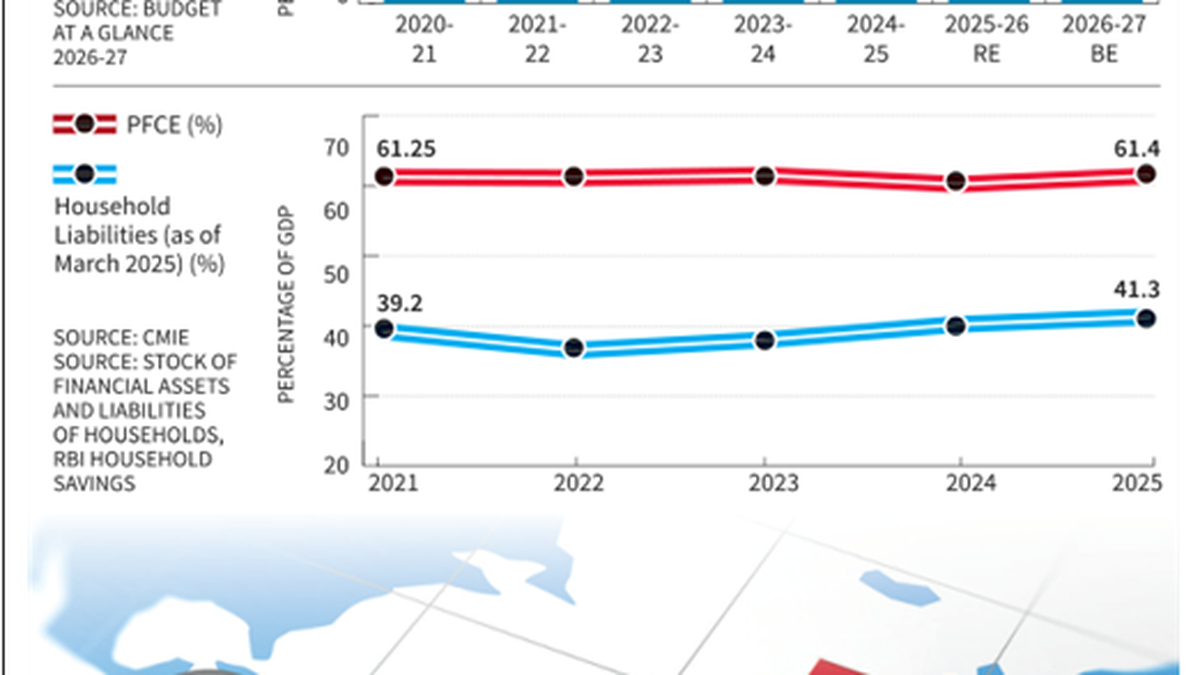
Yet income dynamics are weaker. Real wages remain subdued, household liabilities have risen to roughly 41 percent of GDP, and private investment continues to lag the state’s capex-led expansion.
This divergence reflects a deeper shift in India’s fiscal architecture: revenue buoyancy is increasingly driven by transaction-linked taxation while expenditure tilts toward capital formation. In a stable global environment this model can sustain growth, but when energy markets become volatile, its durability depends on whether fiscal revenues, consumption and investment can withstand external commodity shocks.
Shifts in revenue structure
India’s revenue structure has been shifting in ways that matter more in a volatile global environment. Revenue receipts have risen from 8.5 percent of GDP in FY16–20 to about 9.1 percent in FY22–FY25 (PA), but the increase reflects recomposition rather than a broadening of income taxation. The Union Budget 2026–27 estimates gross tax revenue at ₹44.04 lakh crore, yet much of the buoyancy now comes from transaction-linked channels. GST collections reached ₹22.8 lakh crore in FY25, while levies on financial and cross-border transactions have also expanded.
Direct taxes typically expand when more workers move into stable paid employment. As a result, revenue growth increasingly depends on the volume of economic transactions rather than income deepening.
External shocks particularly energy price spikes that raise transport costs and compress household spending can quickly slow transactions. In such conditions, a fiscal model reliant on activity-linked taxation becomes more sensitive to geopolitical disruptions that ripple through consumption, trade and financial markets.
This vulnerability has been evident during past shocks. During the pandemic, widening gaps between projected and actual GST revenues forced the Union government to borrow over ₹2.69 lakh crore between 2020 and 2022 to compensate states for revenue shortfalls.
The effects of oil price surge
India’s fiscal system remains structurally exposed to oil price volatility. The country imports around 85–87 percent of its crude oil, making it directly vulnerable to external energy shocks a direct macroeconomic transmission channel.
Empirical estimates suggest that a $10 per barrel rise in crude prices can increase Consumer Price Index inflation by roughly 0.2 percentage points, widen the current account deficit by about $9–10 billion (around 0.4 percent of GDP) and reduce GDP growth by nearly 0.5 percentage points under partial pass-through conditions. Oil shocks also propagate through the fiscal system: higher energy costs raise fertiliser and LPG subsidy requirements, increase transport and logistics costs, and elevate inflation-linked expenditure.
Recent policy responses illustrate this transmission. Following the Russian invasion of Ukraine, the Indian crude basket surged from roughly $59 per barrel in 2019 to over $120 in mid-2022.
To contain inflation, the government reduced central excise duties on petrol and diesel by a cumulative ₹13 and ₹16 per litre between November 2021 and May 2022, resulting in an estimated ₹2.2 lakh crore revenue loss. At the same time, energy-linked subsidies expanded, with fertiliser support rising sharply and total energy subsidies touching nearly ₹3.2 lakh crore.
Amid the ongoing conflict in West Asia, estimates by ICRA suggest that if oil prices average around $100 per barrel, India’s current account deficit could widen from about 0.7-0.8 percent to nearly 1 percent of GDP, while government expenditure could rise by as much as ₹3.6 trillion due to higher subsidy and compensation requirements. This underscores how energy shocks translate simultaneously into external imbalances and fiscal stress.
When oil prices spike, governments typically absorb part of the shock through tax reductions and subsidy expansion, compressing fiscal space. In a system increasingly reliant on transaction-linked taxes, such shocks can simultaneously weaken consumption, reduce GST buoyancy and expand expenditure pressures, creating a direct fiscal squeeze.
Impact on households
Household balance sheets reveal a key channel through which energy volatility transmits into the domestic economy.
Private consumption accounts for roughly 61.4 percent of India’s GDP, yet household liabilities have risen sharply from about 36–37 percent of GDP in 2022 to over 41 percent by 2025, increasing sensitivity to inflationary shocks and suggesting that consumption is being sustained less by income growth and more through credit expansion.
Net financial savings have also become more volatile, falling to around 3–4 percent of GDP in recent quarters before recovering to about 7.6 percent, indicating a weakening of financial buffers.
The exposure is being amplified by the current shock, as disruptions to LPG supply chains — over 60 percent of which depend on imports — have translated into longer refill cycles and local shortages, raising household energy costs even as leverage remains elevated.
At the same time, India’s expenditure strategy has pivoted toward infrastructure-led growth. The Union Budget 2026–27 places effective capital expenditure at ₹17.15 lakh crore.
While such front-loaded investment strengthens long-term productive capacity, it compresses fiscal space for welfare stabilisers. Allocations for the Mahatma Gandhi National Rural Employment Guarantee Act fell to ₹60,000 crore in 2023–24, 33 percent below the previous year’s revised estimate; by December 2022, States had already spent 117 percent of available funds, with ₹8,449 crore in pending liabilities.
In a low-wage environment, imported energy inflation compresses real incomes while debt servicing obligations remain fixed. Rising household leverage therefore becomes a macroeconomic vulnerability, especially when fiscal policy prioritises capital formation over income support and external shocks weaken consumption. Beyond households, geopolitical uncertainty is also shaping corporate investment and credit allocation.
Implications for industrial sector
India’s industrial upswing is increasingly concentrated in capital-intensive sectors aligned with public investment. Industrial output rose 7.8 percent in December 2025, with manufacturing expanding 8.1 percent year-on-year and 4.8 percent over April–December. High- and medium-technology industries now account for about 46 percent of manufacturing value added, according to the Economic Survey 2025-26.
By contrast, labour-intensive industries remain weak.
Private investment remains cautious despite rising project announcements.
CMIE (Centre for Monitoring Indian Economy) data shows private firms account for nearly 80 percent of new project announcements, yet only about 9 percent reached completion in 2022–23, suggesting a recovery that expands production capacity more than wage-linked income. Recent financial stability assessments show bank balance sheets are considerably stronger than a decade ago.
In a volatile global environment, this financial strength has translated into greater risk selectivity rather than broader credit expansion.
The recent LPG crisis induced shortages of commercial cylinders have forced the closure of restaurants, cloud kitchens and small food businesses, with gig worker unions reporting a 50–60 percent decline in food delivery orders. Such shocks disproportionately affect labour-intensive and informal sectors, where incomes are directly tied to daily demand and lack institutional protection, even as capital-intensive sectors remain relatively insulated within the financial system.
As external pressures intensify, they raise a broader question of fiscal optionality: the state’s ability to absorb shocks without abandoning consolidation targets. With fiscal space tied to capital expenditure and revenues dependent on economic transactions, geopolitical disruptions can quickly narrow the room for counter-cyclical intervention. In such a context, India must rebalance toward income-led demand, more resilient revenue bases and greater energy diversification, or risk turning external shocks into a recurring source of fiscal stress.
(Deepanshu Mohan is professor and dean, O.P. Jindal Global University. He is a visiting professor at LSE and a visiting academic fellow at University of Oxford. Saksham Raj and Aditi Lazarus contributed to this column.)
