


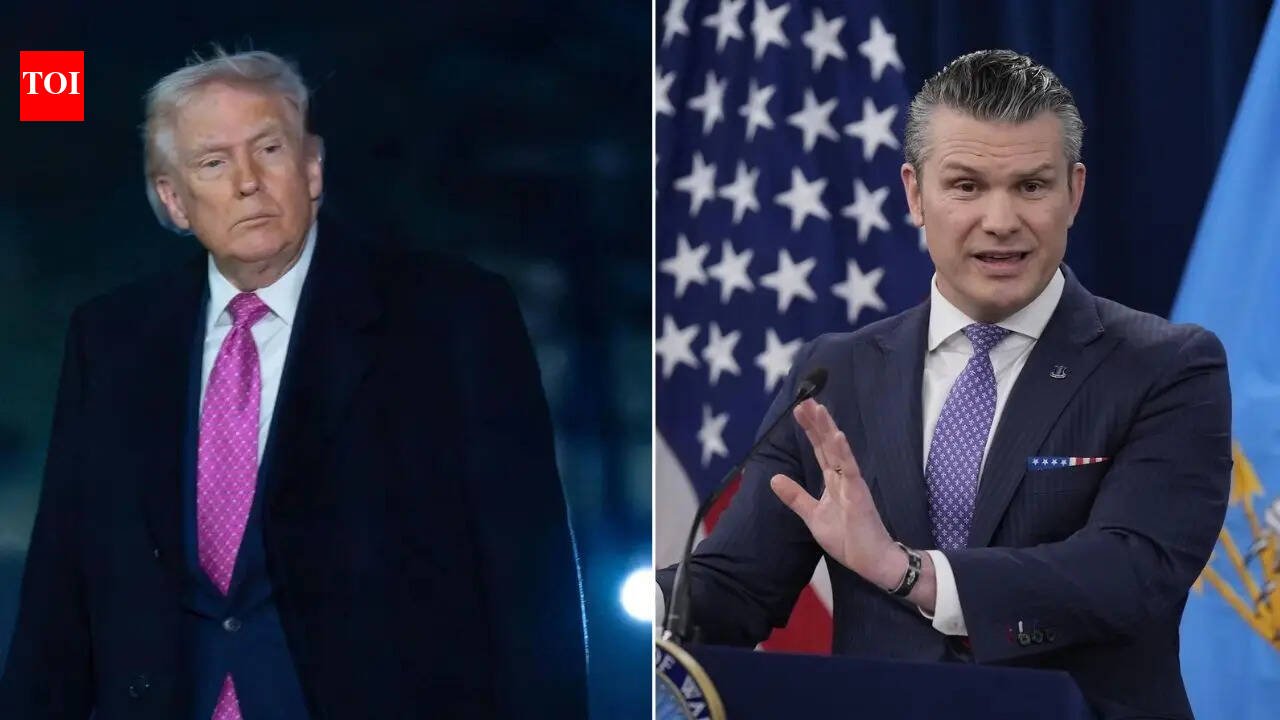
US defence secretary Pete Hegseth on Tuesday said that the coming days in the Middle East conflict would be “decisive.” He further warned Iran that Tehran should “cut a deal” if it is “wise,” asserting that President Donald Trump “doesn’t bluff and he does not back down.“
‘Trump doesn’t bluff’
Hegseth urged Tehran to agree to a deal, stressing that Trump was firm in his approach. “If Iran is wise, they will cut a deal,” he said, adding that Trump “doesn’t bluff, and he does not back down.”“The new Iranian regime should understand that by now. Regime change has occurred. This new regime should be wiser than the last. Trump is willing to make a deal, and the terms are known to them. If Iran is not willing, then the United States Department of Defense will continue with even greater intensity,” he added.
‘Negotiate with bombs’
He said the US “would much prefer” a negotiated settlement but warned of continued military action if talks fail. The Pentagon chief further said that “active” and “ongoing” efforts were ongoing. “They are ongoing. They’re active, and I think gaining strength. And we appreciate that. As I said in my remarks, we would much prefer to get a deal if Iran was willing to relinquish, material they have and ambitions they have open the strait. That’s the goal,” Hegseth told reporters.“We don’t want to have to do more militarily than we have to. But I didn’t mean it flippantly when I said, in the meantime, we’ll negotiate with bombs,” he added.
‘Upcoming days will be decisive’
Addressing a press conference alongside joint chiefs chairman gen. Dan Caine, Hegseth said the balance of power was shifting rapidly. “The upcoming days will be decisive. Iran knows that, and there’s almost nothing they can militarily do about it,” he said.“We have more and more options, and they have less… in only one month we set the terms, the upcoming days will be decisive. Iran knows that, and there’s almost nothing they can militarily do about it,” he added.Citing intelligence inputs, Hegseth claimed US strikes were impacting Iranian military morale, leading to desertions and shortages of key personnel.
Strait of Hormuz and global stakes
Hegseth said maritime movement through the Strait of Hormuz had improved slightly. “There are many more vessels flowing through today than there were,” he said, adding that the president has been clear: “open it for business or we have options.” He also echoed Trump’s message to allies, saying “other countries should pay attention when the president speaks” and should be ready to step up in securing the critical waterway.
No clarity on ground troops
On the possibility of deploying ground forces, Hegseth declined to give details.“You can’t fight and win a war if you tell your adversary what you are willing to do, or what you are not willing to do, to include boots on the ground,” he said.“If we needed to, we could execute those options … or maybe we don’t have to use them at all,” he added, stressing the need for strategic unpredictability.
Concerns over Russia, China role
Hegseth also said the US was closely monitoring the role of Russia and China in supporting Iran.“As far as Russia and China, we know exactly what they’re doing, what they are or are not doing,” he said, adding that Washington was “addressing it, mitigating it or confronting it head on” where necessary.
Escalation continues
This comes after US President Donald Trump, in a social media post early Tuesday, urged countries such as the United Kingdom to “go get your own oil” amid disruptions in the Strait of Hormuz.“All of those countries that can’t get jet fuel because of the Strait of Hormuz, like the United Kingdom, which refused to get involved in the decapitation of Iran, I have a suggestion for you: Number 1, buy from the US, we have plenty, and Number 2, build up some delayed courage, go to the Strait, and just take it,” he said.“You’ll have to start learning how to fight for yourself, the USA. won’t be there to help you anymore, just like you weren’t there for us. Iran has been, essentially, decimated. The hard part is done. Go get your own oil!” he added.Trump also criticised France, alleging it had been “unhelpful” in the elimination of the “Butcher of Iran.”This comes amid fresh escalation in the region, including an Iranian drone strike on a Kuwaiti oil tanker near Dubai. The attack is part of a broader pattern of strikes on energy infrastructure that has pushed global oil prices higher.Brent crude was hovering around $106 a barrel on Tuesday, up more than 45% since the conflict began on February 28, reflecting growing concerns over supply disruptions.Hegseth concluded by reiterating that the conflict would “end on our terms,” underscoring Washington’s intent to maintain pressure on Tehran even as diplomatic efforts continue.
