


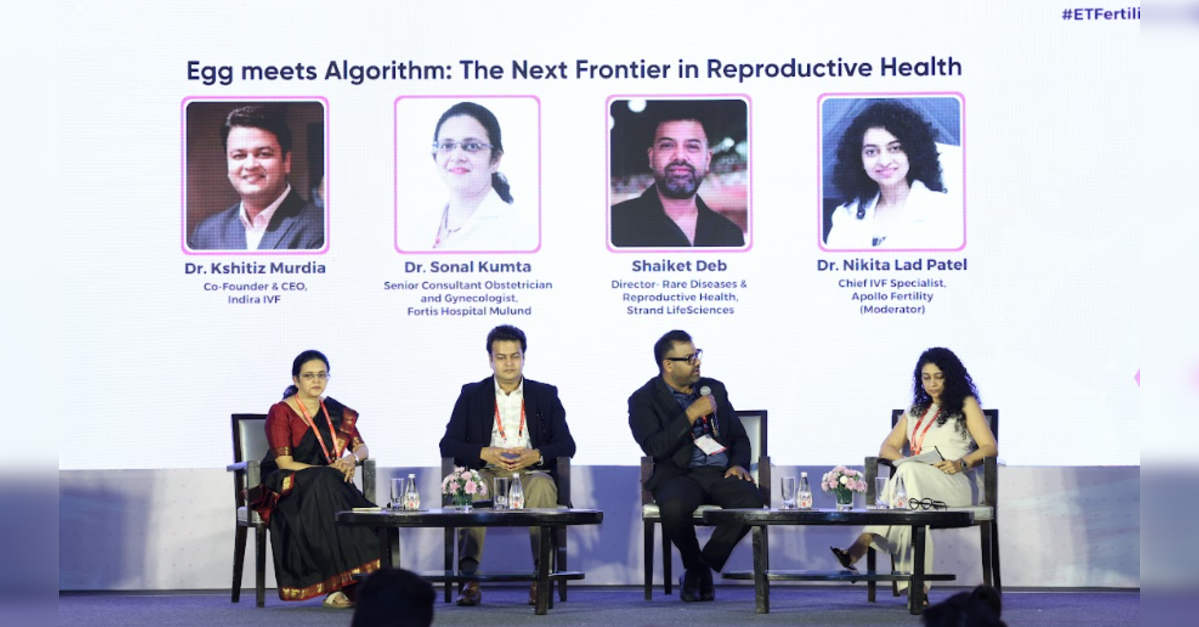
Mumbai: At the ETHealthworld Fertility Conclave, a forward-looking panel discussion on “Egg Meets Algorithm – The Next Frontier in Reproductive Health” brought together clinicians, embryologists and genomics experts to examine how artificial intelligence (AI) is reshaping fertility care. The conversation underscored a critical shift: from subjective, trial-and-error IVF practices to a more data-driven, predictive and personalised approach.
Setting the tone, Dr Nikita Lad Patel, Consultant IVF Specialist, Apollo Fertility, highlighted how AI is beginning to decode patterns in gametes and embryos that remain invisible to the human eye. By leveraging advanced analytics, clinicians are increasingly able to refine embryo selection and improve outcomes while potentially reducing the need for repeated IVF cycles. However, she noted that AI today represents “two sides of a coin”—while it holds promise for improving pregnancy chances and clinical precision, its real-world application is still evolving.
Dr Kshitiz Murdia, Co-Founder and CEO of Indira IVF, offered a pragmatic perspective, noting that while AI has not yet dramatically improved pregnancy rates, its most immediate impact lies in enhancing consistency and reducing variability in clinical practice across India. In a country with wide disparities in expertise and infrastructure, AI-powered clinical support systems can help standardise decision-making across clinics and practitioners.
He emphasised that IVF generates vast amounts of data from patient demographics and hormonal profiles to embryo development and transfer techniques. Integrating this data into unified platforms and applying AI-driven analytics could unlock the next big leap in fertility care. “It’s not just about selecting the best embryo or marginal gains in pregnancy rates,” he explained, adding that the real value lies in delivering consistent, high-quality care across geographies and clinicians.
At the same time, Dr Murdia cautioned against over-reliance on algorithms. Current AI tools, he noted, can sometimes misclassify embryos, particularly in complex cases. This reinforces the need for a “human-in-the-loop” approach, where embryologists and clinicians remain central to decision-making, with AI serving as an assistive tool rather than a replacement.
Expanding the discussion to high-risk pregnancies, Dr Sonal Kumta, Senior Consultant Obstetrician and Gynecologist, Fortis Hospital, Mulund, highlighted the potential of data-driven insights in managing patients with bad obstetric history, including recurrent miscarriages and unexplained pregnancy losses. Such cases, she said, are often emotionally and clinically challenging due to the lack of clear diagnostic answers.
She believes AI and large datasets could help identify underlying patterns whether hormonal, genetic or thrombotic enabling more precise risk assessment and treatment planning. From decisions on interventions like cervical cerclage to optimising foetal monitoring, data-backed insights can provide greater clarity and confidence in managing these high-stakes pregnancies. However, she stressed that clinical expertise remains indispensable, with AI acting as a supportive layer to strengthen evidence-based care.
The role of AI in reproductive genetics was another key focus area. Shaiket Deb, Director – Rare Diseases and Reproductive Health, Strand Life Sciences, pointed out that most existing genetic classifications are based on Western datasets, which may not fully apply to the Indian population. With the integration of AI and locally generated data, researchers are now beginning to identify population-specific genetic variations and their clinical relevance.
AI is also accelerating the interpretation of genetic data, reducing turnaround times for variant analysis from weeks to just a few days. By streamlining the filtering and prioritisation of genetic findings, it is helping clinicians make faster and more informed decisions, while also bringing down costs. At the same time, Deb cautioned against indiscriminate testing, noting that not every patient requires extensive genetic screening, and AI can help tailor testing strategies more appropriately.
Collectively, the panel converged on a clear message: AI is not a replacement for human expertise but a powerful enabler. Its true potential lies in augmenting clinical judgment, improving standardisation, and unlocking insights from complex datasets that were previously underutilised.
As fertility care becomes increasingly data-intensive, the intersection of biology and technology where the “egg meets algorithm” is poised to redefine reproductive medicine. While the journey is still in its early stages, the integration of AI promises a future where fertility treatment is not only more precise and personalised, but also more equitable and accessible across diverse patient populations.
