


The latest ball-tampering controversy in the Pakistan Super League has pushed an old issue back into the spotlight. On March 30, the Pakistan Cricket Board charged Lahore Qalandars batter Fakhar Zaman with a Level 3 offence under Article 2.14 of the PSL code, which deals with changing the condition of the ball. The charge relates to the closing stages of Lahore’s match against Karachi Kings, when the umpires inspected the ball in the final over, changed it and awarded Karachi five penalty runs. Karachi, who had needed 14 from the over before the intervention, went on to win by four wickets with three balls to spare. Fakhar denied the charge at an initial hearing before match referee Roshan Mahanama, with a further hearing due within 48 hours of the PCB’s statement.
That sequence matters because ball tampering remains one of cricket’s clearest integrity offences: it can materially alter swing, reverse swing and late movement, and in a tight finish it can shift a match. The current PSL cas has reopened a long, uneven history in international cricket, where some players were formally punished, some were acquitted, and some incidents became larger in public memory.
The early landmark cases
One of the most famous early controversies came at Lord’s in 1994, when England captain Michael Atherton was seen on television taking dirt from his pocket and rubbing it onto the ball during a Test against South Africa. Atherton said he had used dirt only to dry his hands. He was fined £2,000, with the issue framed around both the use of dirt and his failure to properly disclose it. The incident became known as the “dirt in the pocket” affair and remains one of the first major televised ball-condition controversies of the modern era.
In July 2000, a more straightforward disciplinary landmark came. Pakistan fast bowler Waqar Younis became the first player at the international level to be both suspended and fined for ball tampering. During the tri-series in Sri Lanka, he was fined 50% of his match fee and banned for one ODI, while Azhar Mahmood was also fined in the same matter. That case is important historically because it marked the point at which the offence moved from controversy into a more clearly codified disciplinary category.
The 2001 Mike Denness episode involving Sachin Tendulkar remains one of the most contentious entries in this history. Tendulkar was accused during the Port Elizabeth Test in South Africa, but the later understanding of the charge was narrower than the phrase “ball tampering” often suggests. The issue centred on cleaning the seam without informing the umpires, and the case spiralled into a much bigger India-South Africa-ICC dispute. It remains part of the historical record, but it sits in a more disputed category than the clearer guilty findings against other players.
Cases that led to direct sanctions
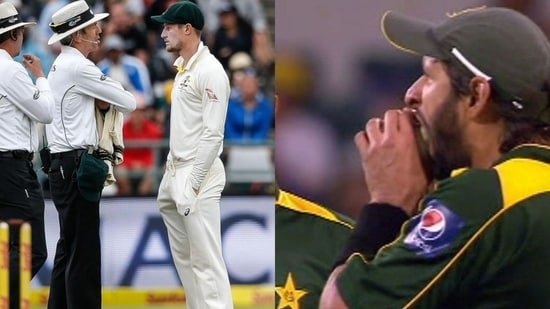
Shahid Afridi’s 2010 case was far less ambiguous. During an ODI against Australia at Perth, Afridi was caught on camera biting the ball. He pleaded guilty and was banned for two T20 internationals. In disciplinary terms, it was one of the cleanest recent cases because the footage and admission left little room for dispute.
South Africa then featured heavily in the next stretch of cases. In 2013, Faf du Plessis was fined 50% of his match fee after footage during the Dubai Test against Pakistan showed him scuffing the ball on the zip of his trousers. Three years later, du Plessis was again found guilty, this time in Hobart after footage appeared to show him using saliva affected by a mint or lolly to shine the ball during the Test against Australia. He was fined his match fee but allowed to continue playing.
In 2014, another South African, Vernon Philander, was fined 75% of his match fee during the Galle Test against Sri Lanka after television footage showed him scratching the surface of the ball with his fingers and thumb. That case again underlined how broadcast technology had become central to policing the offence.
In 2018, Sri Lanka captain Dinesh Chandimal was suspended for one Test after being found guilty of changing the condition of the ball during the St Lucia Test against the West Indies. That incident also led to five penalty runs and a ball change during the match, a detail that directly parallels the current PSL case.
A year later, West Indies wicketkeeper-batter Nicholas Pooran was suspended for four T20Is after admitting to changing the condition of the ball in an ODI against Afghanistan. The ICC said video footage showed him scratching the surface of the ball with his thumbnail.
The outlier that changed the conversation
No ball-tampering episode reshaped modern cricket like the Cape Town scandal of 2018. Cameron Bancroft was caught on television attempting to rough up the ball with sandpaper during Australia’s Test against South Africa at Newlands. Captain Steve Smith admitted the plan had been discussed by the leadership group, and Cricket Australia’s investigation later found David Warner had been responsible for developing the plan and instructing Bancroft.
ICC sanctions landed immediately in-match, but Cricket Australia’s punishments were far heavier: 12-month bans for Smith and Warner and a nine-month ban for Bancroft.
That episode changed the scale of the consequences. Earlier cases had often ended with fines or short suspensions. Cape Town turned ball tampering into a full-blown governance crisis, producing leadership bans, reputational damage and a lasting shift in how the offence was viewed.
Why the PSL case matters
That is why the Fakhar case matters beyond one PSL match. The historical pattern shows that cricket authorities have treated ball tampering in sharply different ways depending on evidence, admission and visibility. Some incidents ended in fines, others in bans.
For now, the current PSL case sits at the charging stage, not the verdict stage. But the moment the umpires changed the ball and awarded five runs, it entered a lineage of incidents that have repeatedly forced cricket to defend the integrity of its most basic contest: bat, ball and the condition in which that ball is bowled.
