


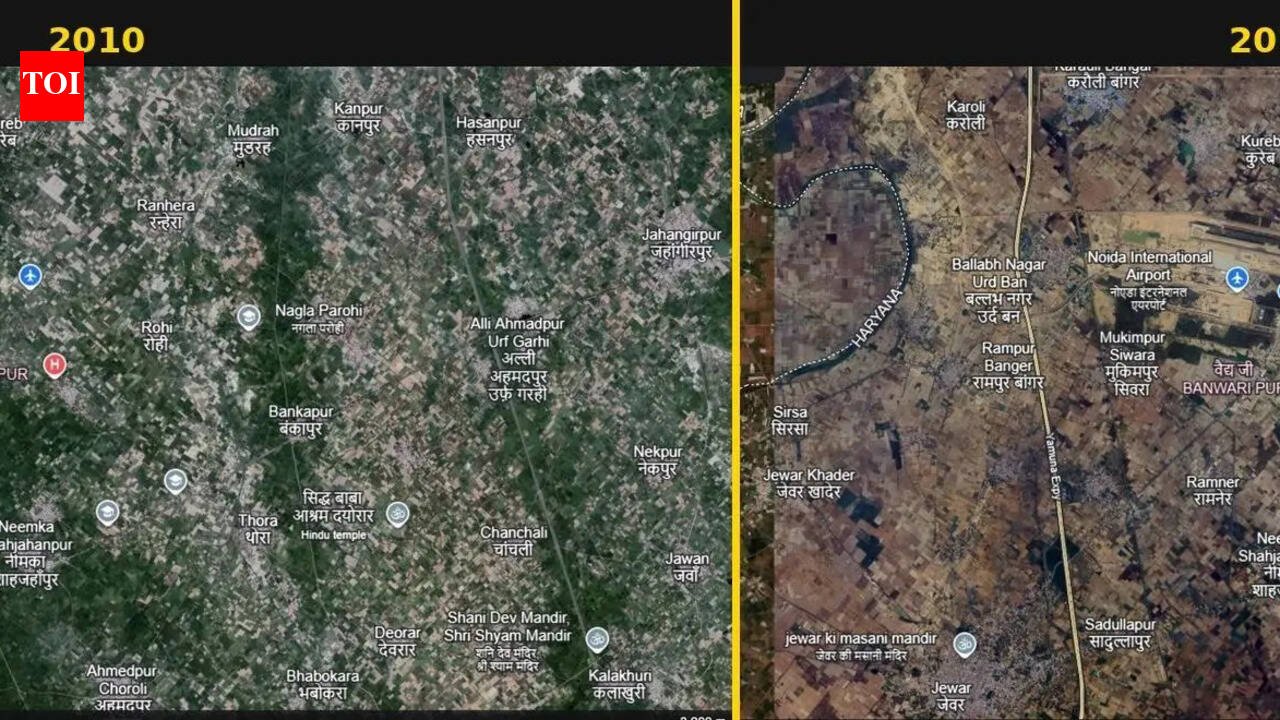
NOIDA: Areas under Yamuna Expressway Industrial Development Authority (YIEDA) have undergone a major transformation in the past few years, driven by the emergence of Noida International Airport — a catalyst for investment and industrial expansion along the Yamuna Expressway corridor.What was once a largely agrarian and low-density stretch is now evolving into a planned industrial ecosystem. While the Yamuna Expressway was essentially floated as a gamechanger for the realty landscape along the stretch, the real change came towards 2020, ahead of the foundation stone laying of the airport. According to a research report by real estate firm SquareYards, apartment prices recorded a noticeable acceleration towards 2023.Data from a CAG report and a board meeting held by Yamuna Authority earlier this year show that in the last 15 years, the prices of properties have increased by 600-1,000% in different categories from 2008-09 to 2026-27.In 2008-09, residential plots were priced at Rs 4,750/sqm, which increased to Rs 36,260/sqm in 2026-27; group housing plots were Rs 4,000/sqm and rose to Rs 54,380/sqm; commercial plots from Rs 9,500/sqm to Rs 72,510/sqm; institutional plots from Rs 3,050/sqm to Rs 18,680/sqm; and industrial from Rs 1,400/sqm to Rs 16,240/sqm.This year, the Authority has committed substantial financial resources to sustain this momentum, including a Rs 11,829 crore budget for 2026-27, with a major share earmarked for land acquisition around the airport region.A significant portion of the outlay, about Rs 8,000 crore, has been earmarked for acquiring land for a proposed industrial and urban ecosystem near the airport. Another Rs 2,011 crore will go towards development and construction in Yamuna City, while Rs 502 crore has been set aside for the airport-related works, and Rs 300 crore for multi-modal connectivity projects.Yamuna Authority area is spread along Yamuna Expressway in a 3,352sqkm area. It spans 1,149 villages in six districts — Gautam Buddha Nagar, Bulandshahr, Aligarh, Mathura, Hathras and Agra. The Authority’s notified area is being developed as an integrated urban-industrial region anchored around the airport. The shift is visible in both the scale and diversity of projects being rolled out — ranging from a medical device park, data centre, apparel park, and logistics hubs to a proposed film city and sector-specific industrial clusters.In the past year alone, industrial allotments increased. At least 54 new industrial plots were allocated, 731 lease deeds conducted, and 795 people got physical possession of their properties.Additionally, the Authority sanctioned maps of 398 plots during one year. At present, YEIDA areas have 341 under-construction industrial sites, 60 completed units, 33 functional units.Real estate developers said Noida International Airport is set to emerge as a powerful gateway for Uttar Pradesh, significantly enhancing global connectivity and attracting investments across sectors. “We anticipate a strong ripple effect on the real estate market, with property values witnessing a steady upward trajectory in the coming years,” said Manoj Gaur, CMD, Gaurs Group.He added that the development of this world-class airport will not be limited to Noida or Greater Noida but will serve as a strong gateway for the entire state of Uttar Pradesh. “As a result, the region will evolve into a major hub for industrial and logistics activities. This will generate large-scale employment opportunities, leading to increased demand for quality housing and planned urban developments,” he said.Ajay Chaudhary, CMD of Ace Group, also said that Jewar International Airport is not merely an infrastructure project but the epicentre of the economic transformation not only of Uttar Pradesh but also of the entire North region of India. “Due to better coordination between state and Centre, a large number of international companies have housed around the Yamuna Expressway, likely to generate lakhs of jobs. Ultimately, this move will boost the economy of the entire region,” he said.
