


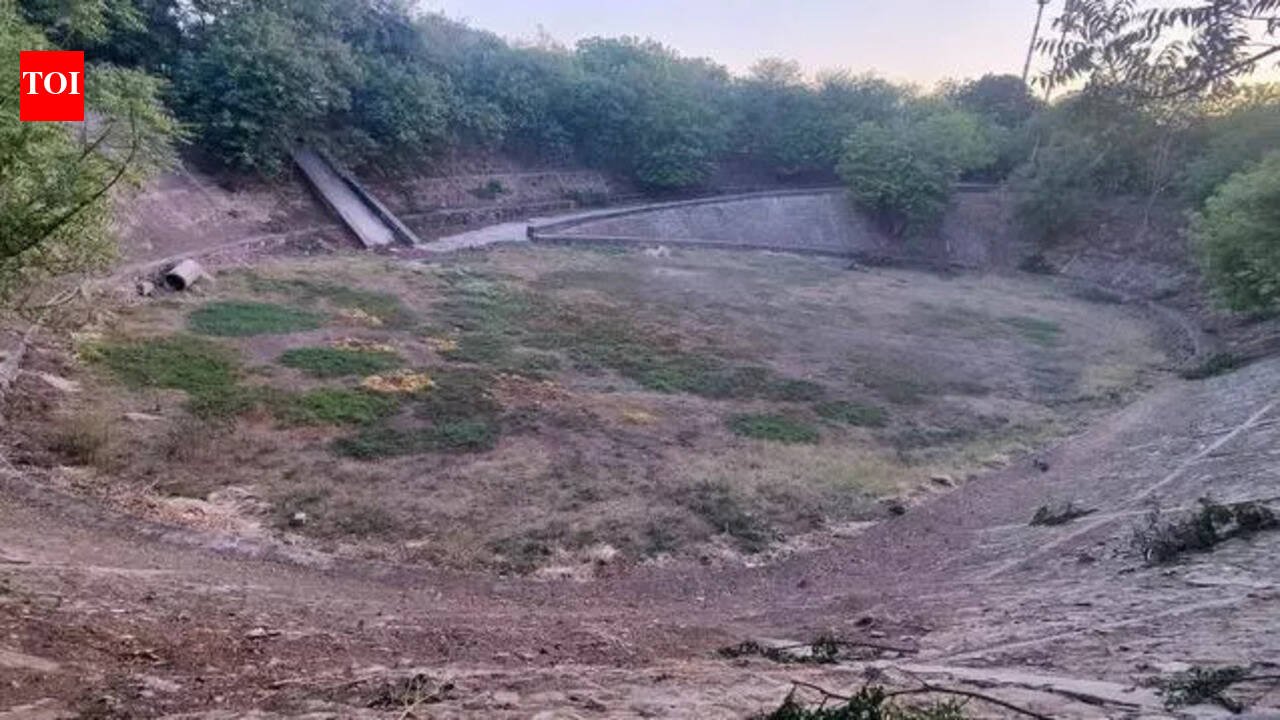
Ahmedabad: The city’s lakes are caught in a cycle of brief abundance and prolonged dryness. Over the past few years, the civic body has spent crores to interlink lakes and channel rainwater into them, ensuring that 89 lakes receive inflow during the monsoon. Yet, the gains have proven short-lived, with nearly half of these lakes drying up within six months of the rains. This recurring pattern has raised concerns about whether the current approach focuses more on inflow than long-term water retention. The Ahmedabad Municipal Corporation (AMC) is now planning to use treated sewage water to keep lakes filled throughout the year.During the last monsoon, 89 of Ahmedabad’s 156 lakes received rainwater, with filling levels ranging from 50% to 100%. “However, within six months of the monsoon, about 50% of these lakes had dried up. Memnagar lake, Kaligam lake, Gotila Garden lake on Sindhu Bhavan Road, and Thaltej lake currently have little or no water. Only a few, including Vastrapur lake, Charodi lake, Shakari lake and Sarkhej Roza lake, continue to hold water,” said a source in the civic body.Ahmedabad city is spread over an area of 480.88 sq km. Despite an average rainfall of 900mm during the monsoon season, the current system fails to ensure year-round water retention. To address this, the AMC is now planning to use treated sewage water to keep lakes filled throughout the year.“As per the National Lake Conservation Plan (NLCP), lakes should ideally hold water year-round and be larger than 10 hectares, or at least 3 hectares if they hold socio-economic or religious value. In Ahmedabad, 64 lakes are larger than 3 hectares, but only three — Shilaj (18.18 hectares), Makarba (11.03 hectares) and Ramol (10 hectares) — exceed 10 hectares. These three remain undeveloped, though plans are underway,” said a source.Officials say developing these larger lakes could play a key role in stabilising the city’s overall water ecosystem.Under this plan, sewage treatment plants (STPs) of varying capacities are proposed at 12 lakes: Asarwa, Vastral, Naroda, Motera, Shilaj, Chharodi, Gota, Nikol, Sarkhej, Saijpur, Malav lake, and Yadudi lake. “Additionally, five lakes are being considered for water treatment through bioremediation methods,” the source said, adding, “The move is expected to ensure a more consistent water supply.”Ahmedabad Municipal Corporation (AMC) officials say the problem is not just storage but access. Of the 156 lakes, 67 do not receive rainwater at all. While 87 lakes have inlet systems to channel stormwater, two still lack such infrastructure.An AMC official said, “Encroachments, construction over lakebeds, and lack of civic control over some lakes have disrupted natural water flow. Therefore, there are no stormwater lines or inlet systems to bring rainwater to these lakes. Efforts are being made to acquire control of the lakes from the collector to facilitate rainwater inflow.” It is noteworthy that during the 2024 monsoon, 24 lakes, including Sola lake, were filled to 100% capacity. Of these, 14 were in the western parts of the city and 10 in the eastern areas. Lakes in west Ahmedabad such as Sola lake, Dev City lake, Gota lake, Mahila lake, Chandlodia lake, Yadudi lake, Chharodi lake, Motera lake, Shubham lake, Vistamata lake, Vadu lake, Mumatpura lake, Puniya lake, and Kothia lake, were filled to 100% of its capacity. However, the rapid drop in water levels after the monsoon highlights the need for sustainable water management.
