


Russia stands to reap gains from surging global fertilizer prices amid the U.S.-Israeli war with Iran, adding to Moscow’s windfall from higher oil and gas revenues.
The conflict, now in its fourth week, has tightened global supplies of key crop nutrients by damaging Gulf energy infrastructure and choking off shipping through the Strait of Hormuz, a critical artery for both fuel and fertilizer exports.
Urea, the most widely traded fertilizer, has risen by roughly 50% since the Iran war began.
Middle East granular urea prices surged to $604-$710 per ton by March 19, from $435-$490 before the crisis and around $400 at the start of the year, price reporting agency S&P Platts said.
Futures for next-month delivery rose to $745 per ton on Monday from $475 on Feb. 27, Josh Linville, vice president of fertilizers at brokerage StoneX, told The Moscow Times.
He said the Middle East hostilities have had an “incredible impact” on global nitrogen prices.
As the world’s second-largest fertilizer producer after China, Russia is well positioned to capitalize on the disruption.
It produced 65.4 million metric tons of fertilizer in 2025, nearly 65% of which — or around 43 million metric tons — was exported.
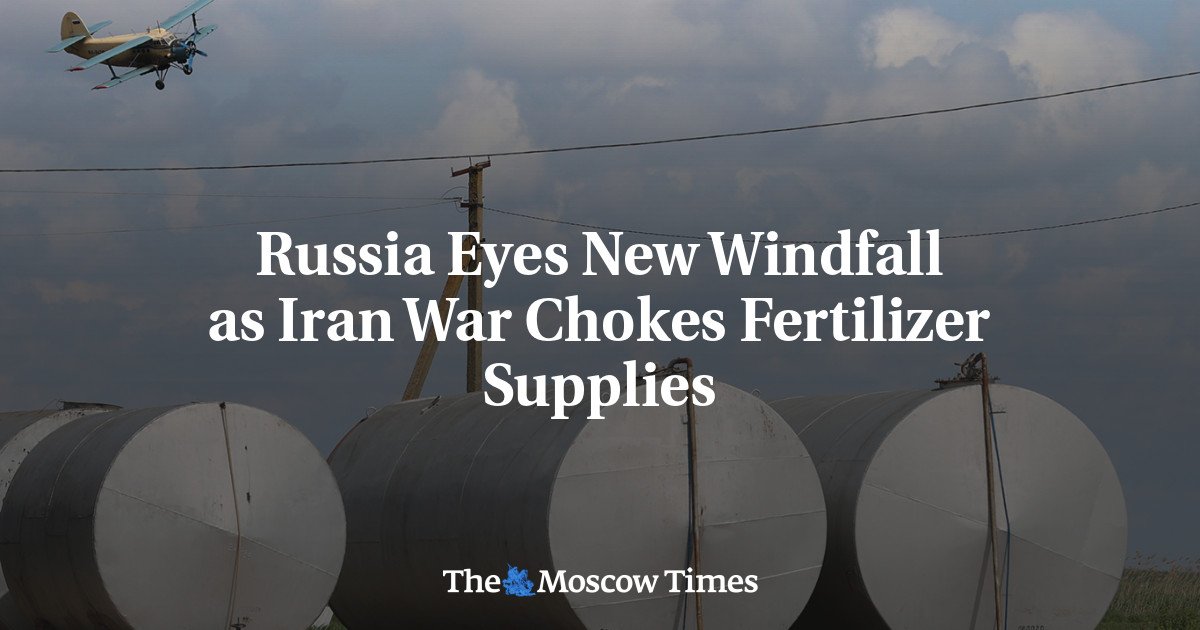
Igor Kubedinov / TASS
Fertilizer export revenues exceeded $11 billion in 2025, implying that a sustained 50% price increase could generate roughly $360 million in additional monthly income, or more than $1 billion per quarter.
That is still smaller than gains from energy exports, where a $10-$30 increase in oil prices can bring Russia’s oil sector an additional $1.5-$4.5 billion per month.
Prices for Russian fertilizers have already climbed to levels not seen since 2022, when uncertainty over Western sanctions on Moscow following the invasion of Ukraine rattled global markets.
Baltic FOB urea, which is loaded onto vessels at Russia’s Baltic Sea ports, rose to around $418 in February after averaging about $375 per ton in 2025.
By March 13, it had climbed to $563-$586 per ton — a 40% increase over pre-crisis levels — with some deals concluded at around $600 per ton, according to data cited by the Vedomosti business daily.
Nitrogen fertilizers, including urea, ammonium sulfate and calcium ammonium nitrate, are the most widely used globally on crops such as wheat or vegetables and are estimated to account for up to 40-50% of crop yields.
Their production is highly dependent on natural gas, which typically makes up 60-80% of costs. That leaves prices highly sensitive to energy shocks.
The Middle East is a major hub for both fertilizers and the gas used to produce them, with countries such as Qatar and Saudi Arabia among leading exporters.
However, expanding exports may prove challenging for Russia as rising prices begin to strain the domestic market ahead of the spring planting season and production capacity remains limited.
Fertilizer prices in Russia have risen by more than 30% since the start of the year, raising concerns about lower crop yields, the pro-Kremlin daily Izvestia reported.
Farmers have asked the Agriculture Ministry to intervene after domestic prices effectively converged with export levels following the removal of export duties.
The ministry said this week it had suspended exports of ammonium nitrate outside government contracts for one month to ensure sufficient domestic supply.
Industry executives say producers are already operating near capacity.
Andrei Guryev, head of the Russian Fertilizer Producers Association, said plants were operating “at near full capacity” amid a surge in orders, while Andrei Sizov, head of consultancy Sovecon, estimated capacity utilization at around 90%.
Even so, Russia could redirect more shipments to markets like the U.S. and parts of Asia as Middle Eastern supplies tighten, Linville said.
Europe and Australia could also face shortages, but existing restrictions may limit Russian exports there, he said.
Hungary has already asked the European Union to ease fertilizer tariffs introduced in 2025, while Australian industry group Fertilizer Australia has urged its government to consider lifting restrictions to avoid what it called “catastrophic impacts” on domestic agricultural output in the 2026 season.
A Message from The Moscow Times:
Dear readers,
We are facing unprecedented challenges. Russia’s Prosecutor General’s Office has designated The Moscow Times as an “undesirable” organization, criminalizing our work and putting our staff at risk of prosecution. This follows our earlier unjust labeling as a “foreign agent.”
These actions are direct attempts to silence independent journalism in Russia. The authorities claim our work “discredits the decisions of the Russian leadership.” We see things differently: we strive to provide accurate, unbiased reporting on Russia.
We, the journalists of The Moscow Times, refuse to be silenced. But to continue our work, we need your help.
Your support, no matter how small, makes a world of difference. If you can, please support us monthly starting from just $2. It’s quick to set up, and every contribution makes a significant impact.
By supporting The Moscow Times, you’re defending open, independent journalism in the face of repression. Thank you for standing with us.
Continue
Not ready to support today?
Remind me later.
×
Remind me next month
Thank you! Your reminder is set.
