


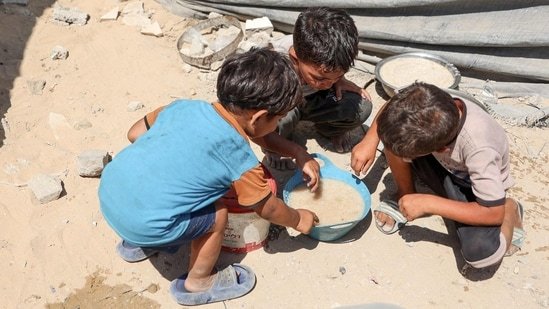
The world today is again at an increasingly fragile and uncertain moment. From the prolonged war in Ukraine to escalating tensions in West Asia, geopolitical conflicts are once again shaping global priorities. Nations are rearming, nations are preparing for self-defence and defence budgets are soaring. Yet, amid this surge in military preparedness, a persistent crisis of hunger, food insecurity, and underinvestment in food production continues to deepen.
The numbers are alarming.
Global military expenditure reached a record $2.7 trillion in 2024, representing a 9.4% increase in a single year—the steepest rise since the Cold War era. Even more striking is the long-term trend: military spending has increased for ten consecutive years, growing by 37% between 2015 and 2024. The current geopolitical climate has only accelerated this surge. Close to $250 billion is spent every month on defence.
More than 100 countries increased their defence budgets last year, driven by rising geopolitical tensions. In regions such as Europe and West Asia, spending has risen sharply, reflecting a world preparing not just for conflict, but for prolonged instability and a heightened need for self-defence.
As nations recalibrate their defence priorities, one of the most fundamental human needs—food–faces growing neglect. Food, the basis of human existence, and agriculture, the source of that food, are being overshadowed.
Food is not merely a basic necessity; it is the foundation of global stability, human development, and economic progress. The current moment–marked by tensions between Israel and Iran, alongside ongoing conflicts elsewhere illustrates how rapidly the world mobilises resources when security is threatened. But it also raises a deeper question: What do we define as security?
Is it the accumulation of weapons, or the assurance that every human being has access to food–the fundamental requirement of their existence?
Global food security today presents a paradox of abundance and deprivation. On average, the world produces enough food to supply 2,900–3,000 kilocalories per person per day, well above the minimum dietary requirement. In theory, this is sufficient to feed everyone. Yet, this aggregate availability masks deep inequalities in access and distribution.
Despite adequate global supply, an estimated 673–733 million people faced chronic hunger in 2023–2024—roughly one in every eleven people globally. Even more striking, nearly 2.3 billion people, or about 28–29% of the global population, are moderately or severely food insecure, lacking consistent access to safe and nutritious food. This underscores that the challenge is not merely one of production, but of affordability, access, and the stability of food systems.
Conflict significantly exacerbates these challenges. It erodes purchasing power and reduces access to adequate diets, even when food is available in markets. The Russia–Ukraine war provides a clear example. Both countries are major exporters of key commodities such as wheat and sunflower oil. They produce close to 34% of the World’s wheat and over 70% of Sunflower oil. In the initial months of the conflict, global wheat prices rose by nearly 20%, directly affecting affordability and availability worldwide and especially for countries in Africa.
The ongoing tensions in West Asia add another layer of pressure. While the region is not a major food producer, it plays a pivotal role in global energy markets. Rising fuel prices increase the cost of fertilisers, transportation creating cascading effects on food production costs, food prices, and inflation.
The opportunity cost of war is profound.
Global spending on agricultural research and development—arguably the backbone of long-term food security—remains strikingly low at around $40 billion annually. This is nearly 70 times less than what the world spends on defence. As countries increasingly recalibrate budgets to accommodate rising military expenditure, investments in agriculture risk being further constrained.
The imbalance becomes even more glaring when we consider how we define long term security and return on investments. An additional $ 15.2 billion per year in agricultural innovation could significantly reduce hunger, enhance climate resilience, lower food prices, and transform global food systems. That is less than one percent of global military spending and will give returns in terms of securing human beings from the biggest crisis- lack of food.
Today, nearly 800 million people worldwide face hunger, that is close to one in ten people on Earth. Food insecurity is rising, driven by conflict, climate shocks, and economic instability. The number of people facing acute food insecurity has increased by nearly 20% since 2020.
Conflict is one of the largest drivers of hunger. Wars disrupt supply chains, displace farmers, destroy infrastructure, increase the cost of production, and inflate food prices. Yet, instead of investing in systems that can prevent these cascading crises, the global response has largely been to intensify militarisation.
It is a vicious cycle: Conflict drives hunger, and hunger fuels instability–leading to further conflict.
We are spending trillions to protect nations, while failing to invest enough to feed them.
This article is authored by Purvi Mehta, senior global agriculture systems specialist, New Delhi.
