


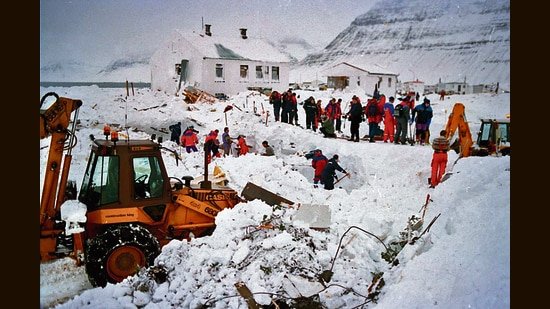
“The screams haunt me – can’t get them out of my mind.”

“I can’t go to a fire now… I’ve lost too many houses; I’ve seen too many people lose everything — I can’t do it anymore.”
“I keep thinking what more could I have done. The guilt eats away at me.”
This is what it can feel like to be on the frontlines of disaster.
In the eight months between August 2019 and March 2020, the southeast coast of Australia witnessed a Black Summer: tens of thousands of wildfires that ravaged over 20 million hectares, destroyed more than 3,000 buildings and killed more than 400 people.
Three years later, three trains collided in the Balasore district of Odisha, killing 296 people and injuring over 1,200 others.
Thousands of miles apart, in two very different tragedies, first-responders dove right in. The quotes above are what they were left with, months and years later, according to two studies: a paper by researchers at Kalinga Institute of Medical Sciences, Bhubaneswar, and a survey led by University of Western Australia.
The anxiety of doing the job and surviving was just the beginning of the struggle, noted the Odisha study, published in the Indian Journal of Psychiatry in 2024.
“At a disaster site, first-responders become like a well-oiled machine: working quickly and efficiently to coordinate, responding to command and rescuing people, all in the face of devastating tragedies and, sometimes, scarce resources,” says Anil Kumar Gupta, a strategic consultant on disaster resilience, and a professor with the Integrated Centre for Adaptation to Climate Change, Disaster Risk Reduction and Sustainability (ICARS) at IIT-Roorkee.
Sadly, the kinds of psychological scars these tragedies leave are rarely studied, he adds.
The most pressing stressor is often the moral / ethical one: deciding who to rescue, who gets treatment, who gets left out, says Gupta, also a former professor with the National Institute of Disaster Management (NIDM).
This can cause feelings of guilt, failure, futility, lack of confidence, and ideas of personal condemnation.
FIELD NOTES
How real is the problem?
The Australian survey found that, of the 66,300 emergency workers (53,200 volunteers and 13,100 response-force employees) on duty during the Black Summer, 4.5% of the volunteers and 5.1% of the employees reported symptoms of post-traumatic stress disorder.
After the Balasore train tragedy, personnel on the scene reported palpitations, nightmares, and emotional detachment, the Odisha study noted.
This kind of trauma can have long-term effects on physical and behavioural health, the authors state. Meanwhile, walking into subsequent disasters can cause the responders to be retraumatised over and over.
As the gap between events shrinks, and the events intensify, there is less time to process the grief, and less time for recovery.
WHAT LIES AHEAD
The world has seen a five-fold increase in the number of weather-related disasters over a 50-year period (1970-2019), as a result of climate change, more-extreme weather and improved reporting, a 2021 report by the World Meteorological Organization (WMO) found.
Of these, the most severe in terms of human toll have been droughts, storms, floods, heat waves and cold snaps.
As average global temperatures rise, the number of such disasters is projected to reach 560 a year, by 2030. This is an increase from the 350-to-500 medium-to-large-scale disasters that took place every year over the past two decades, notes the Global Assessment Report (GAR 2022) released by the UN Office for Disaster Risk Reduction (UNDRR).
SAFE SPACES
Recognising that the rising frequency and intensity can feel crushing, some countries are stepping up efforts to help first-responders through it.
In Sweden, between the rain, flash floods, heat and forest fires, “it’s getting harder to predict the intensity and impact. The environment and landscapes we knew so well are no longer the same,” says Petur Gudmundsson, a firefighter from Stockholm.
It helps to have safe spaces where first-responders can share their anxieties, he adds.
In Iceland, where Gudmundsson was a rescuer too, and in Sweden, formal and informal spaces of this kind are emerging. Sometimes it’s as simple as a unit heading to a sauna together. “Even if only one person really needs to talk, everyone will go along so the person can open up in a relaxing, supportive environment,” Gudmundsson says.
As the process becomes more structured, planned meetings now extend to operators answering distress calls and paramedics. At the very least, someone who is beating themselves up over a decision gets to hear from others at these meetings.
“Once we get a better understanding of how an incident unfolded, it helps with the healing process,” Gudmundsson says. “As first-responders, we’re trained to be resilient, hardy, and this comes naturally to us. But having a sort of formal support system makes the work a little easier.”
