Soon after the nominations for the Academy Awards were announced, two things became clear. The Best Actress in a Leading Role category had some of the strongest contenders in Oscar history. However, despite the stellar performances, there was no competition. Jessie Buckley’s performance as Agnes, William Shakespeare’s wife, in Hamnet, was the overwhelming favourite.
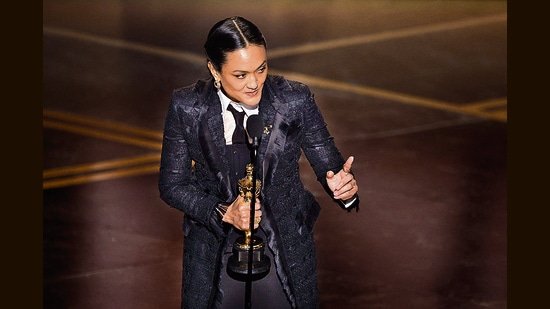
‘I want all the women in the room to stand up… I don’t get here without you,” said Autumn Durald Arka-paw, the first woman and first woman of colour to win the Oscar for Best Cinematography (for Sinners). (Reuters)
The other nominated performances — Rose Byrne in If I Had Legs I’d Kick You, Renate Reinsve in Sentimental Value, Kate Hudson in Song Sung Blue and Emma Stone in Bugonia — should still have had the Academy’s voters in a quandary. They are all outstanding and, in a particularly satisfying coincidence, all play unusual, difficult women.
Hudson plays tribute performer Claire Sardina and quite literally hits all the right notes. Stone adds “otherworldly” to her repertoire with Yorgos Lanthimos’s weird thriller; it says a lot about her acting range that she leaves one guessing right till the end. Hudson and Stone still felt like the weaker links in the category, but only because Buckley, Byrne and Reinsve stand as first among equals.
Drawing on Maggie O’Farrell’s novel Hamnet, in an adaptation co-written by her and director and co-writer Chloe Zhao, Buckley imagines Agnes with rich depth. She is a wild girl, full of magic, who grows up to become a mother who can bring her stillborn child to life. But she is powerless against death when it comes for her 11-year-old son. Buckley brings Agnes’s witchy complexity to life with a performance that tugs at every heartstring.
As powerful as her portrayal is, it is also rooted in a conventional understanding of motherhood. Byrne offers a sharp contrast. “This isn’t supposed to be what it’s like; this isn’t it,” Byrne’s Linda says desperately, as she finds everything collapsing on her, in writer-director Mary Bronstein’s film about motherhood, failure and fury. Byrne is a livewire as Linda, focusing on the exhaustion, frustration and spiralling despair that make up the shadowy underside of this experience.
A child’s perspective of difficult parents comes through in Joachim Trier’s Sentimental Value, which won for Best International Feature. Reinsve delivers an elegant, pitch-perfect performance as Nora, an actress who has a troubled relationship with her father (Stellan Skarsgard; nominated for Best Supporting Actor). Nora isn’t ready to forgive him, yet, much as she resents him, they share an artistic and emotional connection. Reinsve conveys a wealth of emotion and meaning in small, everyday gestures. Thanks in large part to her, this Norwegian film feels like a wonder.
Ultimately, the predictions proved to be accurate and Buckley did win. More than Best Actress, though, it was the Oscar for Best Cinematography that ended up celebrating women in a way that felt unforgettable. Autumn Durald Arkapaw became the first woman and first woman of colour to win this award, for her brilliant work on Sinners. “I really want all the women in the room to stand up, ‘cause I feel like I don’t get here without you guys,” she said in her acceptance speech.
For all the cop-outs and raised eyebrows, there’s no doubt this year’s Oscars shone a light on some incredibly talented women.