


By Naresh Kumar Kumawat
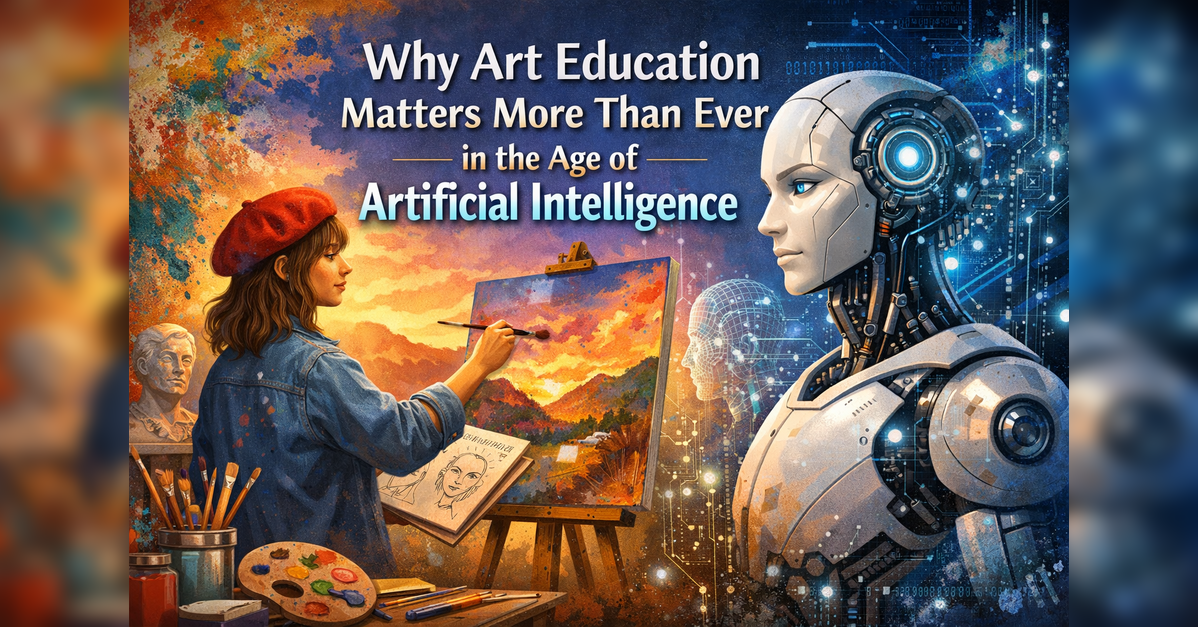
Artificial Intelligence is gradually changing the course of operation in different industries at a great pace. Education systems are also witnessing the impact of this significant shift. Machines are increasingly capable of performing tasks like automated data analysis to AI-assisted writing and design tools. Earlier, these tasks were considered uniquely human. The ability to think creatively, interpret ideas and express originality has become more valuable than ever before. This is exactly why art education is very important. It has to become an essential pillar in preparing students for the future.
Creativity beyond algorithms
Artificial intelligence is exceptionally good at identifying patterns in data. They can process vast amounts of information and generate outputs based on existing data. However, the operating pattern of AI is still bound by the code or training it has received. Creativity in the true sense is the ability to imagine something entirely different that challenges the convention and thinks beyond established patterns. This type of thinking remains fundamental to humans.
Art education nurtures this ability in humans through painting, music, theatre, sculpture or digital art. The idea behind promoting education in art is to help students learn to explore ideas without predefined answers. The process of learning in an art program encourages experimentation, risk-taking and personal expression. These experiences help students develop flexible thinking. It enables them to approach complex problems from an out-of-the-box perspective. No machine can ever match or replicate this ability available only in humans.
Developing critical and independent thinking
Art education is beyond aesthetically pleasing work as it involves observation, interpretation and analysis. When students study art or create their own work, they learn to question meanings and explore cultural contexts. They also evaluate different viewpoints.
In a world where AI-driven information can be generated instantly, the ability to critically evaluate becomes very important. Art sharpens the human-based skills like interpreting symbols, narratives and emotions. These skills foster deeper understanding and independent thinking. Arts education programs enable students to analyse complex issues and communicate their thoughts constructively.
Encouraging innovation
A majority of innovations are made when different disciplines collaborate in the
Many of today’s breakthroughs occur at the intersection of different disciplines. Innovation often requires combining technical knowledge with creative insight. Art education encourages exactly this type of multidisciplinary thinking.
Students in the arts learn ways to visualise concepts, design solutions and approach challenges with imagination. These abilities complement the fields of science, technology, engineering, arts and mathematics. It recognises that creativity is essential to technological progress.
Preparing students for a changing future
The future employers will likely demand skills beyond the technical. They will want employees to have creativity, adaptability, empathy and problem-solving. It will become the skills that define successful professionals.
Students who gain artistic learning environments are more comfortable with ambiguity and exploration. They learn that failure can be part of the creative process. They also learn that experimentation often leads to new ideas. These lessons become important in a dynamic world where careers and industries are constantly evolving.
The goal of education must shift from competing with AI to using AI to strengthen skills that only humans can have. Art education does this by nurturing imagination. It also instils emotional awareness and innovative thinking.
The right way to future learning
Educational institutes are largely using digital tools and AI technologies to enhance learning. Art education must remain an important part of the curriculum. Technology can be used to enhance education. However, it cannot replace the human capacity for creativity and expression. By investing in art education, educators and policymakers can ensure that the next generation grows as skilled users of technology. It will also ensure they grow as imaginative thinkers capable of shaping the future with originality and insight.
Naresh Kumar Kumawat is the Director, Matu Ram Art Centres.
DISCLAIMER: The views expressed are solely of the author and ETEDUCATION does not necessarily subscribe to it. ETEDUCATION will not be responsible for any damage caused to any person or organisation directly or indirectly.
