


Hello and welcome to Regions Calling, your guide to developments beyond the Russian capital from The Moscow Times.
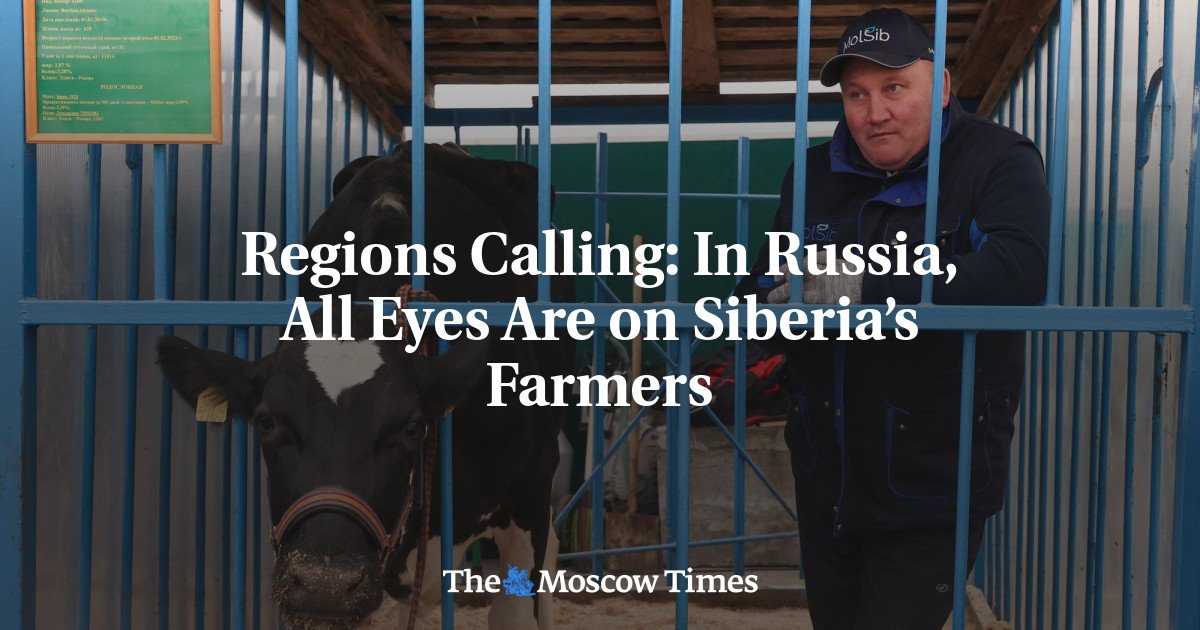
This week, we focus on what has been the hottest topic on the Russian internet for over a week: small farmers across Siberia who are fiercely defending their livestock in defiance of government orders to cull thousands of animals.
But first, here is what else happened in the regions:
The Headlines
The republic of Tatarstan’s State Council Speaker Farid Mukhametshin resigned on Tuesday after holding the position for more than 30 years. Mukhametshin, 78, will be replaced by his deputy Marat Akhmetov, a 71-year-old former agriculture minister.
A court in the northwestern republic of Komi sentenced hairdresser-turned-opposition politician Oksana Bagirova to six years in prison on Monday on charges of “justifying terrorism.”
The charges against Bagirova, who ran for regional parliament last year with backing from the Communist Party, were linked to social media comments about Russia’s invasion of Ukraine.
Members of the Russian Academy of Sciences’ Siberian branch last week spoke out against a controversial plan for apatite ore mining in the republic of Buryatia.
Scientists believe that mining in the vicinity of the Selenga River, the main tributary of Lake Baikal, would risk polluting the world’s largest freshwater lake. Backed by Buryatia’s head Alexei Tsydenov, the project sparked a series of protests in Buryatia last year.
At least 19 Russian regions introduced healthcare funding cuts this year compared to just five such regions in 2025, the exiled investigative outlet IStories reported. The largest cuts of over 30% were introduced in the northwestern Vologda region and Siberia’s Irkutsk and Kemerovo regions.
The Spotlight
In Russia, All Eyes Are on Siberia’s Farmers
“All of this was built on milk. If I didn’t keep livestock, where would I find the big bucks?” Marina, a resident of a small Siberian village, tells the camera as she shows the unfinished floors and bare walls of her home, where she lives with her husband and their teenage son who has cerebral palsy.
The roof alone cost the family 800,000 rubles ($9,700) to install, she says.
“This might not seem like anything to some people, but we earned every penny with our backs,” she tells blogger and Kozikha native Daria Mironenko in the video.
Marina is among the dozens of residents of Kozikha, a village of less than 1,000 people in Siberia’s Novosibirsk region, whose livelihoods depend on small family-run farms.
dariagriamironenko / Telegram
Those livelihoods are now under threat as authorities across Siberia seek to cull livestock for vaguely defined disease control measures.
The farmers’ plight — and their efforts to stand up to the authorities — have captured the nation’s attention.
During the video, Marina’s husband interrupts to say that one of their cows, Varya, has just calved.
“Can you imagine that in a few days they could come to put this baby calf to sleep? Can you imagine how I will feel? Every cow is my everything,” she says with tears in her eyes.
Officials say the cull is necessary to curb the spread of a “highly dangerous disease.” But locals insist that animal control squads deployed by the Agriculture Ministry have administered no tests and are trying to kill thousands of healthy animals.
For weeks, locals in Kozikha have been protesting, writing appeals and barricading roads to the village and farms to protect their livestock.
Their village cordoned off by the police, farmers like Marina have been unable to make money by selling their products or to buy groceries anywhere except the small local store where stocks have been depleted. Already struggling to feed their families, many worry this is just the beginning of their troubles.
Similar accounts have emerged in villages across the Novosibirsk region.
In Novokluchi, a village some 300 kilometers east of Kozikha, an animal control team entered Svetlana Panina’s small farm while she was away last week and killed 150 rams, 40 cows, seven goats, three camels and two piglets.
“We were basically left homeless, without anything, without any means of existence. We want to get to the governor to make him explain what right he had to do this,” said Panina, who picketed outside the Novosibirsk governor’s office on Saturday.
After failing to meet the governor, Panina tried to approach regional Agriculture Minister Andrei Shindelov on Monday. The video of Shindelov running from her down the ministry building’s hallways quickly went viral.
On Wednesday, Panina protested again — this time near the State Council building in the regional capital of Novosibirsk.
Shindelov announced Monday that a region-wide state of emergency over a “highly dangerous disease” had been in place since Feb. 16.
His statement is the only confirmation of the authorities’ epidemic control measures. A March 6 governor’s decree cited by officials carrying out the cull has not been made public.
The secrecy surrounding the attempted animal killings has allowed for speculation and conspiracy theories to blossom.
Some claim that the campaign is backed by large local agricultural producers trying to get rid of smaller competitors. Others say the slaughter was lobbied for by meat-producing giant Miratorg and its alleged owner, former President Dmitry Medvedev.
Neither of these rumors could be verified.
C_agriculture / Telegram
Officials’ failure to specify which exact disease they are battling has also left room for multiple theories.
While some believe authorities might be using excessive measures to battle pasteurellosis, a curable bacterial infection, others suggest they could be keeping people in the dark about an outbreak of lethal foot-and-mouth disease.
On Tuesday, authorities introduced quarantine measures in the villages of Kolyvan and Gzhatsk, which are located around 370 kilometers apart, citing an outbreak of rabies at two small farms.
The predicament of the Novosibirsk region’s farmers has resonated with people far beyond its borders, including popular pro-Kremlin celebrities and bloggers, as well as the exiled opposition.
“What kind of a mess are we being led into? They shut down Instagram, Telegram, YouTube…[The government] turned off the internet everywhere and now wants to take cattle [from people],” popular influencer Victoria Bonya said in an Instagram video. “We need to rise up as a society and talk about this!”
Regional opposition deputies have also spoken out in defense of the farmers.
State Duma Deputy Mikhail Delyagin reportedly asked Russia’s top investigator Alexander Bastrykin to launch a probe into the cases of mass killings of farm animals.
Meanwhile, Tatarstan’s head Rustam Minnikhanov announced that hotspots of “dangerous animal infections” have been identified in at least 15 Russian regions, including the Volga republics of Chuvashia and Udmurtia.
Other affected regions could include the Zabaikalsky, Omsk, Tomsk, Sverdlovsk, Samara and Penza regions, as well as the republics of Altai and Sakha (Yakutia), according to media reports.
The losses of Russian farmers whose livestock was culled due to quarantine measures amounted to 1.5 billion rubles ($17.6 million) this month alone, the pro-Kremlin daily Izvestia reported.
dariagriamironenko / Telegram
Though Novosibirsk authorities promise to pay affected farmers 70,000 rubles ($800) per 400-kilogram adult cow and an additional compensation equal to the minimum wage over nine months, the farmers say this is far from enough.
“These are mere pennies! That is an absolute joke, not a payment, given that this cow was raised for many years with no plans to sell it for meat. By the time the new cows are grown, the family will be completely broke and out of business,” Izvestia quoted one farmer as saying.
Back in the Novosibirsk region, authorities reportedly charged several protesters with administrative offenses and ordered each to pay a fine of 12,000 rubles ($140). At least two local journalists covering the issue have been questioned by police.
On Thursday, the village of Kozikha was awoken by the arrival of a large police convoy.
Uniformed officials traveled to the Vodoley collective farm, where 600 cows and 220 sheep are housed, claiming it was the alleged hotspot of a “highly dangerous disease.”
The police left a few hours later, leaving the animals unharmed, according to local sources.
Though it remains unclear whether the authorities will return, locals appear resolved to fight on until the end.
“There is a saying: ‘God approaches slowly, but punishes cruelly.’ Whoever is doing this, you have children, you have grandchildren…you should really think about that,” Marina said Sunday in a video recorded by Mironenko.
On Tuesday, Mironenko said authorities threatened to send child protection services to Marina’s home if the videos with her testimony were not taken down.
The videos remained published at press time.
Photo of the Week
Pavel Talankin, a former school events coordinator and videographer from the Chelyabinsk region, is pictured holding his Oscar for the documentary “Mr. Nobody Against Putin.”
The film, which chronicles the indoctrination of schoolchildren in Russia amid the invasion of Ukraine, won the Academy Award for Best Documentary Feature Film on Sunday.
“Mr. Nobody Against Putin” is based on secretly preserved footage that Talankin filmed while working at a school in Karabash, a heavily polluted mining town of about 10,000 people in the north of the region.
Culture & Entertainment
- The human rights project Marem, which helps female victims of domestic violence in the North Caucasus, has organized a multimedia exhibition at the Reforum Space Berlin on display until March 22. More information is available here.
- The Democratic Community of Russians in Cyprus will host a screening of Masha Novikova’s documentary “Russia vs Lawyers” in Limassol on March 21. More information here.
- A free screening of “Mr. Nobody Against Putin” will take place on March 27 in The Hague during the Movies that Matter Festival. More information about the event is available here.
Would you like to feature information about your upcoming Russia-related event or webinar in the next Regions Calling newsletter? Drop us a line at [email protected].
A Message from The Moscow Times:
Dear readers,
We are facing unprecedented challenges. Russia’s Prosecutor General’s Office has designated The Moscow Times as an “undesirable” organization, criminalizing our work and putting our staff at risk of prosecution. This follows our earlier unjust labeling as a “foreign agent.”
These actions are direct attempts to silence independent journalism in Russia. The authorities claim our work “discredits the decisions of the Russian leadership.” We see things differently: we strive to provide accurate, unbiased reporting on Russia.
We, the journalists of The Moscow Times, refuse to be silenced. But to continue our work, we need your help.
Your support, no matter how small, makes a world of difference. If you can, please support us monthly starting from just $2. It’s quick to set up, and every contribution makes a significant impact.
By supporting The Moscow Times, you’re defending open, independent journalism in the face of repression. Thank you for standing with us.
Continue
Not ready to support today?
Remind me later.
×
Remind me next month
Thank you! Your reminder is set.
