


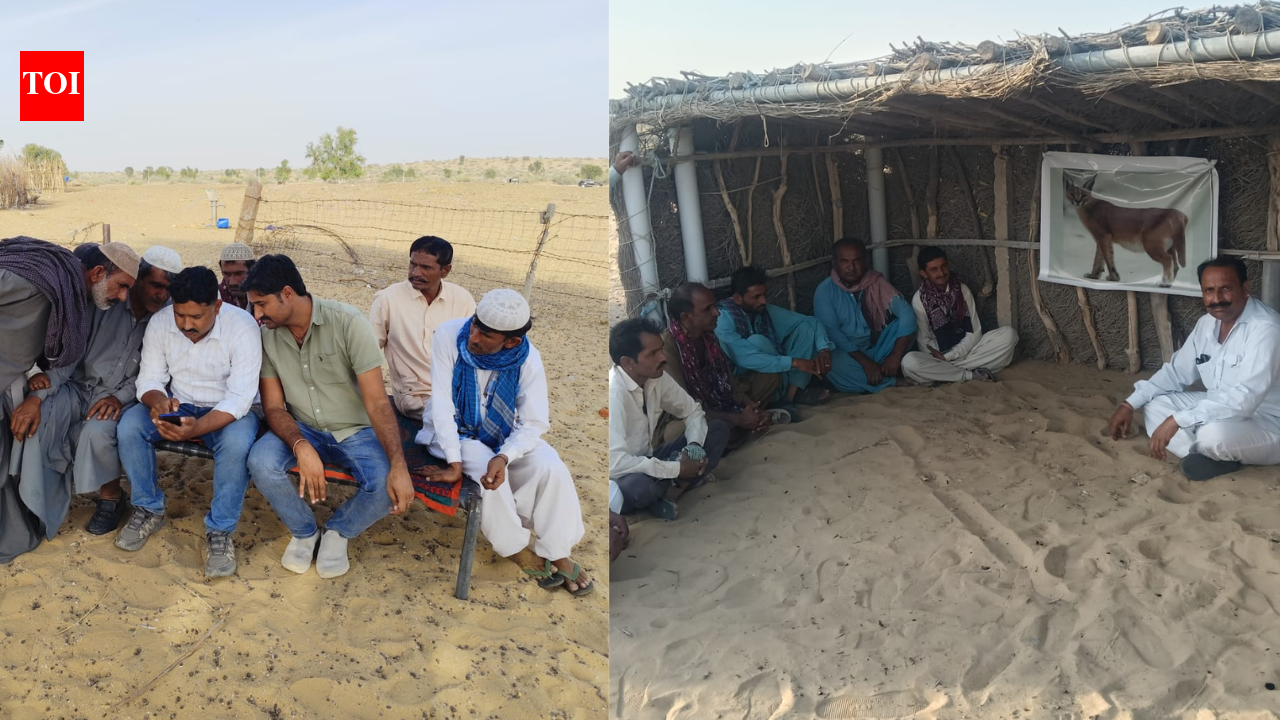
JAISALMER: Following an incident in which a rare and endangered Caracal was killed and its carcass burnt by villagers in the Bachhiachhor area of Shahgarh, near the India–Pakistan international border, the Forest Department has launched a unique awareness campaign in desert regions.The campaign, which began on Tuesday, targets local shepherds, goat herders and rural communities to raise awareness about conservation of the rare wild cat. Teams from the IGNP-II division of the Forest Department, led by Devendra Bhati and Ranjeet Singh Dholiya, are visiting remote hamlets in border areas to educate residents. Villagers are being shown banners with images of the caracal and are being encouraged to report sightings to the department, for which they will receive incentives. Confirming the initiative, Jodhpur CCF Anoop K.R. said the campaign was launched immediately after the retaliatory killing of the animal in Shahgarh. Locally known as “Padang”, the caracal is sometimes seen as a threat by villagers as it occasionally preys on sheep and goats, leading to such incidents. Officials are informing villagers that even if the animal attacks livestock, it should not be harmed. Instead, such cases should be reported to the Forest Department. The department has also assured that “problem animals” will be safely captured and relocated if required. Senior forest officials and wildlife experts are working together to develop strategies for the management and conservation of captured animals. The initiative aims to reduce human-wildlife conflict and ensure protection of the endangered species. Meanwhile, the discovery of a burnt caracal carcass in Jaisalmer has raised serious concerns about the survival of one of India’s rarest wild cat species. Experts have warned that the species is on the brink of extinction in the country. According to Sumit Dookia, Associate Professor at Guru Gobind Singh Indraprastha University and Honorary Scientific Advisor to ERDS Foundation, the caracal population in Jaisalmer represents one of the last remaining groups of this species in India. Over the past year, regular signs and tracks of caracals have been reported in the Ramgarh–Shahgarh landscape. He said the region is a typical arid grassland habitat, home to species such as the Indian gazelle. While human settlements are sparse, the area is frequented by nomadic pastoralists throughout the year. Dr Dookia described the caracal as a medium-sized, solitary wild cat that comes together only during the breeding season. He termed the recent death of an adult caracal as deeply alarming, indicating rising conflict between local herders and the species. He also highlighted major threats to the caracal, including habitat degradation and fragmentation, expansion of wind and solar energy projects, retaliatory killings and human disturbance. Warning about critically low numbers, Dr Dookia said the caracal population in India may be as low as 50–60 individuals, making it one of the most endangered wild cat species in the country. He stressed that conservation of Jaisalmer’s desert grasslands is crucial for the long-term survival of the species and the biodiversity of the arid ecosystem.
