


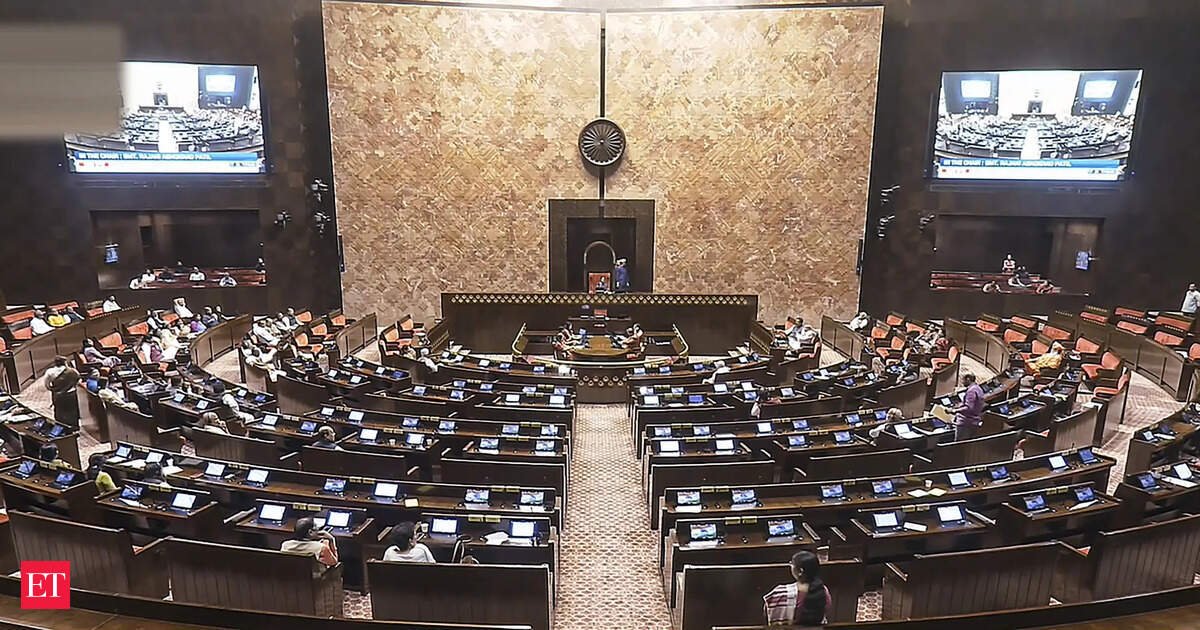
The Prime Minister lauded the contribution of the members, whose tenures will end between April and July, and called Parliament an “open university” that offers an opportunity to gain insight into intricate nuances of life.
Among those retiring are former prime minister H D Devegowda, Leader of Opposition Mallikarjun Kharge and veteran politician Sharad Pawar, who have been in active politics for over five decades. Pawar has already been re-elected to the Upper House. One-third of the Rajya Sabha members retire every two years.
Modi reserved special praise for the three senior leaders, calling them stalwarts who have spent more than half their lives in parliamentary proceedings.
“The manner in which they continue to attend the House with such dedication — a spirit from which all new parliamentarians ought to learn — is truly exemplary,” he said.
“Such a long tenure is no small feat — it is a matter of immense significance.”
Addressing the Upper House on the occasion of the farewell, Modi said such moments naturally dissolve partisan divides. “When an occasion such as this arises — naturally and spontaneously — we rise above partisan differences, and a shared sentiment emerges within us all,” he said.
To members who do not plan to return, the Prime Minister offered reassurance. “In politics, there is no such thing as a full stop. The future awaits you as well, and your experience and contributions will forever remain an enduring part of our national life,” he said.
The Prime Minister also paid tribute to outgoing Deputy Chairman Harivansh, saying he is “gentle and soft-spoken” yet “a man of rigorous action, constantly working for the betterment of every corner of India”.
In a lighter vein, the Prime Minister singled out Union Minister Ramdas Athawale. Lamenting that wit and humour in the House had declined in the age of round-the-clock media — “everyone has become extremely self-conscious”, he said.
“While members come and go, our Athawale-ji is truly evergreen. He is departing, yet I am confident that no one here will feel a void; he will continue to serve and contribute tirelessly,” Modi quipped.
Reflecting on the bicameral structure of Parliament, Modi said it is akin to seeking a “second opinion” — a practice that strengthened democratic decision-making.
Modi also noted that some outgoing members had the rare distinction of having served in both the old and new Parliament buildings. He described a six-year Rajya Sabha term as a transformative experience.
“The House serves as an open university. It offers the opportunity to gain insight into the intricate nuances of national life. In a sense, one receives both formal education and initiation here,” he said.
“The experience gained in Parliament is truly expansive.”
Chairman C P Radhakrishnan opened the House proceedings by noting that a total of 59 members from 20 states, including nine women members, will retire.
The Chairman described DeveGowda as “a distinguished leader whose presence has added great stature to the House,” and said Kharge “has been an important voice in the democratic functioning of this House” across a long career spanning both Lok Sabha and Rajya Sabha.
On Harivansh, Radhakrishnan said he “presided over this House with dignity, impartiality and a deep sense of responsibility”.
Radhakrishnan urged the outgoing members to view their departure as a new beginning.
“Retirement should not be viewed as an end but as the beginning of new roles and responsibilities. It signifies the passing on of the baton to new members who will carry forward the legacy of this institution with fresh ideas, renewed energy and commitment.”
He closed with a Tamil sentiment that though one retires, the good done through one’s deeds continues to live on.
In his farewell speech, Kharge called for a review of the rules of procedure and conduct of business in the House.
He also said the House should have more sittings so that issues of public importance can be discussed with all seriousness.
He also called for more participation from opposition members in formulating legislation. Any impediment to that would weaken the institution of parliament, he said.
“Those involved in politics never retire from public life, nor do they ever grow tired in their passion for serving the nation,” he noted.
Referring to his long association with Deve Gowda, whose party JD(S) has joined hands with the BJP, Kharge said he “shared his love and affection with us but tied the knot with Modi”.
Deputy chairman Harivansh expressed gratitude in his farewell address to all his contemporaries and seniors for enlightening and inspiring him throughout his political journey.
Recollecting memories of working with senior MPs during the initial days of his parliamentary duties, Singh said that, today, he cherishes those memories as they have become guiding principles for him.
Several members spoke about their retiring colleagues and remembered their contributions.
Members also highlighted the need for giving proper retirement benefits to former parliamentarians. They also demanded that they be allowed to sit in the new Parliament building and space be created for them, just as the old building had the central hall.
They also asked the government to issue instructions to empanelled hospitals to treat ex-MPs in the same manner as sitting MPs while availing of CGHS benefits.
Congress leader Jairam Ramesh took a swipe at the government, saying there was no farewell function for former chairman Jagdeep Dhankhar, who, he alleged, was “compulsorily retired”.
