


Donald Trump has said the United States does not need Nato after being rebuffed by a number of the organisation’s member countries over his appeal for a multi-national naval force to reopen the key strait of Hormuz trade route closed by Iran.
Speaking to reporters from the Oval Office, the US president described the rejection of his calls as a “very foolish mistake”, adding without evidence: “Everyone agrees with us, but they don’t want to help. And we, you know, we as the United States have to remember that because we think it’s pretty shocking.”
Trump added that he thought Europe would have sent minesweepers to assist the with the operation in the strait, adding that it was “not a big deal” but was “unfair” to the US.
Once again among Trump’s targets was the British prime minister, Keir Starmer, who Trump said he was disappointed with, adding that the relationship with the UK had been good before Starmer took office.
The US president’s remarks came after Starmer said on Monday that while the UK would be “taking the necessary action to defend ourselves and our allies, we will not be drawn into the wider war”. British government sources said there was no plan for UK ships to be deployed in the strait.
A number of US allies have questioned Trump’s changing logic for, and the necessity of, the US-Israeli war against Iran, now in its third week.
In an earlier post on his Truth Social network, Trump also called out Japan, Australia and South Korea for saying they would not be sending warships. “Because of the fact that we have had such Military Success, we no longer ‘need,’ or desire, the Nato Countries’ assistance _ WE NEVER DID!” he wrote.
“Likewise, Japan, Australia, or South Korea.”
His remarks came in the midst of an escalating crisis in the Middle East, which has seen Iran attack cargo vessels transiting the strait of Hormuz bringing oil shipments from large parts of the Gulf to a halt and triggering sharp rises in the global price of oil.
On a typical day, ships carrying about a fifth of the world’s oil travel through the narrow passageway but Iran has said it would not now allow “even a single litre” to be shipped to its enemies. That has sent oil prices above $100 (£75) per barrel and threatened a surge in inflation for the global economy.
In response to reports that he was considering potential ground operations by American or Israeli forces – either in the shape of taking over the Kharg Island oil port complex or in the area of Isfahan where Iran has stored stores much of its of highly enriched uranium – Trump said, “I’m really not afraid of that. I’m really not afraid of anything” when asked if such a move might risk a Vietnam-style quagmire.
Reuters meanwhile reported that the White House was encouraging the Ahmed al-Sharaa regime in Syria to help disarm Hezbollah in eastern Lebanon, a proposal that could pit Sunni former Salafists from the al-Nusra Front, which was implicated in sectarian massacres, against Shia Hezbollah forces.
Trump’s messaging on Tuesday remained contradictory as it has through much of the war, with the US president refusing to be drawn on a timeline even as he bragged about his military successes.
“Look, if we left right now it would take 10 years for them to rebuild,” he said. “We’re not ready to leave yet, but we’ll be leaving in the near future.”
Separately the Washington Post reported that senior Israeli officials told US diplomats that Iranian protesters would “get slaughtered” if they took to the streets against their government, even as Israel continued to publicly call for a popular uprising.
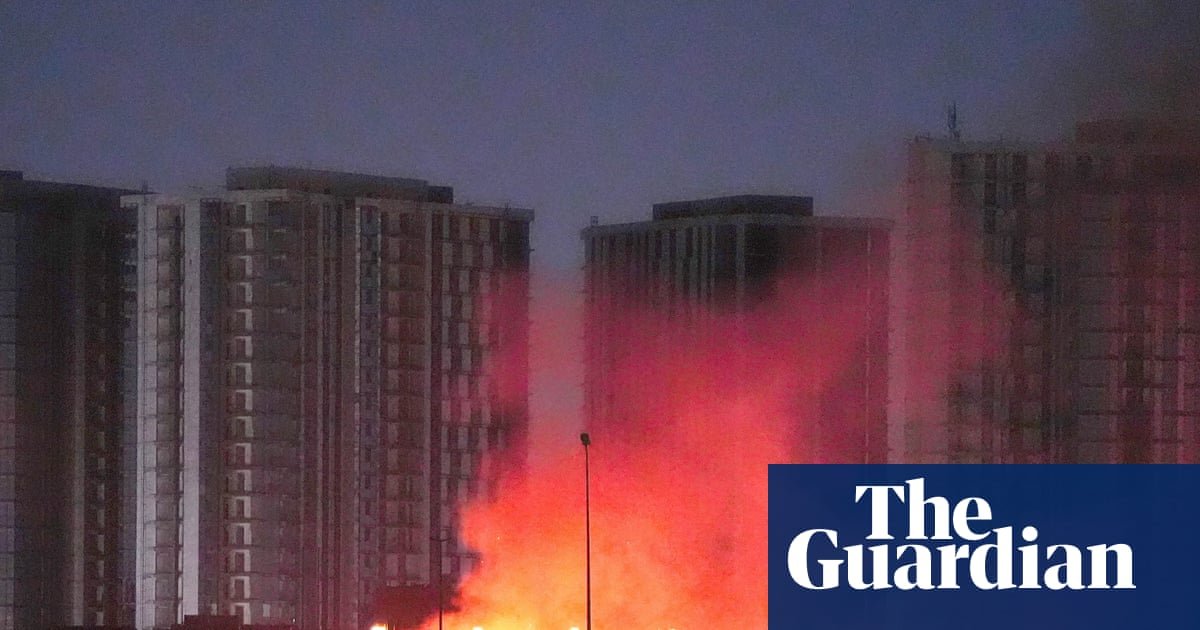
Iran launched fresh attacks across the Gulf on Tuesday, widening a conflict that has already begun to spill beyond its initial fronts.
Qatar said it had intercepted a missile, with falling debris causing a fire but no casualties. In the UAE, authorities briefly shut down airspace as the military responded to what it described as missile and drone threats before declaring the situation stabilised.
In Iraq, drone and rocket attacks reportedly struck near the US embassy in Baghdad, while a separate strike killed four people at a house said to be hosting Iranian advisers. The incidents underscored how quickly Iraq was being drawn deeper into the regional confrontation.
Explosions were also reported across Iran, including in Tehran, Ahvaz, Isfahan and Shiraz. Meanwhile, Iraq’s oil minister said Baghdad had reached an understanding with Tehran to allow tankers to cross the strait of Hormuz.Trump also hailed the reported death of Ali Larijani, the secretary of Iran’s supreme national security council, in an Israeli strike, without actually naming him but referring to his supposed role in spearheading the recent crushing of mass protests.
“Their leaders are gone,” Trump said of Iran’s clerical regime. “A lot of people say their actual top was killed yesterday, along with somebody else who was responsible for the killing 32,000 – he was in charge of the killing of protesters.
“It’s an evil group. I mean, they’ve killed much more than 32,000 people. And the man who was responsible for that was also killed yesterday.”
