


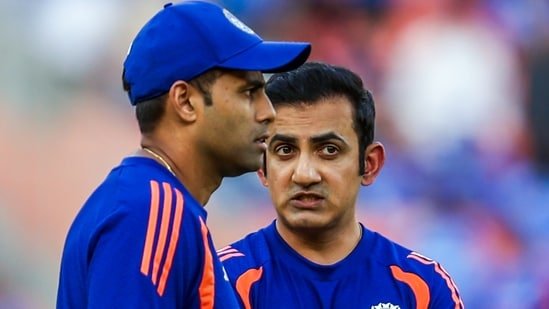
Suryakumar Yadav isn’t short on ambition. Fresh off leading India to a historic third T20 World Cup title, he was quick to shut down any talk of retirement, making it clear that his sights remain firmly set on the future.
“Kyun retire karwana hai? Sab kuch toh sahi chal raha hai (Why do you want me to retire? Everything is going just fine),” he said with a chuckle. But ambition alone may not be enough anymore.
Because when it comes to ODI cricket, a format he has repeatedly admitted he is yet to fully understand, Suryakumar may simply be running out of time.
Indian cricket, under the leadership of Ajit Agarkar and Gautam Gambhir, has undergone a visible shift. The move away from a star-driven culture to a more role-specific, team-first approach has been evident, with even stalwarts like Virat Kohli and Rohit Sharma not entirely immune to the transition.
In a previous era, Suryakumar, an ICC trophy-winning captain and one of the most destructive T20 batters of his generation, might have been afforded a longer rope in the ODI setup. The logic would have been simple: if he could dominate one white-ball format, the other would eventually follow.
And India did try.
By 2022, Suryakumar had built a reputation as the new “Mr 360” in T20 cricket, rising to the top of the ICC rankings. India were keen to harness that form and translate it into ODI success, with the 2023 World Cup firmly in focus. The world had rarely seen a batter capable of exploiting every pocket of the field with such wristwork and range, equally adept against pace and spin. India invested heavily in that promise, even at the expense of other middle-order options like Sanju Samson.
The project never truly took off.
Across 2022 and 2023, Suryakumar struggled to find rhythm in a format that demands far more than instinctive strokeplay. ODI cricket exposed a gap, not in talent, but in tempo. His high-risk, high-reward approach, which thrived in T20s, often left him caught between gears in the 50-over format.
There were also technical patterns. He appeared vulnerable against deliveries that shaped back into him and frequently played with hard hands when softer options were required. In a format where pacing an innings is as crucial as shot-making, those limitations proved costly.
Suryakumar himself acknowledged the challenge in an interview with PTI on Sunday. “I feel that as much as I have experienced ODI cricket closely and I have seen it, it is a format where you have to bat in three different ways. Sometimes if you go in early, if wickets fall quickly, then you have to bat like Test cricket. Then you have to bat with a good strike rate like a one-day format, and then later at the end of the innings, you have to bat like a T20 format. So, that is one format that I never understood,” he said.
This isn’t a new admission either.
In an earlier interaction, with journalist Vimal Kumar on his YouTube show last November, Suryakumar even turned to AB de Villiers, the original “Mr 360” and one of the few batters to master both white-ball formats, for help.
“Please help me, I couldn’t find that balance between the two formats,” he had said.
That honesty is rare. But it also sharpens the reality.
At 35, with the next ODI World Cup just over a year away, India are unlikely to invest in a player still “figuring out” the format. The current setup already has multiple, more settled options, and the broader roadmap points towards continuity rather than late experimentation.
Even a strong domestic run or a late surge may not be enough to change that equation. This is no longer just about form. It is about timing.
In elite sport, windows don’t stay open indefinitely. And in Suryakumar’s case, the ODI window is no longer narrowing, it is practically shut.
That, however, does not diminish his stature. If anything, it reinforces how exceptional he has been in T20 cricket, where he redefined the limits of modern batting and established himself as a match-winner of the highest order. But formats demand different currencies.
Suryakumar still has time, clarity, and a defined role in T20 cricket. In ODIs, he has none. His ambition to return is understandable. But ambition must eventually align with reality. And right now, reality suggests that Suryakumar’s ODI chapter may already be over, even if he isn’t quite ready to accept it.
