


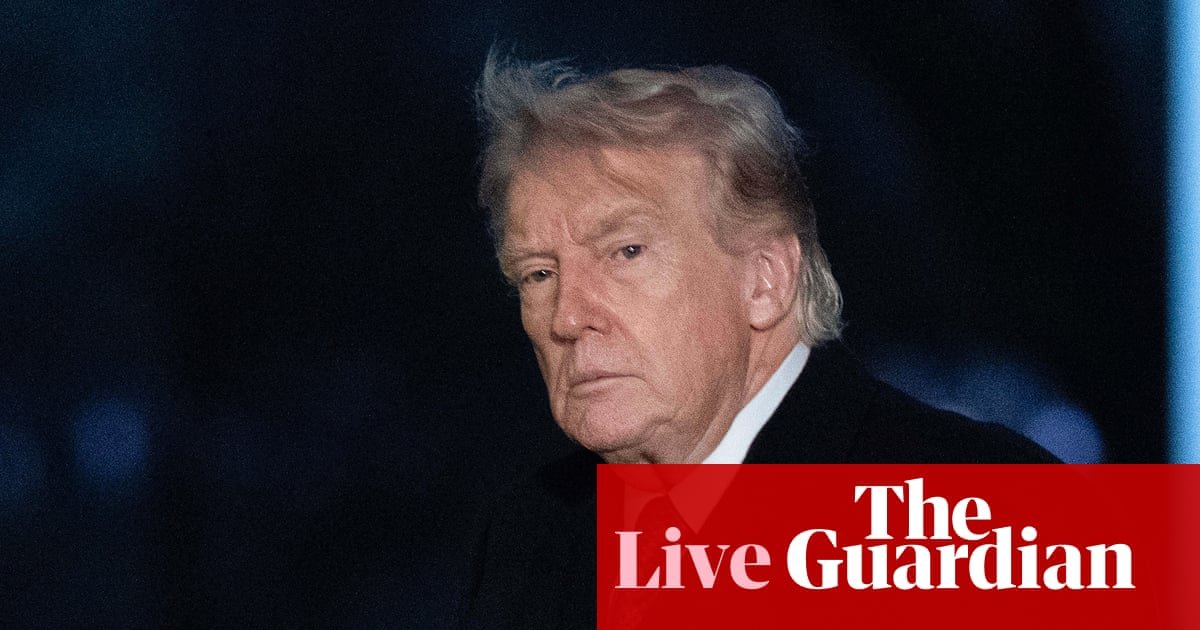
Donald Trump attacks supreme court over tariffs again in late-night social media post
Good morning and welcome to the US politics liveblog.
In a late-night social media post, Donald Trump has claimed he has the “absolute right” to impose new tariffs after the supreme court ruled many of the import duties he imposed last year were illegal.
My colleague Callum Jones reports that the president attacked the court on Truth Social in a late night broadside on Sunday, accusing it of having “unnecessarily RANSACKED” the US – and failing to show him sufficient loyalty.
In February, the supreme court found that the Trump administration did not provide sufficient legal justification to use the International Emergency Economic Powers Act (IEEPA) – a 1977 law designed to address national emergencies – for many of the tariffs the Trump administration had put on countries around the world.
Callum notes that the administration has scrambled in recent weeks to piece back together its controversial trade agenda and regain economic leverage.
In response, Trump swiftly imposed 10% tariffs on goods from much of the world under a different law, section 122 of the 1974 Trade Act. But these expire after 150 days, in July. While the president also vowed to raise this temporary duty to 15%, he has yet to do so.
US officials launched a string of trade investigations last week, which set the stage for the potential imposition of a new wave of permanent tariffs to take the place of those that were repealed.
In his Truth Social post on Sunday, Trump wrote:
Our Supreme Court has made these Countries very happy but, as the Court pointed out, I have the absolute right to charge TARIFFS in another form, and have already started to do so.”
Meanwhile, severe weather moving across much of the US means that the House will not be voting today, said Tom Emmer, the GOP House majority whip. The first votes in the chamber are now expected to take place on Tuesday.
Key events
Trump claims over 30 mine-laying ships destroyed in strait of Hormuz, but adds US unsure if any mines dropped in
Trump says the US is “hammering” Iran’s capacity to threaten commercial shipping in the strait of Hormuz.
More than 30 mine-laying ships have been destroyed, he claims, before adding that the US is unsure if any mines have been dropped into the strait.
We hit, to the best of our knowledge, all of their mine-laying ships … but we don’t know that any have even been dropped in, we’re not sure that any have been.
We don’t know that they have dropped any in, but we’ve hit all 30 of their ships.
Trump also repeats his call to other countries to help reopen shipping traffic in the strait, saying some countries told him they were on the way and others were not that enthusiastic about helping.
Trump says US has struck over 7,000 ‘mostly commercial and military targets’ across Iran
Trump says the US military has struck over 7,000 targets across Iran, “mostly commercial and military targets”.
He claims the US has “achieved a 90% reduction in their ballistic missile launches and a 95% reduction in drone attacks”.
The missiles are trickling in now because they don’t have too many missiles left.
He says the US has also attacked Iran’s missile and drone manufacturing plants.
More than 100 Iranian naval vessels have been sunk or destroyed in the last week and a half, he adds.
Donald Trump holds press conference on Iran war
Trump starts by giving an update on his “powerful military campaign against the threats of the Iranian regime”.
“They have been literally obliterated,” he says, repeating his usual lines about Iran’s air force, navy, leaders etc being “gone”. “Other than that, they’re doing quite well,” he says.
Donald Trump is speaking now at a news conference before his lunch meeting with Kennedy Center board members. I’ll bring you all the main lines here.
Centcom says that attack on Kharg Island destroyed ‘more than 90’ Iranian military targets
In a video update today, Adm Brad Cooper, who leads US Central Command (Centcom), said that the large scale strikes on Kharg Island on Friday destroyed “more than 90 Iranian military targets”, including storage bunkers for naval mines and missiles.
A reminder that Donald Trump said that the initial attacks “totally demolished” the stretch of land which is also Iran’s main oil export hub.
Cooper went on to explain that the US has “zeroed in on dismantling Iran’s decades old threat to the free flow of commerce through the strait of Hormuz through a combination of air, land and maritime capabilities”. Although he didn’t elaborate on how the US plans to reopen the waterway, he said that forces have “successfully destroyed over 100 Iranian naval vessels, and we aren’t done”.
“Our progress remains steady, and we remain vigilant against the enemy,” the admiral added. However, he didn’t offer a timeline of when he expects Operation Epic Fury to end. This comes amid the administration’s conflicting and confusing messaging on the success of the war on Iran as it enters its third week.
White House ‘wished UK had stepped up sooner and quicker’ to help open strait of Hormuz
Speaking to reporters outside the White House today, press secretary Karoline Leavitt said allied countries “are benefiting greatly” from the US-Israel war on Iran. She added that the Iranian regime’s ballistic missile capability was a “direct and imminent threat” to European allies.
“I think the president is absolutely right to call on these countries to do more to help the United States to reopen the strait of Hormuz,” she said.
The press secretary also said that Trump “wished the UK had stepped up sooner and quicker” to help unblock the crucial waterway, following the president’s demands for allies to send warships to the region.
Earlier today, prime minister Keir Starmer said the UK “will not be drawn into the wider war” when pressed by reporters about how the country plans to help reopen the strait of Hormuz.
For her part, Leavitt added that Trump “continues to speak with our allies in Europe and is calling on them for support, just as he did when he called on them to step up with respect to their defense spending in Nato. He’s calling them to do more here.”
Trump draws backlash for comment on Iran war: ‘Maybe we shouldn’t even be there’
Richard Luscombe
Donald Trump drew a backlash on Sunday for suggesting US efforts to protect the Strait of Hormuz were unnecessary – and that “maybe we shouldn’t even be there at all” because his country has plenty of oil of its own.
The president made the contradictory comment to reporters on Air Force One after pleading with European and Nato allies to enter the war in Iran to help the US secure the strait amid the largest oil supply disruption in history.
“Really, I’m demanding that these countries come in and protect their own territory – because it is their territory,” he said.
“They should come and they should help us protect it. You could make the case that maybe we shouldn’t even be there at all, because we don’t need it. We have a lot of oil. We’re the number one producer anywhere in the world times two.”
Trump was speaking on the same day as he reversed his earlier position over outside assistance and stepped up pressure on a raft of other countries to become involved in defending the strait.
Australia, France and Japan are among the countries that have said they have no plans to send warships.
Keir Starmer, the UK prime minister, said on Monday that he was working with European allies on “a viable plan” to reopen the strait – but insisted the country “will not be drawn into the wider war”.
Xavier Bettel, Luxembourg’s deputy prime minister, said his country would not give in to “blackmail” from the US.
During the gaggle with reporters on Sunday as the president returned to Washington from a weekend at Mar-a-Lago, his Florida resort, Trump suggested that the US effort to secure the strait was for the benefit of other countries.
“It’s almost like we do it for habit, but we also do it for some very good allies that we have in the Middle East,” he said.
In an interview with the Financial Times on Sunday his tone was more menacing, warning that Nato faces a “very bad” future if it did not assist the US in protecting the strait from Iranian attacks.
One month into DHS shutdown, security lines snake around airports
As the federal shutdown of the Department of Homeland Security (DHS) reached a month, employees at the Transportation Security Administration (TSA) missed their first full paycheck over the weekend. At Austin-Bergstrom International airport in Texas, staff expected a record-breaking volume of passengers as security lines snaked outside the airport, past the departures drop-off, at 4.30am local time on Monday.
By 9am ET the lines had calmed down, according the airport officials. They said they are expecting slightly fewer people flying out on Tuesday, about 32,000, but encouraged travellers to get to the airport as early as possible to mitigate the long lines.
Callum Jones
Oil prices have climbed again amid mounting supply fears after the US struck Iran’s vital Kharg Island oil hub and Donald Trump demanded allies help reopen the strait of Hormuz.
Brent crude, the international benchmark, rose 1.8% to $104.98 per barrel during early trading on Monday. Another weekend of violence across the Middle East compounded concerns over the conflict, and its ramifications for global energy markets.
The US president claimed on Saturday that US strikes had “totally demolished” most of Kharg Island, telling NBC News that its military may hit site “a few more times just for fun”.
Kharg, a five-mile-long coral island in the Persian Gulf about 16 miles from the mainland, is a key processing hub for Iran, through which 90% of the country’s oil exports typically flow.
Trump claimed on social media that he had avoided striking oil and energy infrastructure on the island “for reasons of decency”, and that only military targets had been hit.
But the decision to strike Kharg, which had been largely left untouched by the US-Israeli operation during its first two weeks, did not soothe the apprehensions rattling through global markets.
Read the full report here:
Donald Trump just announced that he’ll host a news conference before his lunch meeting with the Kennedy Center board members at 11.45am ET.
We’ll bring you the latest lines as it gets started.
A reminder that my colleagues are covering the latest developments out of the Middle East at our dedicated live blog. You can keep up with our latest reporting on the US-Israel war on Iran here.
Tom Ambrose
Donald Trump’s proposed meeting with Chinese leader Xi Jinping is not at risk, but could be delayed as the US president remains focused on the Iran war, the White House said on Monday.
Trump is due to travel to China from 31 March to 2 April for a highly anticipated meeting between the leaders of the world’s two biggest economies.
“I don’t think the meeting is in jeopardy, but it’s quite possible the meeting could be delayed,” press secretary Karoline Leavitt told Fox News’ Fox & Friends program.
This comes after Trump told the Financial Times on Sunday he might postpone the meeting if China did not help to unblock the strait of Hormuz.
In his interview, the president said China’s reliance on oil from the Middle East means it ought to help with a new coalition he is trying to put together to get oil tanker traffic moving through the strait. Trump said “we’d like to know” before the trip whether Beijing will help. “We may delay,” Trump added.
Democratic FCC commissioner hits back at Carr’s threats to cancel broadcaster permits over Iran war coverage
The only Democratic member of the Federal Communications Commission (FCC) hit back at chair Brendan Carr’s threats over the weekend to cancel broadcasters’ licenses for pushing “hoaxes and news distortions”.
Carr added that “fake news” outlets now “have a chance now to correct course before their license renewals come up”.
“The law is clear. Broadcasters must operate in the public interest, and they will lose their licenses if they do not,” Carr wrote on social media.
In response, Anna Gomez said that the “FCC can issue threats all day long, but it is powerless to carry them out”.
She added:
Such threats violate the First Amendment and will go nowhere. Broadcasters should continue covering the news, fiercely and independently, without fear of government pressure.
This comes Donald Trump and members of the administration have routinely accused various news outlets of biased and unflattering coverage of the war on Iran.
Donald Trump is in Washington today. We can expect to see the president alongside vice-president JD Vance later. This will be the first time we’ve heard from both of them, together, since the war on Iran began. Their Oval Office meeting at 3.30pm ET is open to the press, so we’ll bring you the latest lines as that gets under way.
In between closed-door policy meetings and executive time, Trump will take part in a lunch with the Kennedy Center board members at 11.45am ET, and meet with the US ambassador to Japan, George Glass, at 4pm ET.
If anything else opens up we’ll provide updates here.
In his rant on Truth Social, although Trump praised the conservative justices on the bench who supported his justification for tariffs –Clarence Thomas, Samuel Alito and Brett Kavanaugh – but lambasted the other justices as “completely inept and embarrassing”.
It’s the latest example of the president’s attack on the judiciary for what he perceives as personal and political attacks on his policy agenda.
On social media, he also targeted James Boasberg, the DC-based federal judge who blocked the justice department subpoeans for Federal Reserve chair Jerome Powell.
The president said that Boasberg suffers from “the highest level of Trump Derangement Syndrome (TDS)” and “has displayed open, flagrant, and extreme partisan bias” against Republicans and the White House. A reminder that Boasberg was also the judge who ruled in April last year that he Trump administration appeared to have acted “in bad faith” when it used rarely invoked Alien Enemies Act to deport hundreds of Venezuelans to a mega prison in El Salvador.
Donald Trump attacks supreme court over tariffs again in late-night social media post
Good morning and welcome to the US politics liveblog.
In a late-night social media post, Donald Trump has claimed he has the “absolute right” to impose new tariffs after the supreme court ruled many of the import duties he imposed last year were illegal.
My colleague Callum Jones reports that the president attacked the court on Truth Social in a late night broadside on Sunday, accusing it of having “unnecessarily RANSACKED” the US – and failing to show him sufficient loyalty.
In February, the supreme court found that the Trump administration did not provide sufficient legal justification to use the International Emergency Economic Powers Act (IEEPA) – a 1977 law designed to address national emergencies – for many of the tariffs the Trump administration had put on countries around the world.
Callum notes that the administration has scrambled in recent weeks to piece back together its controversial trade agenda and regain economic leverage.
In response, Trump swiftly imposed 10% tariffs on goods from much of the world under a different law, section 122 of the 1974 Trade Act. But these expire after 150 days, in July. While the president also vowed to raise this temporary duty to 15%, he has yet to do so.
US officials launched a string of trade investigations last week, which set the stage for the potential imposition of a new wave of permanent tariffs to take the place of those that were repealed.
In his Truth Social post on Sunday, Trump wrote:
Our Supreme Court has made these Countries very happy but, as the Court pointed out, I have the absolute right to charge TARIFFS in another form, and have already started to do so.”
Meanwhile, severe weather moving across much of the US means that the House will not be voting today, said Tom Emmer, the GOP House majority whip. The first votes in the chamber are now expected to take place on Tuesday.
